How to Evaluate an Industrial Laser Cutting Machine: A Buyer’s Guide Beyond Price and Power
-
July 21, 2026

-
16 min read

When manufacturers begin comparing laser cutting machines, the first two questions are usually:
Both questions matter, but neither is enough to determine whether a machine will be suitable for your production.
Two laser cutting machines with similar power ratings can perform very differently when processing real parts. Machine architecture, motion control, workholding, software, automation, service support and factory conditions can all affect cutting quality, cycle time and long-term operating cost.
The right machine is not necessarily the one with the highest power or the lowest quotation. It is the machine that can repeatedly process your actual parts at the required quality, speed and cost.
This guide explains how to evaluate an industrial laser cutting machine before making an investment.
A successful machine selection begins with the workpiece.
Before discussing laser brands, power levels or machine configurations, define what the equipment must produce.
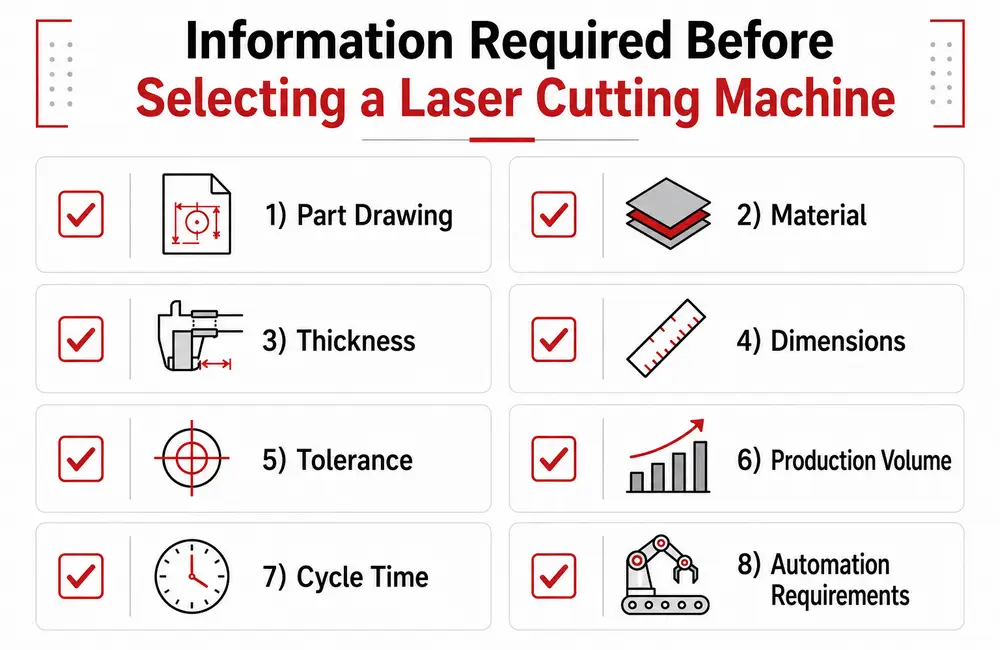
The following information should be collected first:
| Requirement | Questions to Answer |
| Part type | Is the workpiece a flat sheet, tube, profile, structural beam or formed 3D component? |
| Material | Is it carbon steel, stainless steel, aluminum, copper, brass or another material? |
| Thickness | What are the minimum, typical and maximum material thicknesses? |
| Part dimensions | What is the largest workpiece or raw material size? |
| Geometry | Are the cutting paths flat, tubular, angled or three-dimensional? |
| Tolerance | Which dimensions are critical to downstream assembly? |
| Edge quality | How much dross, oxidation or post-processing is acceptable? |
| Production volume | Is the project low-volume, batch-based or continuous mass production? |
| Cycle time | How many parts must be completed per shift? |
| Automation | Is automatic loading, unloading, sorting or fixture changing required? |
A machine should be selected around these requirements—not around the supplier’s standard configuration.
For example, increasing laser power may improve cutting speed on certain thicknesses, but it will not solve a mismatch between the workpiece geometry and the machine architecture. A flat sheet cutting machine cannot replace a true five-axis system when the application requires trimming complex formed parts.
To receive a meaningful machine recommendation, prepare as much of the following information as possible:
A supplier can make a much more accurate recommendation when actual part data is available.
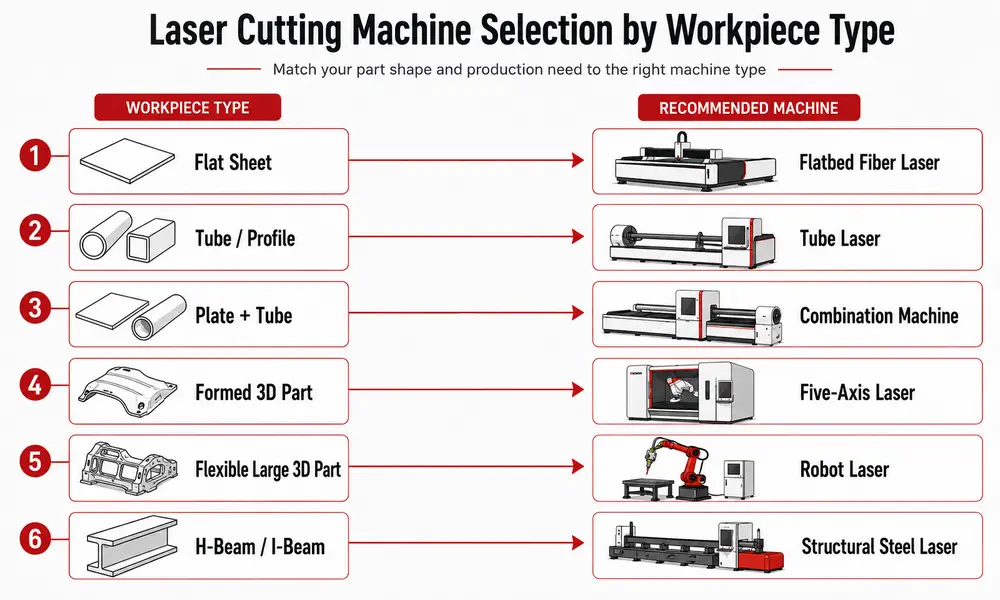
Laser cutting machines are not interchangeable. Each machine architecture is designed for a different type of workpiece and production method.
| Processing Requirement | Recommended Machine Type |
| Flat sheet metal | Flatbed fiber laser cutting machine |
| Thick plates and high-output sheet production | High-power fiber laser cutting machine |
| Round, square or special-shaped tubes | Tube laser cutting machine |
| Both plates and tubes | Tube and plate laser cutting machine |
| I-beams, H-beams and structural profiles | Structural steel laser cutting machine |
| Formed automotive or aerospace components | 3D five-axis laser cutting machine |
| Flexible low-volume three-dimensional parts | Robotic laser cutting system |
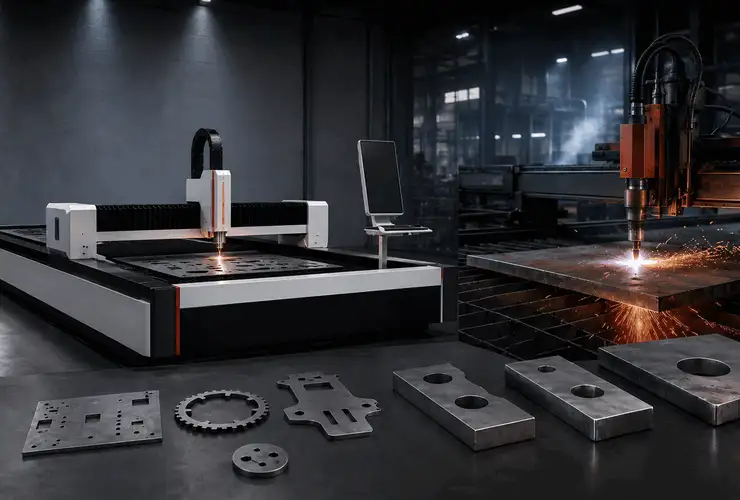
Flatbed fiber laser cutting machines are designed for two-dimensional sheet metal processing. The main selection factors include:
For high-volume or thick-plate production, buyers should also evaluate cutting head capability, heat management, slag removal, dust extraction and material handling.
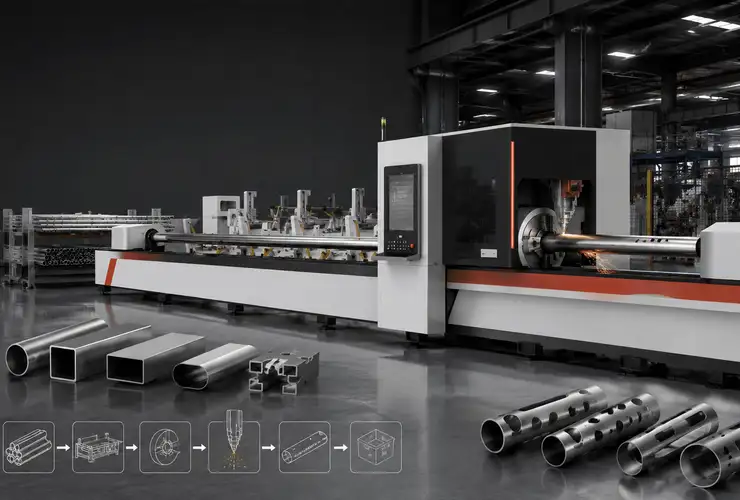
Tube laser cutting machines are more suitable for round, square, rectangular, oval and special-shaped profiles.
Important factors include:
Factories that process both sheets and tubes may consider an integrated plate-and-tube system, provided that the production mix and capacity requirements justify the combined configuration.
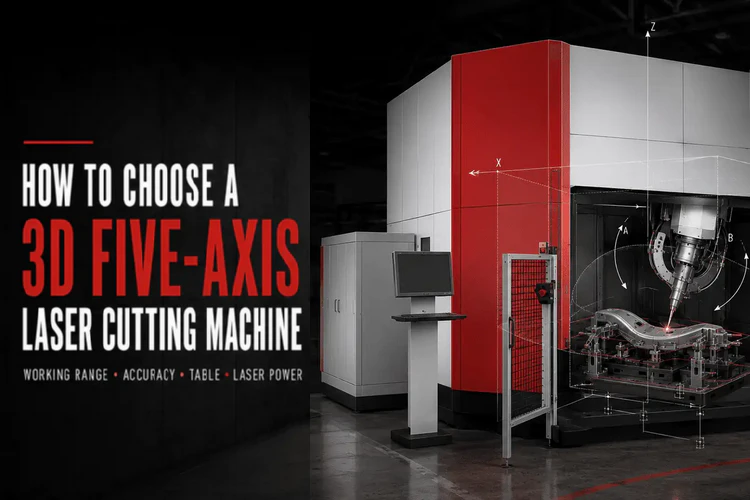
Formed automotive parts, hydroformed tubes, stamped panels and complex three-dimensional components require more than linear X, Y and Z movement.
A dedicated five-axis cutting machine controls both linear and rotary movement so that the cutting head can maintain an appropriate position and orientation along complex three-dimensional paths.
For these applications, the buyer must evaluate:
Robotic laser cutting can provide flexibility for large or varied workpieces, while a dedicated five-axis machine may provide a more controlled platform for repeatable production of formed components. The correct choice depends on part size, tolerance, production volume, programming requirements and fixture strategy.
Machine specifications provide a starting point, but a purchasing decision should not be based on a specification sheet alone.
Maximum speed, maximum acceleration and maximum cutting thickness are usually measured under defined conditions. They do not necessarily represent the machine’s performance on your specific parts.
A more useful evaluation is based on actual processing results.
Ask the supplier to process your actual material and part geometry whenever possible.
Evaluate:
Do not inspect only the best sample produced during the demonstration. Ask the supplier to run the same part repeatedly and compare the results.
A short cutting video may show only the laser-on time. In real production, total cycle time can also include:
The most important number is not simply cutting speed. It is the number of acceptable parts the complete system can produce per hour or per shift.
Send us your drawing, material, thickness and production requirements. Our application team can evaluate the part and recommend an appropriate machine configuration.
Accuracy is one of the most misunderstood areas in laser machine selection.
Several different specifications may be used:
Positioning accuracy describes how closely an axis reaches a commanded position.
Repeat positioning accuracy describes how consistently the axis returns to the same position over repeated movements.
Cutting accuracy is the final dimensional result measured on the workpiece. It can be affected by more than the nominal axis specifications.
Influencing factors include:
For three-dimensional cutting, the fixture is part of the production system.
Even when the machine axes perform consistently, an unstable or inaccurate fixture can cause unacceptable variation.
The buyer should evaluate:
On a five-axis machine, A- and C-axis performance affects the cutting head orientation along the three-dimensional path.
The final result depends on the combined accuracy of:
Therefore, a nominal machine accuracy value should always be verified through actual part testing.
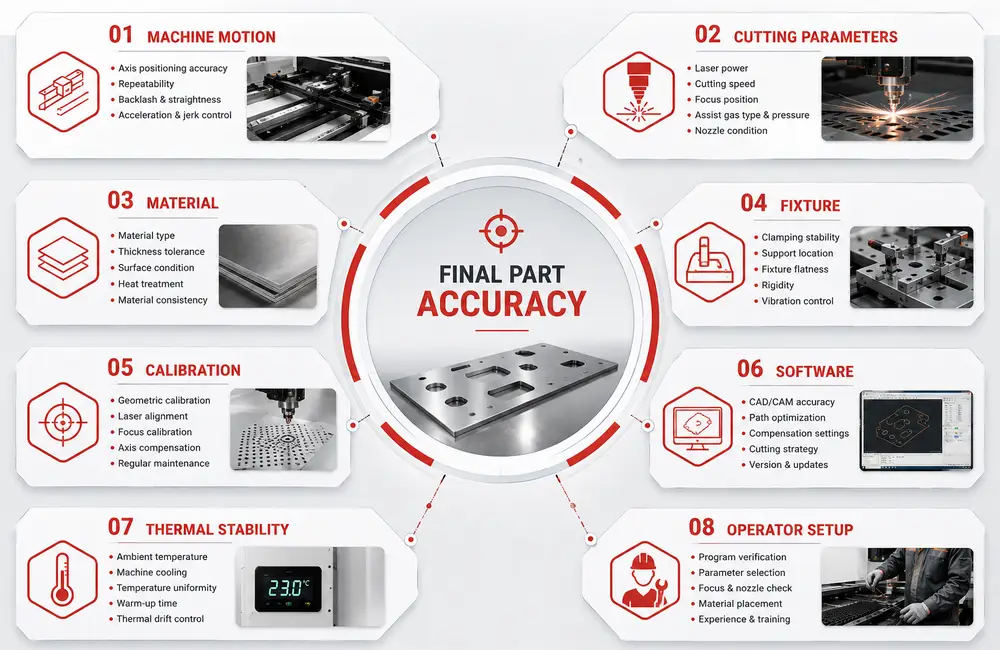
The machine structure affects rigidity, vibration, dynamic response and long-term stability.
However, machine weight alone does not determine quality. A heavier structure is not automatically better if the design, manufacturing process and motion system are poorly matched.
Buyers should evaluate the complete mechanical system.
Questions to ask include:
The gantry should provide sufficient rigidity while allowing responsive movement.
A good evaluation should consider:
Depending on the machine type, the motion system may include:
Instead of comparing component brand names alone, ask how the complete motion system is calibrated and tested.
Inspect:
These details may not appear prominently in a quotation, but they influence daily maintenance and equipment reliability.
The laser source is important, but it is only one part of the machine.
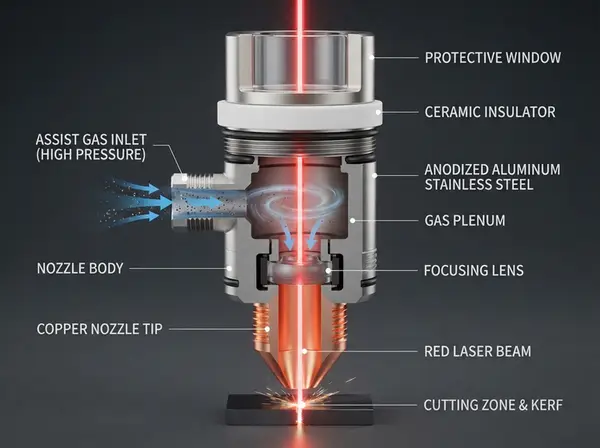
The cutting head, control system, motion platform, process database and software must work together as one system.
Confirm:
Avoid selecting power only according to the maximum thickness listed in a cutting table. Consider the thickness processed most frequently, the required speed, assist gas cost and edge quality.
Evaluate:
For flat sheet cutting, the software may include:
For tube cutting, additional functions may include:
For three-dimensional cutting, evaluate:
A powerful laser source cannot compensate for software that is difficult to program or unsuitable for the production workflow.
The laser machine itself may represent only one part of the production cell.
Material handling, fixtures and automation can have a major influence on actual output.
Consider:
An exchange table can reduce waiting time, but its value depends on whether loading and unloading can keep pace with the cutting cycle.
Evaluate:
For complex three-dimensional parts, evaluate:
Five-axis machine selection should include more than laser power and working envelope.
Review:
A rotary table may improve loading efficiency for high-volume production, while a fixed table may be suitable for other part sizes, fixtures or production strategies. The choice should be based on the complete process rather than a single specification.
A laser cutting system must fit the factory environment as well as the workpiece.
Before ordering, confirm all installation requirements.
Depending on the machine and application, evaluate:
Do not assume that every quotation includes the same safety configuration. Ask the supplier to describe exactly what is included.
Cutting smoke can affect:
Confirm:
Verify:
A detailed factory preparation document should be obtained before shipment.
A machine quotation should be evaluated together with the service plan.
Before placing an order, ask:
The lowest machine price may become expensive if the equipment remains idle while waiting for technical support or spare parts.
Request a clearly written service scope rather than relying only on general promises such as “24-hour support.”
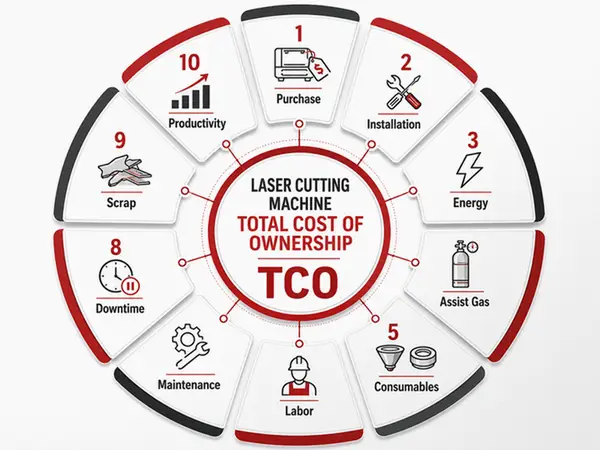
Purchase price is only the initial cost of a laser cutting machine.
A more complete evaluation uses total cost of ownership.
Total Cost of Ownership = Machine Purchase + Installation + Utilities + Consumables + Maintenance + Labor + Downtime + Financing − Productivity Benefits
The calculation period may be three, five or more years, depending on the company’s investment model.
Include:
Include:
Also consider:
A machine with a higher initial price may provide lower long-term cost if it reduces setup, scrap, labor or downtime. However, these benefits should be demonstrated with realistic production data rather than unsupported percentages.
For many factories, the most useful metric is:
Cost per acceptable finished part
This calculation combines:
It provides a more practical comparison than purchase price or maximum cutting speed alone.
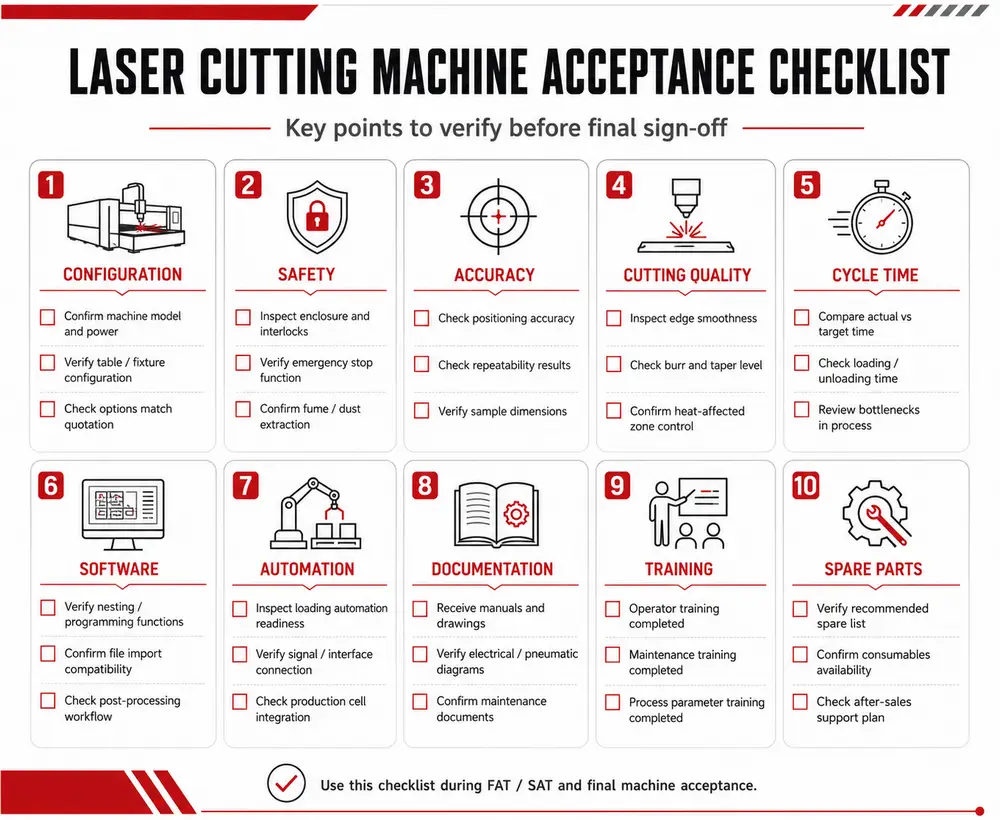
Sample testing should be completed before the final machine configuration is confirmed.
The acceptance criteria should also be discussed before the machine is manufactured or shipped.
A useful sample test should record:
The sample should represent the actual production requirement—not only a decorative demonstration part.
A factory acceptance test may include:
For five-axis applications, also test:
One successful part does not prove production stability.
Where appropriate, process multiple parts under the same conditions and compare:
The objective is not to create one perfect sample. The objective is to prove that the system can repeatedly produce acceptable parts.
A quotation based only on laser power and table size may not reflect the final project cost.
Before requesting a proposal, provide the supplier with:
The supplier should then explain:
A clear technical proposal makes it easier to compare suppliers on equal terms.
Before selecting an industrial laser cutting machine, confirm that you have evaluated:
Price and laser power remain important, but they should be evaluated as part of the complete production system.
The best machine is the one that can repeatedly produce acceptable parts, integrate into your factory and support your production targets over the expected service period.
ZG Laser provides laser cutting solutions for flat sheets, tubes, structural profiles and complex three-dimensional components.
To receive a machine recommendation, send us:
Our team will review the project and recommend an appropriate machine architecture and configuration.
Explore Laser Cutting Machines
Laser power is important, but it should be evaluated together with material, thickness, required speed, machine architecture, cutting head, assist gas, motion system and production volume. Higher power does not solve a mismatch between the machine type and the workpiece.
Use the same part drawing, material, thickness, quality requirements and cycle-time definition for every supplier. Compare complete configurations, sample results, automation, service scope, operating cost and acceptance conditions rather than comparing only headline specifications.
Yes. Sample testing helps verify cutting quality, cycle time, dimensional results and process stability. The test should use your actual material and part geometry whenever possible.
Positioning accuracy describes how closely the machine axis reaches a commanded position. Cutting accuracy describes the final dimensional result on the part and can also be affected by material, parameters, calibration, fixtures and thermal conditions.
A five-axis machine is generally considered when the workpiece is formed or three-dimensional and the cutting head must approach the part from different angles. Typical examples include hot-formed automotive parts, stamped panels, hydroformed tubes and complex 3D components.
The supplier normally needs drawings, material, thickness, part size, tolerance, production volume, cycle-time requirement, automation needs, factory utilities and destination information. For three-dimensional parts, a 3D model is especially important.
To further optimize your laser cutting operations and deepen your engineering knowledge, explore these related technical resources:

English

French

German

Hindi

Italian

Japanese

Korean

Portuguese

Russian

Spanish
Tell us about your manufacturing challenges.
Our engineers will design a laser solution tailored to your exact requirements.