How to Choose a Tube Laser Cutting Machine:Tube Size,Chuck,Loading and Cutting Capability
-
August 19, 2026

-
22 min read

Introduction: A tube laser cutting machine can replace several conventional operations by cutting profiles to length while also producing holes, slots, notches, joint features and complex contours in one programmed process.
However, choosing the right tube laser is not as simple as comparing laser power or maximum tube diameter.
Two machines may both be described as "6-meter tube laser cutters" but differ significantly in:
Modern tube-laser systems are available for everything from small-diameter profiles to large structural tubes, with configurations ranging from manual loading to fully automated bundle loading, unloading and sorting. BLM GROUP, for example, separates its tube-laser portfolio by tube diameter, 2D/3D cutting capability and production requirements, while Bystronic similarly offers different platforms for small-to-medium and large tube processing.
The correct machine should therefore be selected around your actual tube portfolio and production flow.
This guide explains what manufacturers should evaluate before purchasing a tube laser cutting machine.
Before discussing laser power, chuck brands or automation, define the material that must pass through the machine.
Prepare a tube list covering:
A supplier cannot recommend the correct tube laser based only on a statement such as:
"We need to cut steel tubes."
A factory cutting lightweight 30 × 30 mm furniture profiles has very different requirements from a manufacturer processing 200 mm structural tubes.
Prepare a Tube Matrix
| Requirement | Information to Provide |
| Profile | Round, square, rectangular, oval, open or special |
| Minimum size | Smallest regular production profile |
| Typical size | Profiles representing most production |
| Maximum size | Largest required profile |
| Wall thickness | Minimum, typical and maximum |
| Length | Raw bar length |
| Weight | Weight per meter and total bar weight |
| Material | Carbon steel, stainless, aluminum, etc. |
| Volume | Bars or finished parts per shift |
| Features | Holes, slots, miters, joints, bevels |
The most frequently processed tubes should influence machine selection more than a rare maximum-size job.
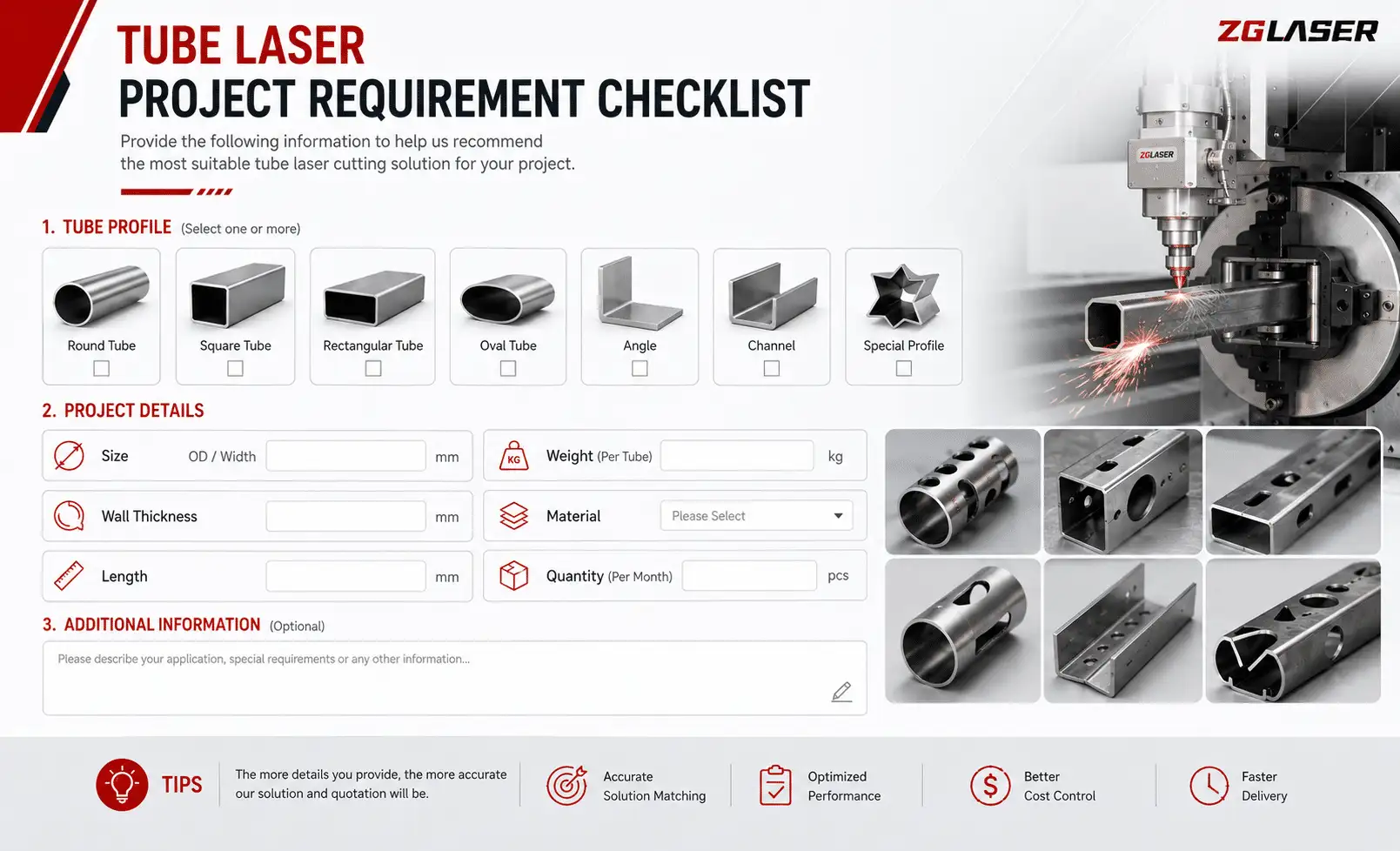
Tube lasers are no longer limited to round tubing.
Depending on the chuck, support system and programming capability, modern systems may process:
ZG Laser's current ZG-FC Tube page specifically lists round, square, rectangular, oval, waist-shaped and hexagonal tubes, and its application section also mentions U-, T-, H- and L-shaped profiles.
BLM likewise distinguishes conventional closed tubes from open and special profiles because the workholding and material-handling challenges are different.
Closed Profiles
Examples include:
These are generally easier to grip and rotate because the cross-section is relatively stable.
Open Profiles
Examples include:
These can present additional challenges:
Do not assume a machine capable of cutting a 150 mm round tube can automatically process every 150 mm open profile.
Special Profiles
Custom extrusions may require:
If special profiles represent a major part of production, send actual samples and 3D cross-section data to the supplier before selecting a machine.
Maximum tube diameter is one of the most visible machine specifications, but it should not be considered alone.
Evaluate four limits:
Minimum Processable Size
Small profiles can create problems with:
Maximum Diameter
For round tubes, confirm the actual processable outside diameter.
ZG Laser’s current standard ZG-FC Tube page lists a round-tube range of Φ20–220 mm.
Maximum Square or Rectangular Section
The maximum square profile does not necessarily equal the maximum round-tube diameter.
ZG Laser currently lists square profiles of 20–140 mm on the same model.
Circumscribed Diameter
For rectangular and irregular profiles, the critical dimension may be the profile’s diagonal or circumscribed diameter because that determines whether the material can rotate through the chuck and machine structure.
Do Not Oversize the Machine Without Reason
Buying a much larger tube capacity than production requires may increase:
If 90% of your business uses tubes below 80 mm, purchasing a machine optimized around very large profiles may not provide the best production economics.
Two tubes with the same outside diameter may have very different weights.
For example, weight changes with:
This affects:
Leading tube-laser manufacturers specify both tube dimension and weight capacity for this reason. BLM’s larger tube platforms, for example, are separated not only by diameter but also by the type and weight of profiles they are designed to process.
Ask the supplier for:
Do not use diameter as a substitute for weight capacity.
The chuck is one of the most important mechanical systems on a tube laser.
It grips the material, centers it and rotates it while the cutting head follows the programmed path.
A poor clamping system can contribute to:
ZG Laser’s current ZG-FC Tube configuration uses a multi-jaw chuck system designed for tube clamping and high-speed rotation.
Questions to Ask About the Chuck
Ask:
Avoid Excessive Clamping Force
Thin-wall profiles can be deformed by excessive chuck pressure.
This is particularly important for:
The chuck should secure the tube without changing its geometry.
Some automated systems dynamically adapt gripping conditions according to the material being processed, illustrating why chuck configuration is more than simply maximum opening size.
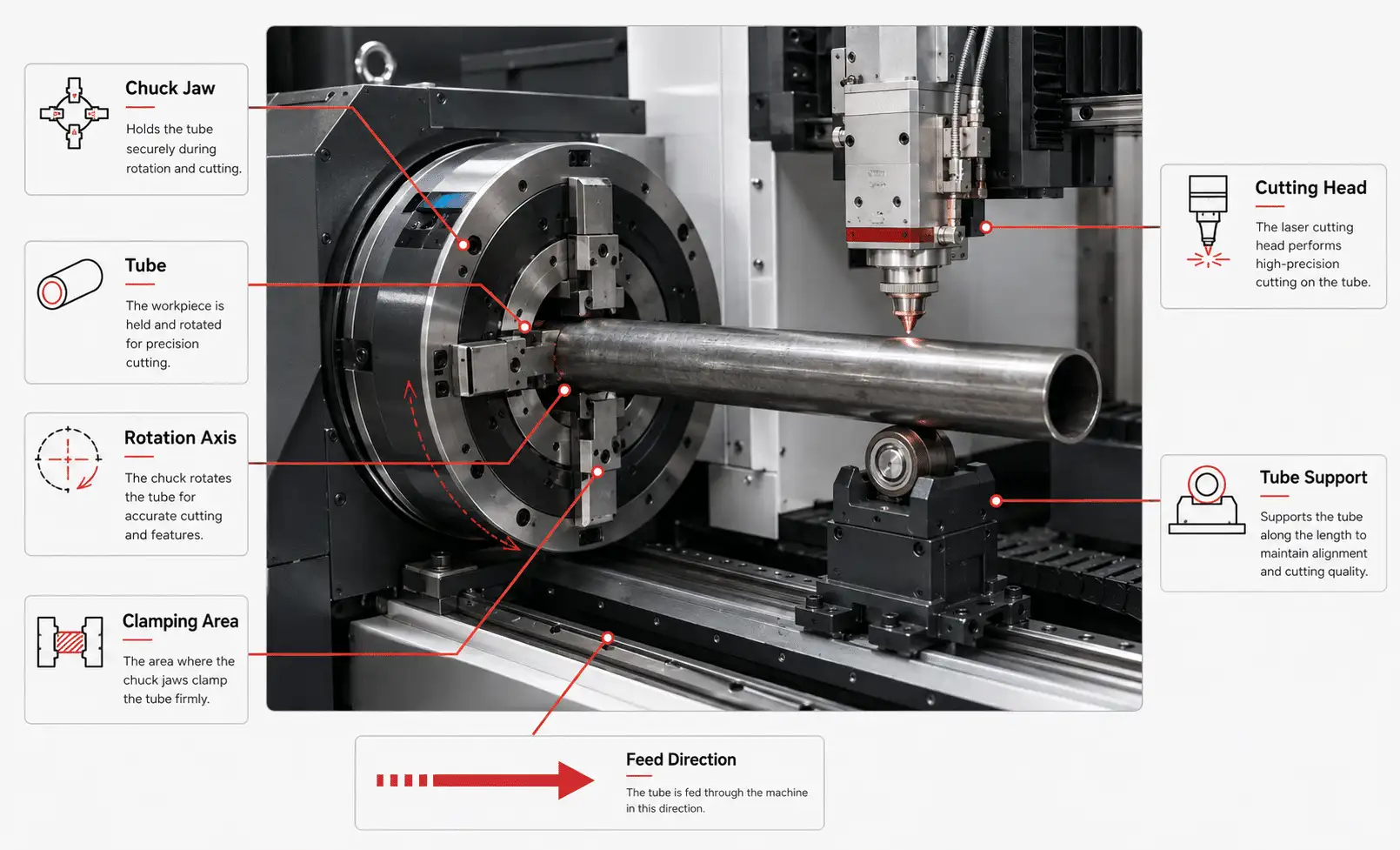
Tail material, or remnant length, is the section of raw tube that cannot be converted into a finished part because the chuck needs material to grip and position the bar.
This is an important purchasing factor because raw tube waste is repeated on every bar.
A machine that leaves unnecessarily long remnants may increase material cost over time.
Tail Material Depends on Machine Design
Factors include:
Do not accept only a statement such as:
"Very short tail material."
Ask the supplier to demonstrate it using your actual tube and final part.
Calculate Annual Remnant Cost
A simple model is:
Annual Remnant Cost = Remnant Length × Tube Weight per Meter × Material Cost × Number of Bars
Even a small improvement per bar can become meaningful in high-volume production.
Zero-Tail Claims Need Careful Review
Different suppliers may use terms such as:
But the definition may differ.
Ask:
Compare real material utilization, not marketing terminology.
Laser power should be selected based on:
Do not choose power only according to the maximum wall thickness.
Thin-Wall Tube Production
When tubes are relatively thin, production may be limited more by:
than by maximum laser power.
A higher-power source does not automatically provide proportional productivity gains.
Thick-Wall Tubes
Higher power may be valuable when processing:
But confirm:
Small Features
High laser power must be controlled when cutting:
The machine’s process database and beam control are therefore important.
Sample Testing Is More Reliable Than a Universal Thickness Table
Ask the supplier to test:
Then measure complete cycle time and edge quality.
This distinction is important when choosing a tube laser.
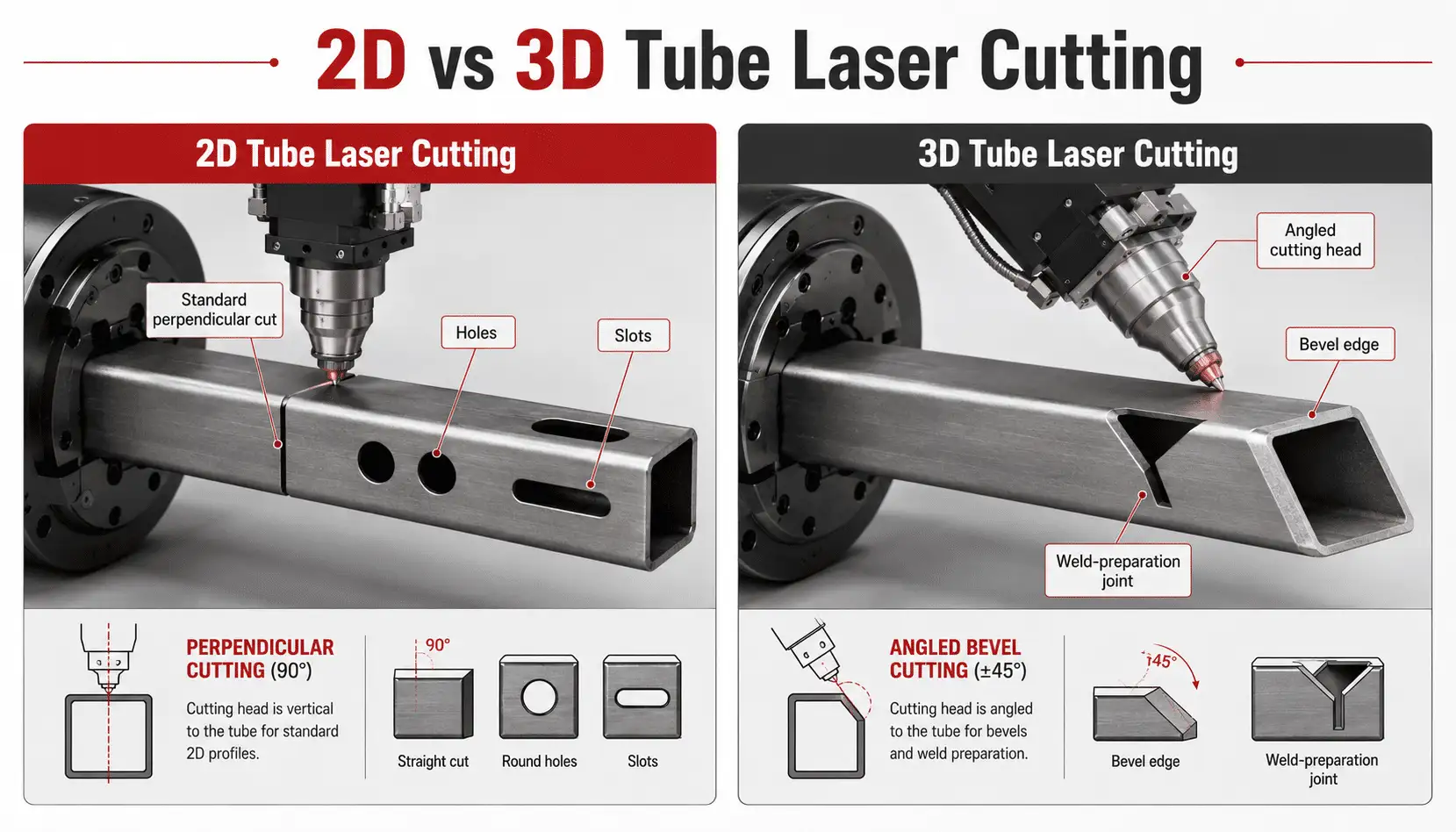
2D Tube Cutting
A conventional tube laser head mainly directs the beam toward the tube surface while the tube itself rotates.
Typical operations include:
For many furniture, machinery and fabrication applications, this is sufficient.
3D Tube Cutting
A 3D or bevel-capable cutting head can change its orientation relative to the tube.
This enables selected operations such as:
BLM’s tube-laser portfolio explicitly separates 2D and 3D cutting platforms, while Bystronic also offers 3D tube systems for more complex tube processing.
Do You Actually Need 3D Cutting?
Choose it when your parts require it—not simply because it sounds more advanced.
If your production consists mainly of:
a 2D system may provide a more economical solution.
If the tube must leave the laser ready for high-quality joining with defined bevel geometry, evaluate a 3D cutting head.
Long tubes rarely remain perfectly straight.
They may:
The machine therefore requires appropriate support throughout:
Insufficient Support Can Cause
Different Profiles Need Different Support
A light round tube behaves differently from:
Ask whether support automatically adjusts to:
BLM’s tube systems, for example, use different support and profile-handling configurations to maintain stability across varying tube types.
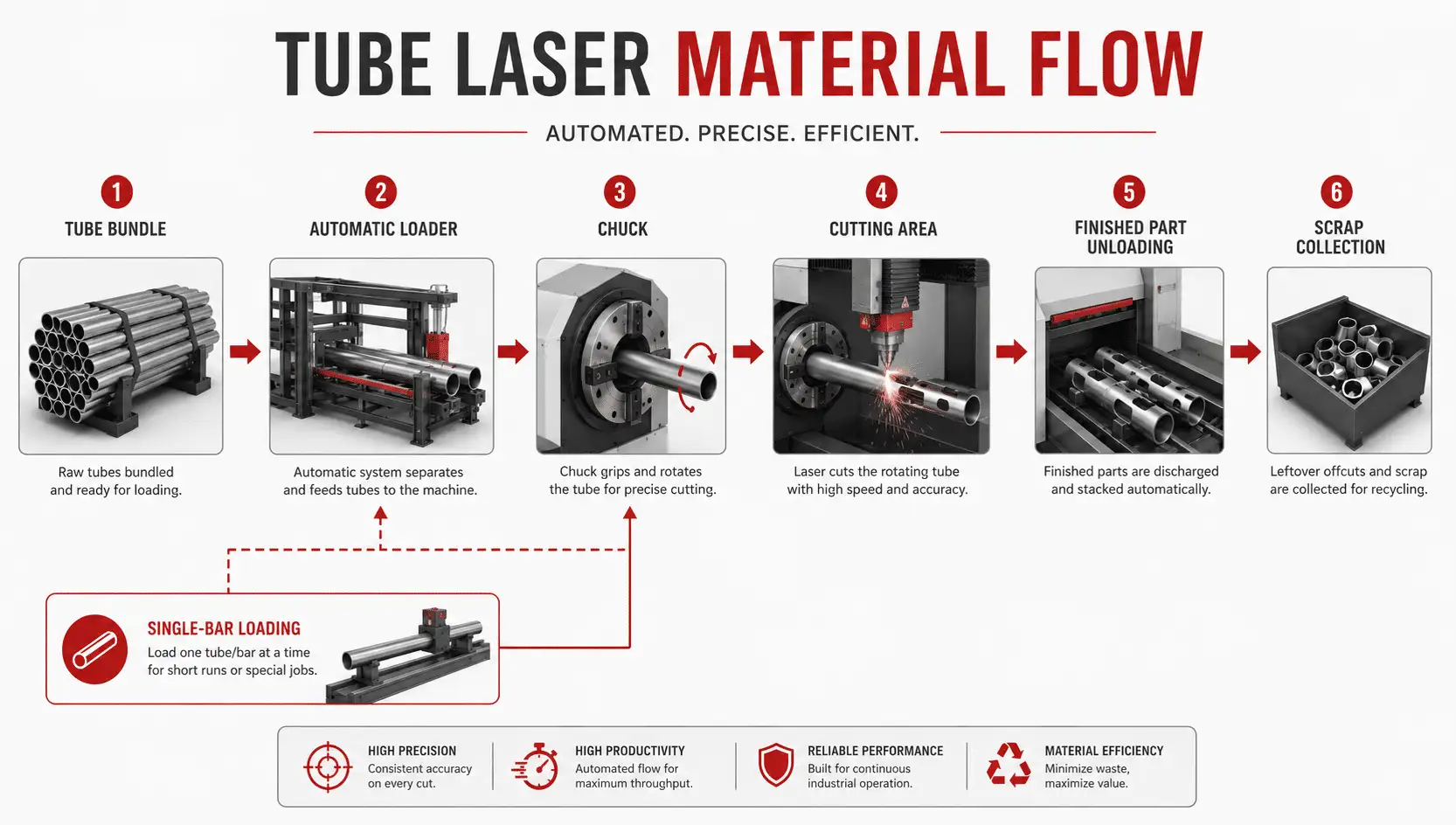
Loading configuration has a major effect on productivity.
Manual Loading
Manual or single-bar loading may be suitable for:
Advantages can include:
But labor and idle time become important as production increases.
Automatic Bundle Loading
A bundle loader automatically separates raw tubes from a bundle and feeds them into the machine.
This is suitable for:
BLM describes systems that can prepare the next tube while another tube is being cut, reducing production-change delays. Bystronic similarly uses bundle loading to reduce manual handling and support continuous production.
But Automatic Loading Is Not Always the Best Choice
It can be less suitable when:
Some systems combine bundle loading with single-bar or chain loading for special profiles, illustrating why loading configuration should follow the production mix rather than a simple "automatic is better" rule.
Many buyers focus on how raw tubes enter the machine but overlook how finished parts leave it.
Consider:
Short Components
Small parts may need:
Long Components
Long finished components require:
BLM's automated tube systems can separate finished parts and scrap through programmed unloading positions, showing how unloading strategy can become part of the production process rather than an afterthought.
Factory Layout Matters
A nominal 6-meter tube machine needs considerably more than six meters of factory length.
Space may be required for:
Loading area + raw tube + machine + cutting area + finished-part unloading + service access
Ask for the complete layout drawing before ordering.
Tube-laser software performs a different job from standard flat-sheet nesting software.
The system must understand the geometry around the entire profile.
Important functions may include:
Specialized tube CAM platforms can also manage profile geometry, assembly joints and production planning. BLM, for example, uses dedicated tube CAD/CAM software for managing tube and profile geometry around 360 degrees.
Ask About File Compatibility
Confirm whether the system accepts:
Do not assume every format is included.
Joint Libraries
Tube lasers can reduce downstream fabrication when software supports features such as:
These can make assembly easier and reduce dependence on manually measuring components.
Many steel tubes are produced with a longitudinal weld seam.
For some parts, seam orientation matters because a hole, bend, cosmetic face or weld should not coincide with the tube seam.
A weld-seam detection system can identify the seam and rotate the tube to a defined position before cutting.
This may be important for:
Not every tube-laser configuration includes seam detection.
Ask:
Bystronic, for example, offers weld-seam search functions on selected tube platforms, demonstrating that this should be treated as a specific option rather than assumed standard equipment.
A tube is not a precision-machined cylinder.
Commercial tubes can vary in:
This means final cutting accuracy depends on more than machine-axis positioning accuracy.
Important Sources of Variation
Machine
Material
Clamping
Support
Process
The current ZG-FC Tube product page lists ±0.03 mm/1000 mm X/Y positioning accuracy and ±0.03 mm repeat positioning accuracy, but these are machine specifications, not a universal guarantee of finished-part dimensional tolerance.
This distinction is important in the rewritten article.
Do not test only a short simple tube.
Use a representative part containing:
Measure:
Test Several Parts
One successful sample demonstrates capability.
Several repeated samples provide information about stability.
For critical projects, ask the supplier to cut multiple identical tubes and compare the results.
For round tube, accessibility may appear simple.
For rectangular or open profiles, cutting geometry can become more complex.
The cutting head must avoid:
This becomes especially important for:
Send a real 3D model rather than only specifying tube dimensions when complex features are required.
The common options include:
The correct gas depends on:
For example:
The gas process should be validated on actual tube samples.
A common purchasing question is whether to buy:
A dedicated tube laser
or
A combined tube-and-plate laser
Dedicated Tube Laser
Generally more appropriate when:
Tube-and-Plate Machine
May make sense when:
ZG Laser currently offers both a dedicated tube platform and a separate tube-and-plate configuration.
Combination Does Not Automatically Mean Better Value
Compare:
A combined machine saves equipment count, but one work type also occupies the machine while the other waits.
Automation becomes particularly valuable when machine waiting time is a significant part of production cost.
Consider automatic loading when:
Advanced industrial systems can integrate loading, cutting, unloading and sorting into one production flow. Current Bystronic automated tube systems, for example, combine bundle handling and automated unloading specifically to reduce manual intervention.
But automation should solve a real bottleneck.
Do not automate only because the option exists.
One reason manufacturers invest in tube lasers is process consolidation.
A conventional tube component may require:
A tube laser may perform several of these geometry-producing operations in one programmed setup.
BLM describes this as one of the major advantages of dedicated tube-laser processing: several profile features can be produced in one machining operation rather than through multiple conventional steps.
However, a laser does not eliminate every secondary process.
Machining may still be necessary for:
Evaluate the actual routing of your part.
Do not compare machines only by purchase price.
Consider:
Equipment Cost
Operating Cost
Material Cost
Production Cost
A useful metric is:
Cost per Acceptable Finished Part
not:
Machine Price ÷ Laser Power
Before finalizing the machine, send representative tube samples or production drawings.
A useful test should include your difficult features rather than a supplier’s demonstration part.
Provide
Test
Record
Repeat
Cut multiple parts if the project has meaningful production volume.
This allows you to evaluate repeatability rather than one ideal sample.
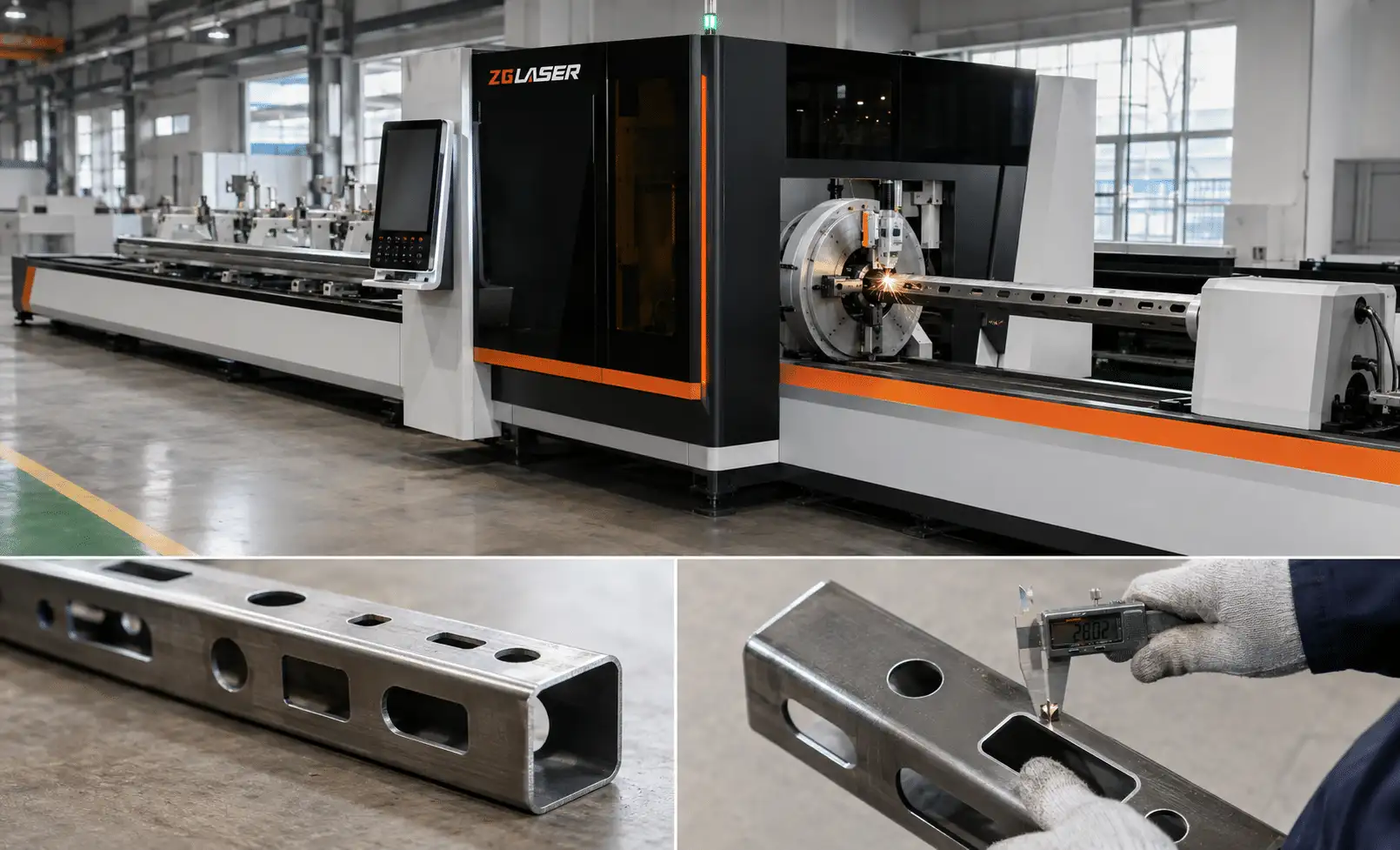
ZG-FC Automatic Tube Laser Cutting Machine
ZG Laser's current ZG-FC Tube platform is designed for a range of metal tubes and profiles, including round, square, rectangular, oval and selected special sections. The current standard product page lists a 6000 mm cutting length, Φ20–220 mm round-tube range and 20–140 mm square-profile range.
However, the final machine configuration should always be confirmed according to:
Before requesting the final quotation, ask:
A good supplier should explain why a configuration fits your production, rather than simply quoting the largest machine available.
Before placing an order, confirm:
Choosing a tube laser cutting machine requires more than comparing laser power, maximum tube diameter or purchase price.
The complete system must match:
For low-volume production, flexible manual loading may be more valuable than a complex automation system.
For repeated high-volume tube processing, automatic loading and unloading can reduce material-handling delays and allow the laser to operate for a larger share of each shift. Current industrial tube-laser platforms increasingly treat loading, cutting and unloading as one integrated production flow.
The most reliable selection method is therefore to provide the supplier with your actual tubes and drawings, conduct representative sample cutting and compare the complete cost per acceptable finished part.
Send us:
Our application team can review the project and recommend an appropriate tube-laser configuration.
Send Your Tube Drawing for Evaluation
Explore ZG-FC Tube Laser Cutting Machine
Compare Tube & Plate Laser Cutting Machine
Q1: What size tubes can a tube laser cutting machine process?
It depends on the machine’s chuck, support system and working range. Buyers should verify minimum size, maximum round diameter, square or rectangular capacity, tube weight and circumscribed diameter rather than looking only at one maximum-size specification.
Q2: Can a tube laser cut square and rectangular tubes?
Yes, compatible tube laser systems can process round, square, rectangular and other profiles. Some systems can also handle open and special sections.
Q3: What is tail material in tube laser cutting?
Tail material is the remaining section of raw tube required for gripping or positioning that cannot normally become a finished part. Its length depends on machine and chuck design.
Q4: Is a higher-power tube laser always better?
No. For thin-wall production, loading, chuck movement, tube rotation and unloading can become more important bottlenecks than laser power.
Q5: What is the difference between 2D and 3D tube laser cutting?
A conventional 2D tube laser is suitable for many holes, slots, contours and perpendicular cuts. A 3D cutting head can change its angle to produce bevels and other angled features. Commercial tube-laser portfolios commonly distinguish between these two capabilities.
Q6: Do I need an automatic tube loader?
It depends on production volume and profile mix. Bundle loading is useful for repetitive high-volume production, while manual or single-bar loading can provide greater flexibility for small batches and special profiles.
Q7: Can a tube laser cut open profiles?
Some machines can process channels, angles and other open profiles, but clamping and support requirements differ from closed tubing. The exact profile should be tested before ordering.
Q8: Should I choose a dedicated tube laser or a tube-and-plate machine?
A dedicated tube laser is generally more suitable when tube production is central to the business or requires automation. A combination machine may be attractive when both sheet and tube volumes are moderate and factory space or investment is limited.
Q9: What information is needed for a tube laser quotation?
Provide profile shape, dimensions, wall thickness, length, material, weight, drawings, tolerance, production volume and loading requirements.
Q10: Should actual tube samples be tested before buying?
Yes. Representative sample testing helps verify chuck compatibility, cutting quality, tube support, tail material, cycle time and dimensional consistency.
For more practical guidance on laser equipment maintenance, troubleshooting, performance optimization, and failure prevention, explore the related technical resources below. These articles provide additional engineering insights to help you improve machine reliability, efficiency, and long-term performance.



English

French

German

Hindi

Italian

Japanese

Korean

Portuguese

Russian

Spanish
Tell us about your manufacturing challenges.
Our engineers will design a laser solution tailored to your exact requirements.