CDA Air Quality Requirements for Industrial Laser Systems
-
September 18, 2026

-
19 min read

Industrial laser systems may use compressed air for different functions, including pneumatic components, protective air, ventilation, purging, or moisture-sensitive internal areas. However, not every compressed-air supply is suitable for every laser application.
For sensitive equipment, CDA air quality can directly affect moisture control, contamination prevention, and long-term system reliability.
CDA stands for Clean Dry Air. In practice, this means that the supplied air must be appropriately treated to control contaminants that may include moisture, liquid water, particles, and oil. The exact requirements depend on the laser manufacturer, equipment design, and application.
For this reason, it is important to avoid a common assumption:
Compressed air is not automatically Clean Dry Air.
A factory may have a central compressed-air system that operates perfectly well for pneumatic cylinders and general production equipment while still requiring additional treatment before the air is suitable for a sensitive laser connection.
This guide explains the major factors behind CDA air quality, how compressed air is contaminated, how dryers and filters work together, and how to evaluate a CDA supply for industrial laser equipment.
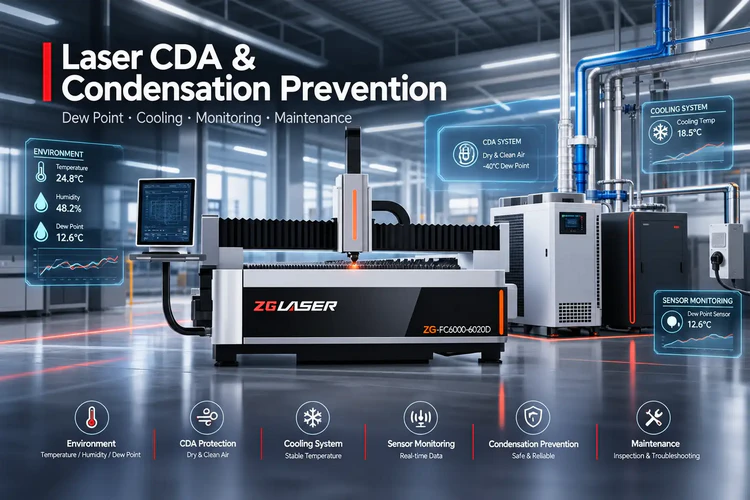
For the complete condensation prevention framework, see our Laser CDA Ventilation Guide: Preventing Condensation in Laser Systems.
CDA air quality refers to the condition of compressed air after appropriate treatment and before it enters equipment that requires clean and dry air.
For industrial laser systems, the most important air-quality categories typically include:
Depending on the application, airflow capacity and air temperature may also be important.
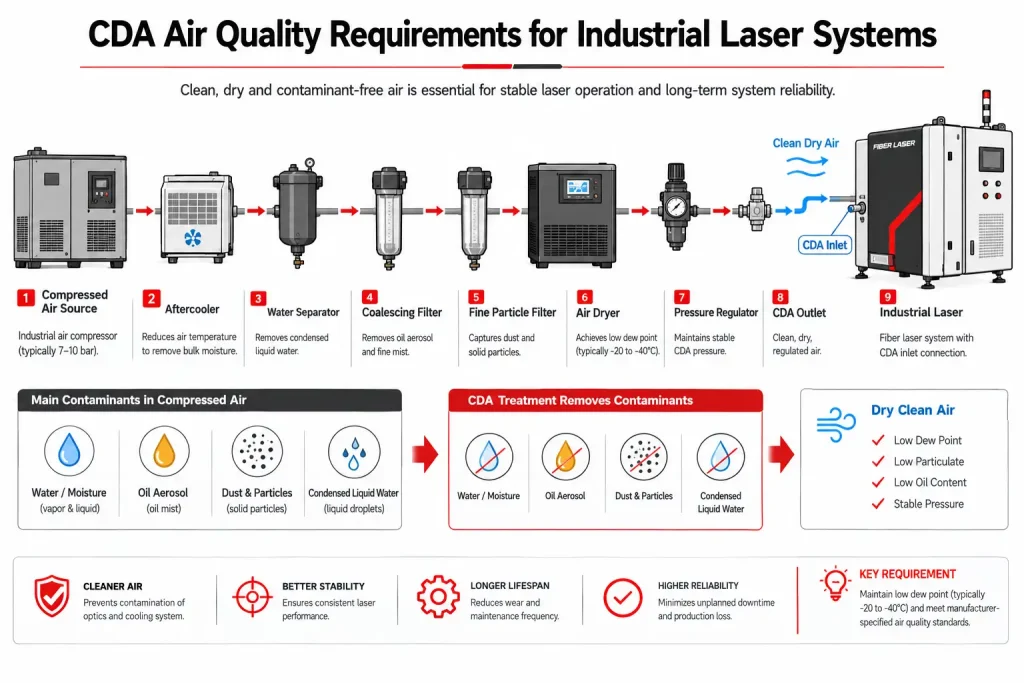
A practical CDA system can therefore be understood as:
Compressed Air Source
↓
Moisture Removal
↓
Particle Control
↓
Oil Control Where Required
↓
Pressure Regulation
↓
Clean Dry Air for Laser Equipment
The required performance of each stage depends on the laser manufacturer's approved specifications.
There is no single universal CDA specification that should be applied to every industrial laser.
Compressed air is often described as one of the most contaminated utilities in an industrial facility.
The air may collect contaminants from multiple sources.
Compression concentrates water vapor and can create conditions where liquid water forms downstream.
Depending on the compressor design and operating conditions, the compressed air may also carry oil-related contaminants.
Contaminants may include:
The longer and older the distribution system, the more important downstream contamination control can become.
Depending on the compressor design and lubrication system, compressed air may contain:
The compressor type should therefore be considered when designing the air-treatment system.
The compressor intake may introduce:
This means that an air line with sufficient pressure is not necessarily suitable for laser CDA use.
CDA moisture is one of the most important considerations for laser applications where air is used to reduce humidity or protect moisture-sensitive areas.
Compressed air can contain water in several forms:
A system can appear dry at one point but generate water downstream when temperature and pressure conditions change.
For this reason, CDA evaluation should consider both visible moisture and the moisture that remains in vapor form.
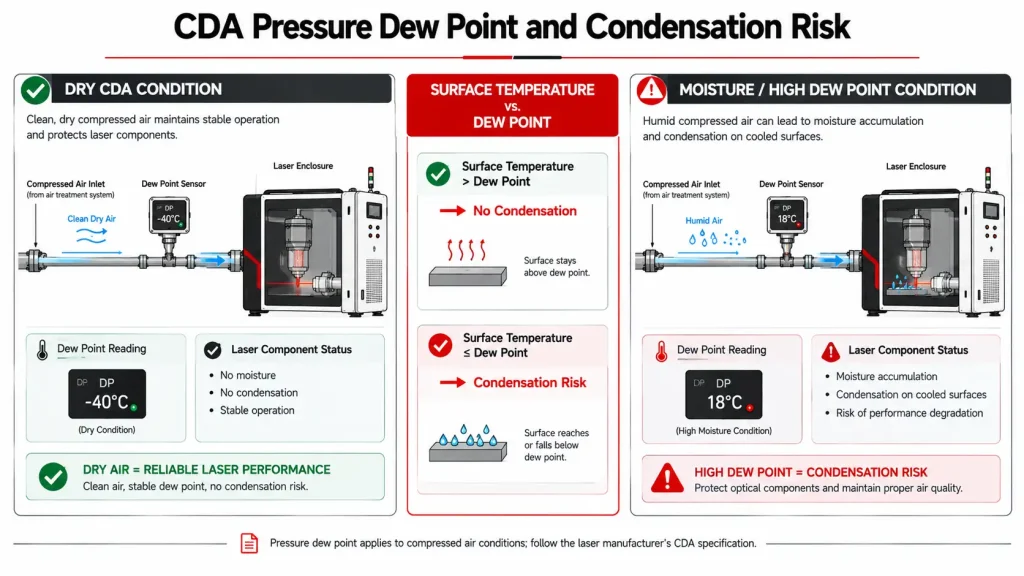
CDA dew point is a useful way to evaluate compressed-air dryness.
Pressure dew point describes the temperature at which water vapor in compressed air may begin to condense under specified pressure conditions.
A lower pressure dew point generally indicates drier compressed air.
However, the required pressure dew point depends on:
Do not select a dryer based only on the assumption that the lowest possible dew point is always required.
Instead, determine the actual air-quality requirements for the equipment.
For a detailed explanation of environmental dew point and laser condensation, see Laser Dew Point and Condensation: A Guide to Humidity Control.
Laser CDA filter performance is important because particles may enter the air system from:
Particles may also be generated within the compressed-air system itself.
A central air treatment system may not completely eliminate contamination generated in long downstream pipelines.
This is why the final stage of filtration near sensitive equipment may be important, depending on the installation design.
However, filter selection should be based on the actual required air-quality specification.
Adding multiple filters without considering their purpose may increase:
Oil-free compressed air is an important consideration where laser equipment requires air with very low oil contamination.
Potential oil sources include:
Oil contamination can be more complicated than visible liquid oil.
Some treatment systems are effective against liquid or aerosol contamination but may have different performance against vapor-phase contaminants.
Therefore, oil control should be evaluated according to the equipment's required air-quality class and the actual compressed-air source.
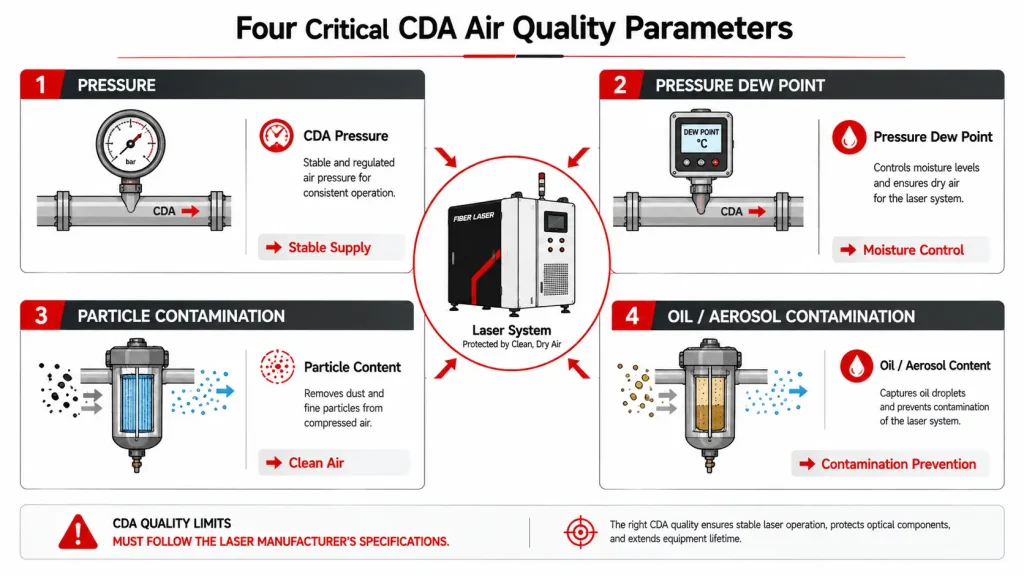
When designing or evaluating a CDA supply for laser equipment, it is useful to convert general air-quality requirements into a clear engineering specification.
The following table can be used as a CDA specification template for system design, technical discussions, supplier communication, commissioning, and maintenance planning.
Important: The final approved values must be based on the laser manufacturer's requirements and the actual installation conditions. The table below defines the engineering parameters that should be specified and verified; it does not establish universal operating limits for every laser system.
| Engineering Parameter | What It Controls | Recommended Specification Method | How to Verify | Why It Matters |
|---|---|---|---|---|
| Supply pressure | Correct operation of the CDA connection | Define the approved operating pressure range from the laser manufacturer | Calibrated pressure gauge or pressure transmitter | Too low may reduce purge or ventilation performance; too high may exceed equipment requirements |
| Pressure stability | Consistent CDA delivery | Define the acceptable pressure variation during actual operating demand | Pressure trend monitoring | Large pressure fluctuations may indicate undersized supply capacity, restrictions, or unstable demand |
| Required flow rate | Adequate ventilation or purge capacity | Use the laser manufacturer's specified flow requirement | Flow meter or validated system calculation | Insufficient flow may not adequately replace or control humid internal air |
| Pressure dew point | Moisture content of compressed air | Specify the maximum allowable pressure dew point required by the laser or application | Pressure dew point meter | Indicates how dry the CDA supply actually is |
| Liquid water | Bulk moisture contamination | Specify no unacceptable liquid-water carryover at the equipment connection | Water separator and drain inspection | Liquid water can immediately compromise sensitive equipment |
| Particle contamination | Solid contamination control | Specify the required particle cleanliness according to equipment requirements or applicable air-quality classification | Filter monitoring or appropriate air-quality testing | Helps protect sensitive passages, valves, and components |
| Oil aerosol contamination | Lubricant carryover | Specify the allowable oil aerosol level where required | Appropriate oil contamination testing | Oil can contaminate sensitive laser-related components |
| Oil vapor contamination | Vapor-phase hydrocarbon contamination | Evaluate separately where the equipment requires strict hydrocarbon control | Application-specific air-quality testing | Some filtration systems perform differently for aerosols and vapors |
| Final filter location | Downstream contamination protection | Define whether point-of-use filtration is required | Installation inspection and maintenance records | Long piping networks may introduce particles after central treatment |
| Filter differential pressure | Filter loading and restriction | Define the replacement or maintenance threshold | Differential pressure gauge or transmitter | Increasing pressure drop can indicate contamination or undersized filtration |
| Condensate drainage | Removal of collected liquid water | Specify automatic or manual drain maintenance requirements | Functional inspection | Drain failure can allow accumulated water to move downstream |
| Air temperature | Stability of air entering the equipment | Confirm compatibility with installation and equipment requirements | Temperature sensor | Temperature changes can affect downstream moisture behavior |
| Air piping condition | Secondary contamination control | Define acceptable piping materials and maintenance conditions | Visual inspection and system audit | Rust, scale, and installation debris can contaminate otherwise clean air |
| Leakage rate | CDA supply efficiency and positive-pressure performance | Define acceptable leakage according to system design | Leak testing and pressure monitoring | Leaks can reduce available flow and, in some designs, allow humid air infiltration |
This table gives engineering teams a more useful specification framework than simply stating that a laser requires “clean and dry compressed air.”
This format is useful because it separates:
That separation makes CDA requirements easier to communicate between laser manufacturers, machine integrators, facility engineers, and compressed-air suppliers.
| Item | Design Requirement | Actual Measured Value | Status |
|---|---|---|---|
| Supply pressure | Manufacturer-approved range | ______ | Pass / Review |
| Available flow | Manufacturer requirement | ______ | Pass / Review |
| Pressure dew point | Maximum allowable value | ______ | Pass / Review |
| Particle condition | Required air-quality level | ______ | Pass / Review |
| Oil contamination | Required air-quality level | ______ | Pass / Review |
| Filter differential pressure | Maintenance limit | ______ | Pass / Review |
| Condensate drains | Functional | ______ | Pass / Review |
| Point-of-use treatment | Installed if required | ______ | Pass / Review |
| Leakage inspection | Acceptable | ______ | Pass / Review |
This type of matrix is particularly useful for:
The purpose is not simply to confirm that the CDA equipment has been installed. It is to verify that the complete air supply is capable of delivering the required condition at the laser connection.
One common mistake is to inspect an air line for visible water and conclude that the air is dry.
Visible water and water vapor are not the same.
A compressed-air system may contain:
As the air travels through the system, temperature conditions can change.
When the air cools sufficiently, water vapor can condense.
This is why air dryers are an important part of CDA air quality.
A properly designed system should control moisture before the air reaches sensitive equipment.
Air receivers, water separators, filters, and other components may collect liquid condensate.
If drains fail:
Drain systems should therefore be included in routine CDA maintenance.
Operators should not assume that a drain is functioning simply because it is installed.
For a preventive maintenance schedule, see Laser CDA System Preventive Maintenance Checklist.
Laser air dryer system selection depends on the required air dryness and application conditions.
The two common approaches are refrigerated drying and desiccant drying.
A refrigerated dryer removes moisture by cooling compressed air and separating condensed water.
Typical advantages may include:
However, the achievable pressure dew point may not be suitable for every moisture-sensitive application.
The suitability depends on the laser manufacturer's requirements and environmental conditions.
Desiccant dryers remove moisture using a moisture-absorbing material.
Potential advantages may include the ability to achieve significantly lower pressure dew points.
However, desiccant systems may require:
They may also consume additional energy depending on the regeneration method.
The correct engineering approach is not:
Always use a desiccant dryer.
Instead:
Select the air dryer based on the required air dryness, operating environment, and equipment specification.
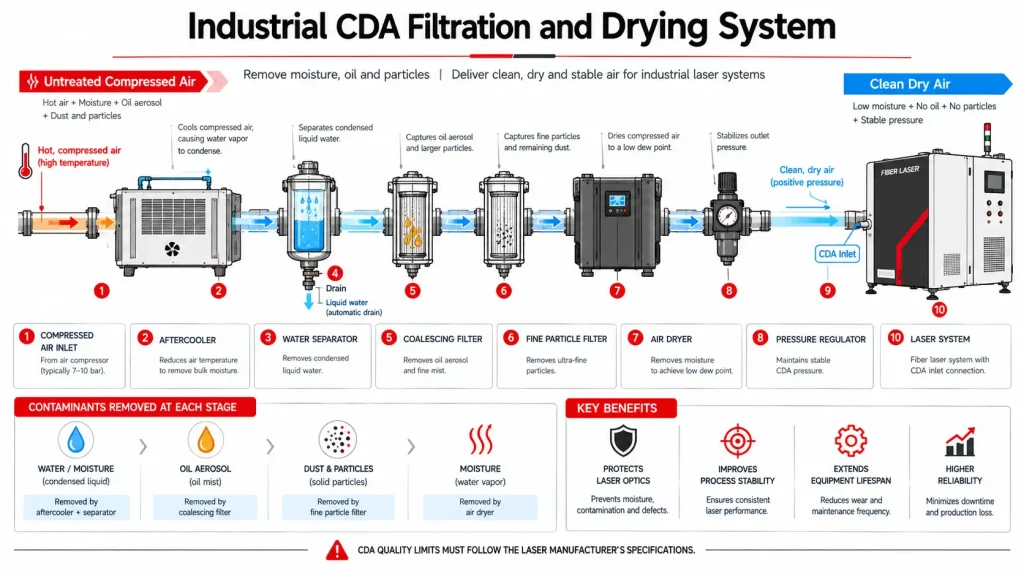
A CDA system often uses multiple treatment stages because different contaminants require different control methods.
A simplified system may include:
Compressor
↓
Air Receiver
↓
Water Separator
↓
Air Dryer
↓
Particle Filtration
↓
Oil Removal Where Required
↓
Final Point-of-Use Filtration
↓
Laser Equipment
The exact configuration depends on:
For a complete engineering discussion, see How to Design a CDA Supply System for Industrial Laser Equipment.
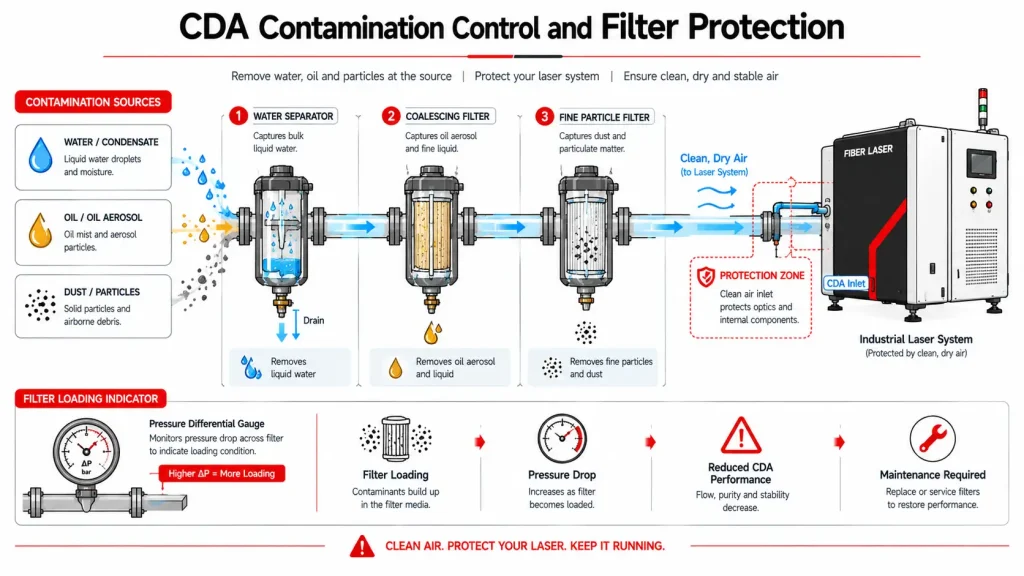
Filters installed near the compressor may protect the central air system.
However, contaminants can still enter downstream piping.
For example:
A point-of-use filter can therefore provide an additional layer of protection for sensitive laser equipment when required by the system design.
However, every additional filter should be evaluated for:
The objective is not to install as many filters as possible. The objective is to achieve the required air quality without unnecessarily restricting the CDA supply.
Laser compressed air requirements are not limited to air cleanliness.
Pressure stability may also affect system performance.
Potential problems include:
The CDA supply should remain within the equipment manufacturer's approved operating range.
Do not increase pressure beyond the specified range simply to compensate for poor air quality or system design problems.
Increasing pressure drop can indicate:
Monitoring pressure before and after critical filters can help identify developing restrictions.
A pressure problem should not automatically be corrected by increasing the regulator setting.
The root cause should first be identified.
A practical evaluation process can use the following steps.
Start with the laser manufacturer's documentation.
Identify requirements for:
The manufacturer's specification should be the primary reference for final equipment limits.
Determine:
This establishes what level of treatment already exists before the CDA supply reaches the laser.
Check:
A properly treated air source can still experience downstream contamination if the distribution system is poorly maintained.
Determine whether additional:
is required near the laser.
Point-of-use treatment may be particularly useful where the central air system is shared by many types of industrial equipment.
Where required, use appropriate testing or monitoring to verify:
Testing methods should match the required air-quality specification.
A CDA system may look correctly installed while actual air quality has deteriorated.
Possible reasons include:
For this reason, a preventive maintenance program should include both:
Component Inspection
and
Performance Verification
Inspection answers:
Does the equipment look normal?
Verification answers:
Is the air actually meeting the required condition?
Both are important.
A filter can look physically intact while its pressure drop is excessive. A dryer can appear operational while failing to achieve the required pressure dew point.
This is why measurable verification is an important part of CDA air quality management.
CDA air quality directly affects the performance of a laser moisture-control strategy.
The basic principle is:
Humid or Contaminated Compressed Air
↓
Moisture Enters Sensitive Laser Areas
↓
Cooling Creates Low-Temperature Surfaces
↓
Condensation Risk Increases
A properly prepared CDA supply can help reduce internal moisture.
However, CDA does not replace environmental humidity control.
The complete strategy should combine:
For the full system overview, see Laser CDA Ventilation Guide: Preventing Condensation in Laser Systems.
The importance of clean and dry air may vary depending on the equipment design and application.
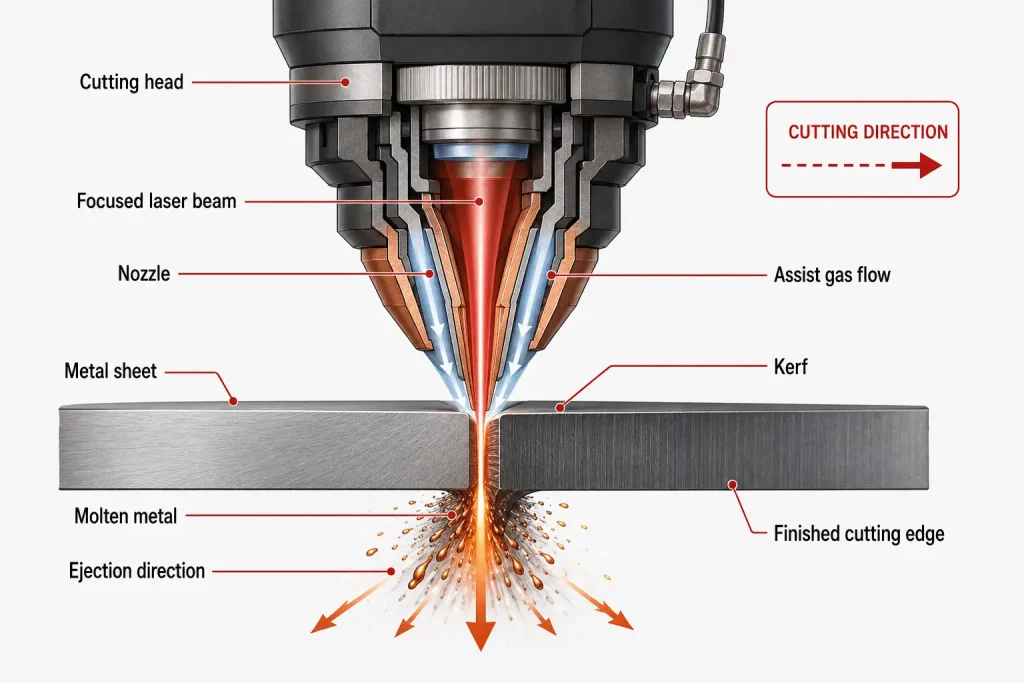
A high-power fiber laser cutting machine may operate for extended production periods with demanding thermal conditions.
Air quality should follow the laser source and machine manufacturer's requirements, particularly where CDA supports sensitive laser components.
Environmental conditions should also be considered because high workshop humidity can increase condensation risk around cooled components.
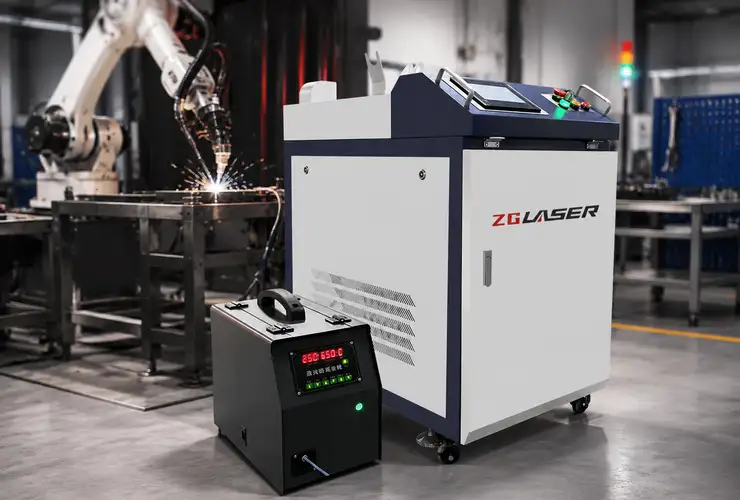
An industrial laser welding machine may be installed in environments where welding operations, manufacturing processes, or local ventilation conditions introduce additional airborne contamination.
CDA system design should consider the actual installation environment.
Where the equipment requires clean dry air for sensitive areas, the air supply should be treated and verified according to the manufacturer's requirements.
A portable laser cleaning machine may be used in variable industrial environments.
If the equipment uses a CDA connection for sensitive components, the quality of the supplied air should be verified rather than assumed.
The same principle applies to specialized systems such as 3D 5-axis laser cutting machines, where equipment configuration and installation conditions may differ significantly.
These product references are application examples only. The actual CDA requirements must always be determined from the specific equipment documentation.
Possible causes include:
The root cause should be identified before replacing components unnecessarily.
Possible causes include:
Check the differential pressure and system configuration.
Possible causes may include:
Visible dryness should therefore never be treated as proof of adequate CDA dryness.
Potential sources include:
Oil contamination should be investigated based on the actual air-source design and required air quality.
A structured maintenance program should include several levels of inspection and verification.
Inspect:
These checks help identify obvious failures before they affect laser operation.
Inspect:
A rising pressure drop can indicate progressive filter loading or a restriction elsewhere in the system.
Where required, perform:
Maintenance intervals should be based on:
For a complete maintenance framework, see Laser CDA System Preventive Maintenance Checklist.
Before placing a new or modified laser CDA system into production, the following questions should be addressed:
This checklist can be combined with the engineering acceptance matrix to create a formal commissioning record.
CDA air quality is a critical part of reliable industrial laser operation where Clean Dry Air is required.
The presence of compressed air alone does not guarantee that the air is suitable for sensitive laser equipment.
A reliable CDA supply should consider:
The correct air-treatment system depends on the actual equipment requirements.
The goal is not to install the largest number of filters or the most complex dryer.
Provide the air quality required by the laser equipment and maintain that performance consistently over time.
A well-designed CDA system should therefore combine proper air treatment, appropriate distribution, point-of-use protection where required, monitoring, and preventive maintenance.
The engineering specification should also be measurable. Instead of simply stating “clean and dry air,” the system should define the required parameters for pressure, flow, pressure dew point, particle contamination, oil contamination, filtration, and verification.
When combined with dew point awareness, correct laser cooling, and approved startup procedures, properly maintained CDA can become an important layer in a complete laser condensation prevention strategy.
For the overall moisture-control framework, see Laser CDA Ventilation Guide: Preventing Condensation in Laser Systems.
CDA air quality refers to how clean and dry compressed air is after treatment. For laser systems, important factors may include moisture, pressure dew point, particles, oil contamination, pressure stability, and flow.
No. Factory compressed air may contain water vapor, liquid water, particles, or oil. It should be properly treated and verified before being used where laser equipment requires CDA.
Pressure dew point is the temperature at which moisture in compressed air may begin to condense under specified pressure conditions. A lower pressure dew point generally indicates drier compressed air.
Not necessarily. Dryer selection should be based on the required air dryness, equipment specifications, operating conditions, and installation environment.
Water vapor is not always visible. Air can appear completely dry while still containing enough moisture to create condensation when temperature or pressure conditions change.
Yes, potentially. Air dryers primarily address moisture, while filters may be required to control particles, liquid contaminants, or oil depending on the system design and required air quality.
Verification methods may include checking pressure, monitoring pressure dew point, inspecting filter performance, measuring differential pressure, and using appropriate air-quality testing methods based on the equipment requirements.
Yes. If CDA contains excessive moisture, it may introduce water vapor into areas that are intended to remain dry. When cold surfaces are present, condensation risk can increase.
Maintenance intervals depend on manufacturer recommendations, operating hours, contamination levels, compressor load, and required air quality. Performance should be monitored rather than relying only on calendar-based replacement.
Check the condensate drains, air dryer performance, water separators, piping conditions, and whether downstream temperature changes are causing water vapor to condense. Follow the equipment manufacturer's approved inspection procedure before returning the laser to operation.




English

French

German

Hindi

Italian

Japanese

Korean

Portuguese

Russian

Spanish
Tell us about your manufacturing challenges.
Our engineers will design a laser solution tailored to your exact requirements.