While fluid quality and temperature calibration are critical, long-term chiller reliability depends on the mechanical health of its internal components.
Executing routine laser chiller component maintenance prevents mechanical wear, reduces compressor strain, and eliminates unexpected operational outages. This guide serves as a technical deep-dive within our master laser cooling system maintenance framework.
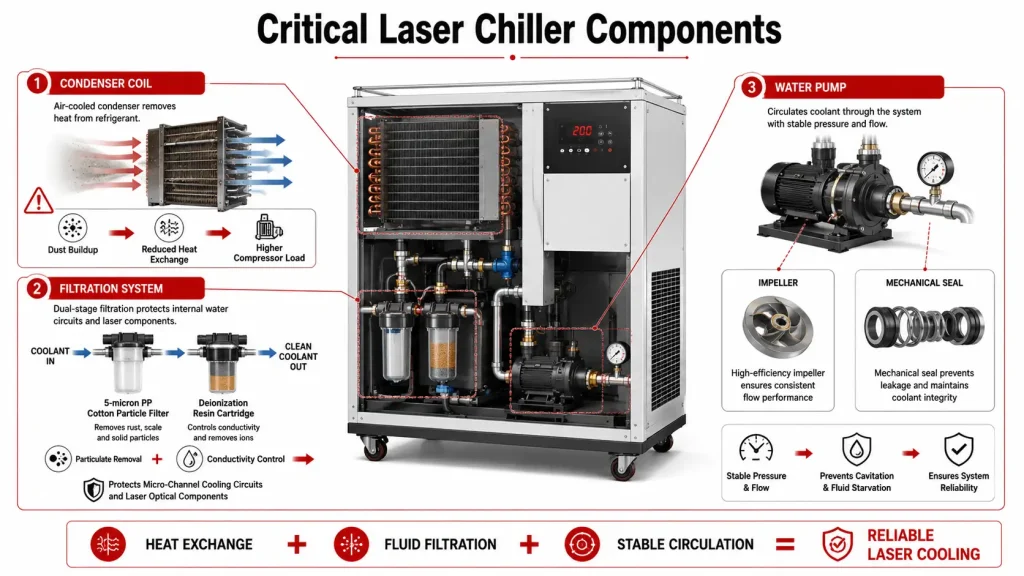
Critical Components of an Industrial Laser Chiller
2. Condenser Coil & Dust Screen Servicing
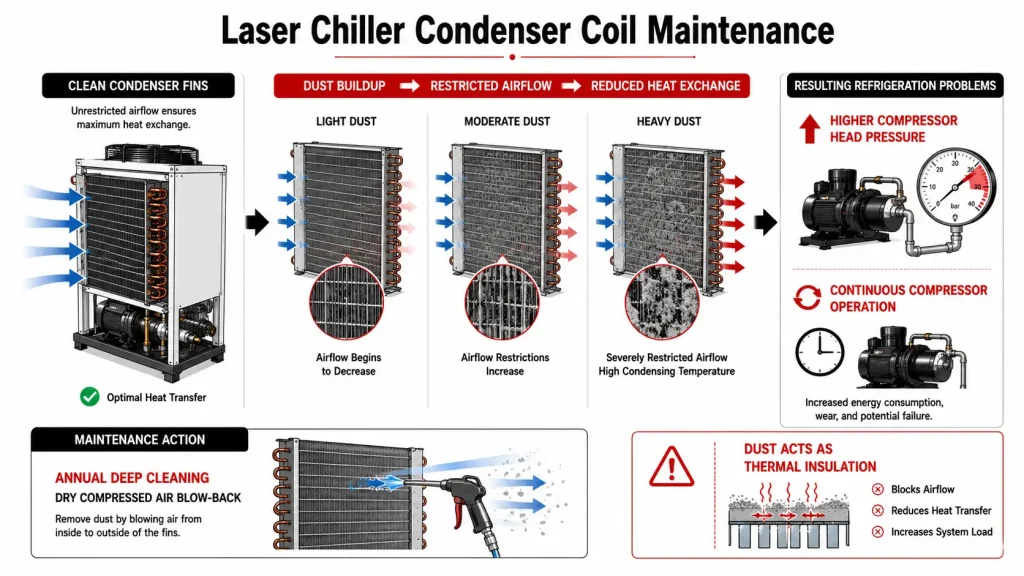
The condenser acts as the primary heat release interface for the refrigeration loop. Dust, oil mist, and shop airborne particulates settle on the thin aluminum fins, creating an insulating layer that prevents heat dissipation.
Cleaning Protocol:
Dust Mesh Screen: Slide out the removable dust filter screens from the side intake panels weekly. Wash with warm water, dry thoroughly, and reinstall.
Condenser Fins: Every 1 to 3 months, use dry compressed air (0.2–0.3 MPa) to blow dust out from the inside of the chiller chassis through the condenser fins.
Fin Straightening: Inspect for bent aluminum fins. Use a specialized fin comb to straighten misaligned fins and restore unrestricted airflow.
Laser Chiller Condenser Coil Cleaning and Maintenance
3. Filtration System Care (Particle & DI Resin Filters)
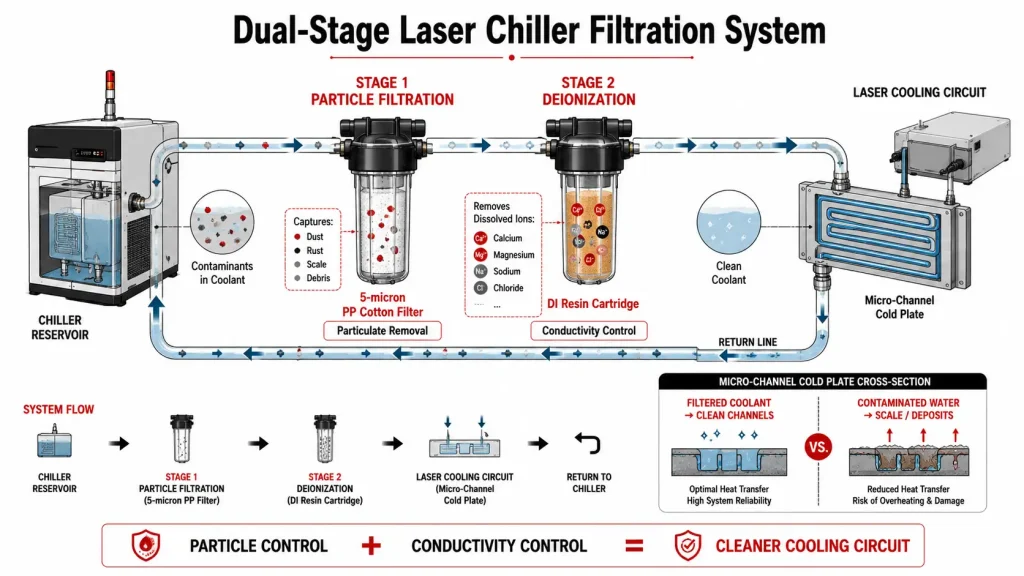
Industrial laser chillers use a two-stage filtration loop to preserve water purity and protect micro-optics:
Replacement Guidelines:
Stage 1: PP Cotton Particle Filter (5-Micron)
Function: Filters rust, dirt, and suspended mineral solids.
Replacement Metric: Replace every 3 months, or when the filter turns dark brown/black.
Stage 2: Deionization (DI) Resin Filter
Function: Captures dissolved ions to maintain low water conductivity.
Shut off the chiller power and relieve water line pressure.
Place a collection tray beneath the filter housings.
Unscrew the housing filter bowl using a standard filter wrench.
Clean the inside of the housing, inspect the rubber O-ring seal for cracks, insert the new cartridge, and hand-tighten firmly.
Dual-Stage Filtration System for Laser Chillers
4. Water Pump & Hydraulic Circuit Servicing
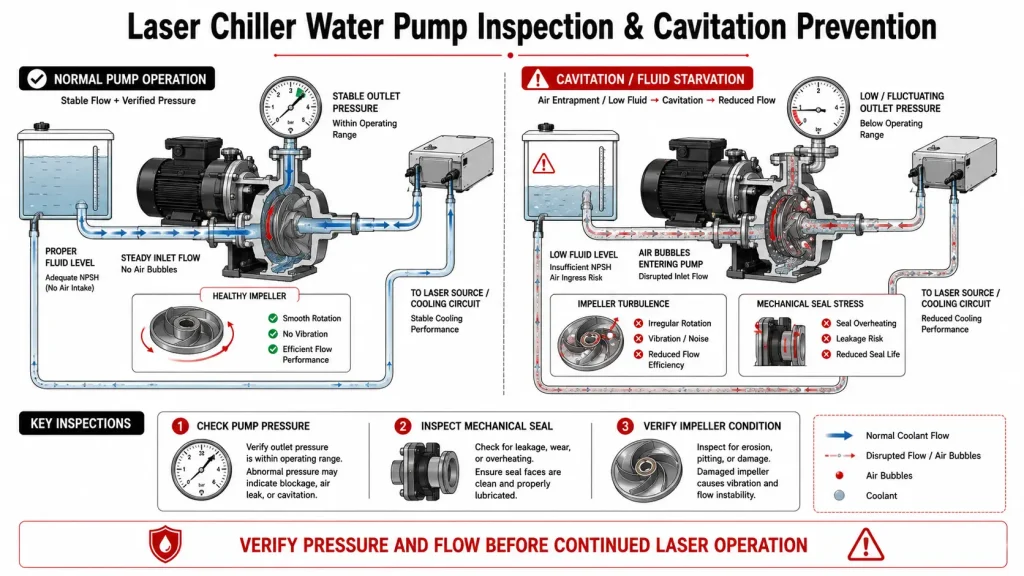
The water pump circulates coolant through narrow cold-plate passages under continuous pressure.
Inspection Checklist:
Pressure Verification: Check the discharge pressure gauge monthly. Sudden pressure drops indicate pump impeller wear, whereas rising pressure points to internal line restrictions (see our laser chiller troubleshooting guide).
Mechanical Seal Inspection: Inspect the pump base for water weeping or dry mineral residue, which signals a deteriorating shaft seal.
Air Airlock Bleeding: If the pump emits a grinding noise, open the top bleed screw on the pump casing until a steady stream of water emerges without air bubbles.
Laser Chiller Water Pump Inspection and Cavitation Prevention
5. Component Care Across Specialized Laser Machinery
Heavy Surface Ablation: Operating a mobile laser cleaning machine in dusty environments requires weekly air filter cleaning to prevent severe condenser choking.
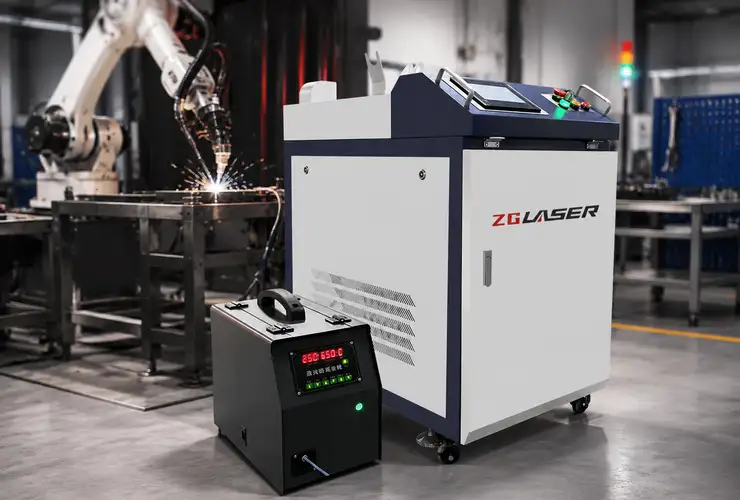
High-Precision Joining: Automated laser welding machine workcells require quarterly DI resin filter replacements to maintain exact dielectric water properties during high-duty production cycles.
Complex Multi-Axis Tooling: A high-speed 3D 5-axis laser cutting machine relies on constant pump pressure to deliver stable fluid flow through articulated 3D motion axes without pressure drops.
6. Recommended Spare Parts Inventory for Plant Managers
To minimize repair downtime, facility managers should stock the following critical spares:
Component Name
Recommended Stock Qty
Replacement Frequency
5-Micron PP Cotton Filters
4–6 units per chiller
Every 3 months
DI Resin Cartridges
2–3 units per chiller
Every 3–6 months
Housing O-Ring Seals
4 sets
Upon sign of wear
Water Tank Air Filter Mesh
1 spare set
Annually
Replacement Water Pump Seal
1 kit
As needed
Frequently Asked Questions (FAQ)
To help you better understand the technical aspects of this equipment, we’ve compiled answers to some of the most frequently asked questions, covering operation, maintenance, troubleshooting, and performance optimization.
Can I clean my condenser fins with water or a pressure washer? No. Using high-pressure water inside a chiller cabinet damages electrical controls and bends the delicate aluminum fins. Always use low-pressure compressed air or a vacuum cleaner with a soft brush attachment.
How do I know if my DI resin filter cartridge is completely depleted? A depleted DI filter can no longer absorb dissolved ions, causing water conductivity to rise rapidly above 10 μS/cm. Some DI cartridges also feature color-changing resin that turns from blue/green to amber when saturated.
What causes a water pump to make a loud whining or rattling noise? Rattling or whining noises usually indicate pump cavitation (trapped air bubbles) or worn motor ball bearings. Bleed the air valve first; if the noise persists, inspect the pump bearings.
Why is my filter housing leaking water after replacing the cartridge? Leaking filter housings are usually caused by a pinched, dry, or improperly seated rubber O-ring seal. Apply a thin layer of silicone grease to the O-ring and ensure it sits flat in its groove before tightening.
How often should I inspect the refrigerant level in my laser chiller? Inspect the refrigerant sight glass or pressure gauge quarterly. If you notice bubbles in the sight glass during active compressor operation, contact a certified HVAC technician to check for Freon leaks.
Recommended Related Readings
For more practical guidance on laser equipment maintenance, troubleshooting, performance optimization, and failure prevention, explore the related technical resources below. These articles provide additional engineering insights to help you improve machine reliability, efficiency, and long-term performance.