Laser Cooling Water Quality Standards & Fluid Flushing SOP
-
August 12, 2026

-
5 min read

Water is the primary thermal exchange medium in industrial laser chillers. However, untreated water contains microscopic contaminants, dissolved minerals, and organic spores that degrade cooling performance. Maintaining strict laser cooling water quality is an essential preventative measure outlined in our master laser cooling system maintenance framework.
Improper fluid selection leads to internal pipe corrosion, micro-channel clogging, and electrical current leakage—ultimately triggering costly machine downtime.
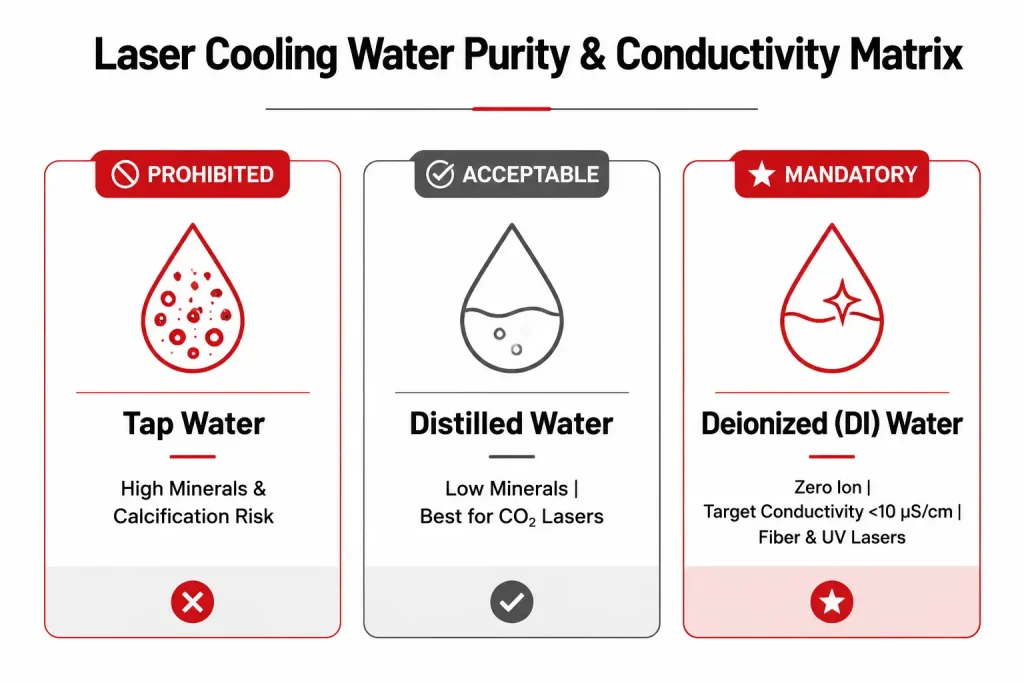
Not all water is suitable for high-energy laser cooling circuits. Selecting fluid media requires balancing purity, electrical resistance, and material compatibility.
Water Quality Specifications:
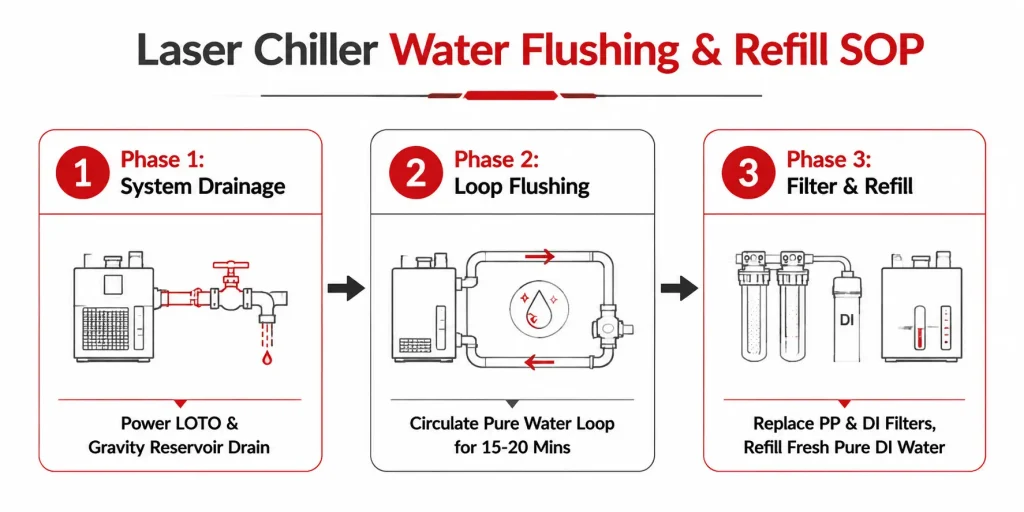
Execute this flushing protocol every 1 to 3 months to prevent bio-film accumulation and mineral settling.
Phase 1: System Drainage
Phase 2: System Flushing
Phase 3: Filter Replacement & Final Refill
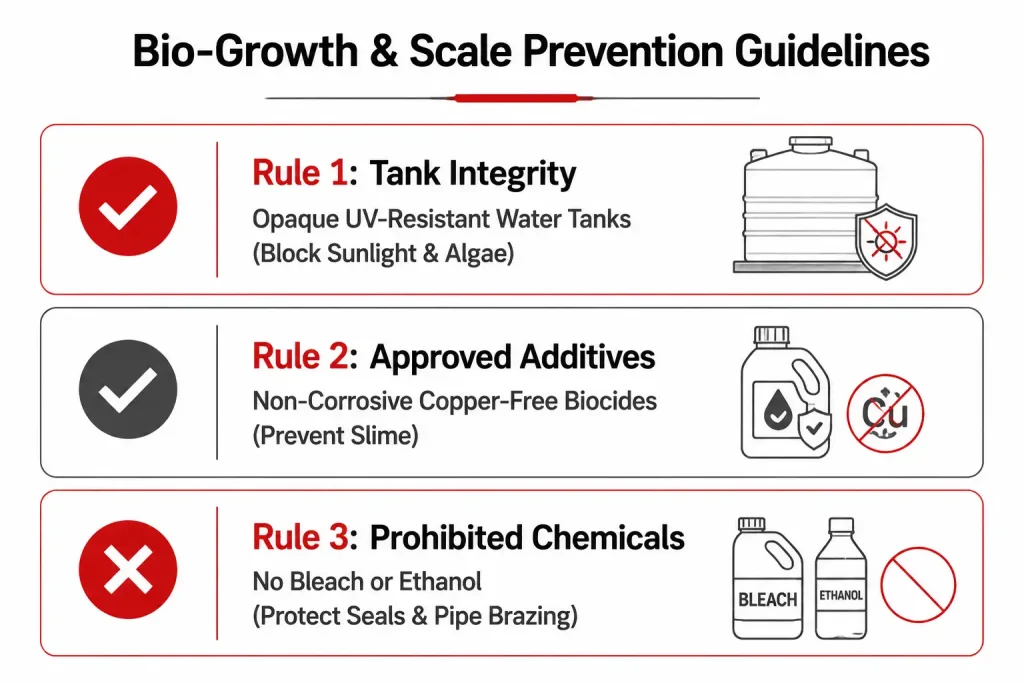
In warm environments, transparent water reservoirs exposed to sunlight foster rapid algae growth. Algae mats clog inline particle filters and trigger immediate low water flow alarms (see our laser chiller troubleshooting guide).
Bio-Control Guidelines:
Never use household bleach (sodium hypochlorite) or ethanol; these agents erode nitrile seals and corrode internal copper brazing.
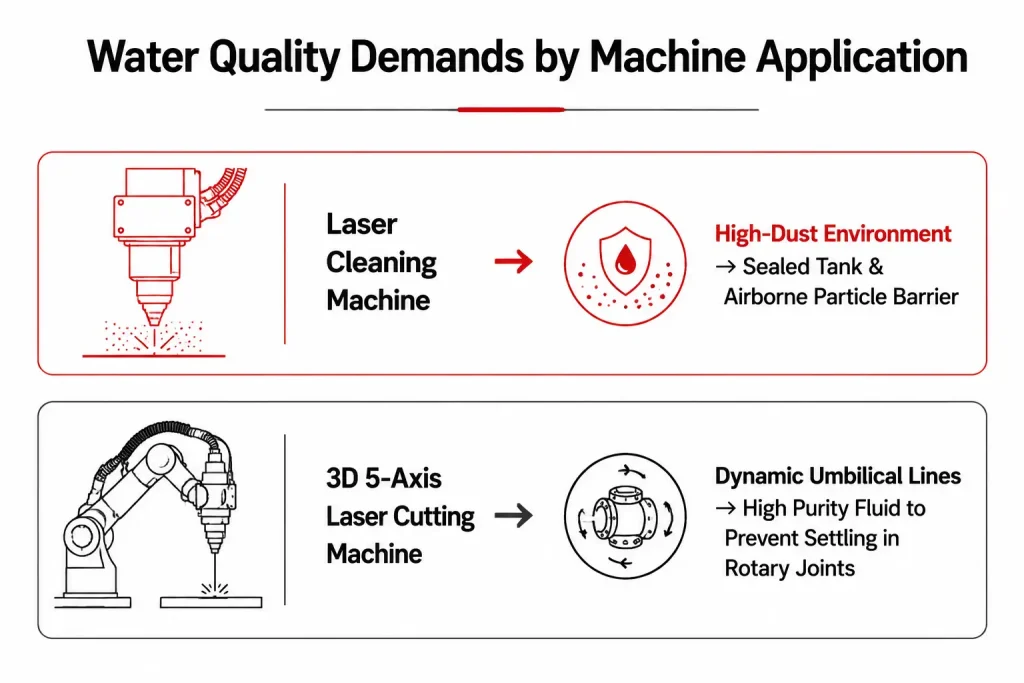
Water purity requirements scale directly with machine complexity and power density:
To help you better understand the technical aspects of this equipment, we’ve compiled answers to some of the most frequently asked questions, covering operation, maintenance, troubleshooting, and performance optimization.
Q1: Can I use 100% pure ultra-pure water (18 ) in any laser chiller?
No. Ultra-pure water (deionized to 18 ) is aggressively hungry for ions. If used in chillers with standard copper or aluminum piping, it will leach metals from the pipe walls (galvanic corrosion). Only use DI water within the 1–10 range specified by the chiller manufacturer.
Q2: How do I test my laser chiller water quality on the shop floor?
Use a handheld digital conductivity meter (TDS/EC meter). Dip the probe into the water reservoir weekly; if the reading exceeds 10 (for Fiber/UV) or 30 (for ), replace the DI resin filter or flush the water.
Q3: What causes coolant water to turn milky or cloudy?
Cloudy water indicates bacterial/microbial contamination or suspended particulate matter from decaying filter elements. The system must be shut down, flushed, and sanitized immediately.
Q4: Is distilled water better than deionized water for lasers?
Distilled water is often preferred for glass tube lasers because it is chemically neutral and less corrosive to brass/copper fittings while providing sufficient purity.
Q5: How does water scale cause the chiller pump to fail?
Scale flakes off pipe walls and accumulates at the pump impeller inlet. This restricts fluid flow, increases mechanical friction, causes pump overheating, and damages shaft seals.
For more practical guidance on laser equipment maintenance, troubleshooting, performance optimization, and failure prevention, explore the related technical resources below. These articles provide additional engineering insights to help you improve machine reliability, efficiency, and long-term performance.




English

French

German

Hindi

Italian

Japanese

Korean

Portuguese

Russian

Spanish
Tell us about your manufacturing challenges.
Our engineers will design a laser solution tailored to your exact requirements.