Seasonal Laser Cooling Protocols Summer Dew Point & Winter Anti-Freezing
-
August 20, 2026

-
5 min read

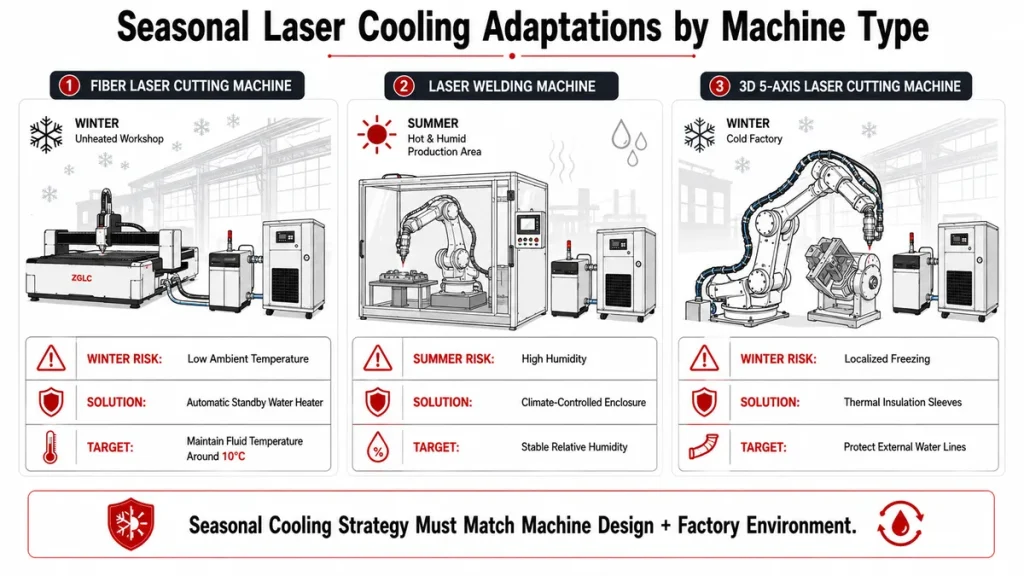
Seasonal environmental shifts create severe operational challenges for industrial thermal management. Summer brings high ambient humidity that risks optical condensation, while winter brings sub-zero temperatures that can freeze cooling lines.
Adapting your seasonal laser cooling care routines ensures uninterrupted performance and protects sensitive optical components year-round. This seasonal framework complements our master laser cooling system maintenance guide.
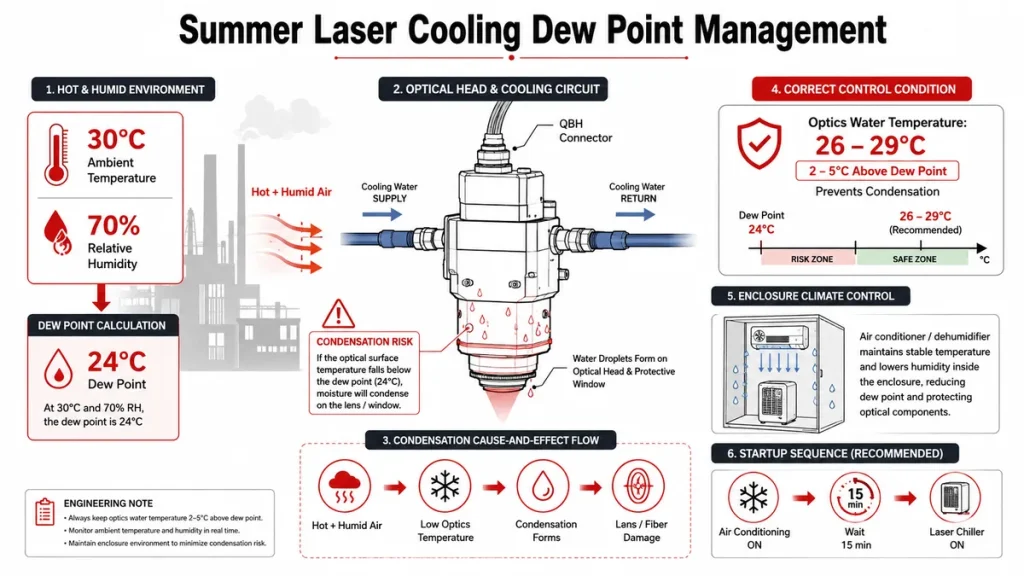
When cold coolant water flows through optical heads in a hot, humid factory, ambient moisture condenses on the outer surfaces of lenses and QBH connectors. Water droplets on optical surfaces refract the high-power laser beam, resulting in immediate lens burn-through and fiber coupler damage.
Dew Point Management Strategy:
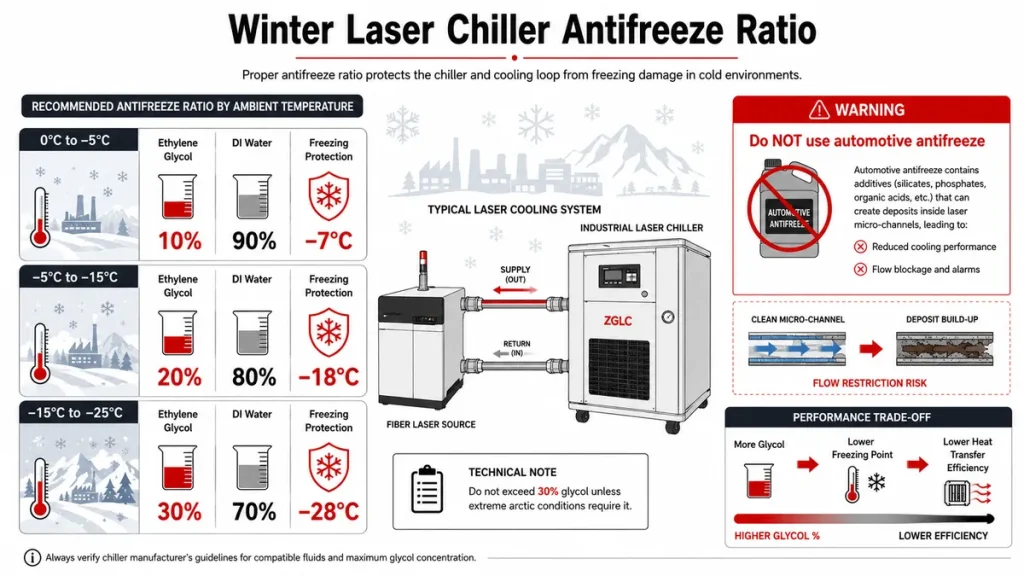
When factory temperatures drop below 0, water trapped inside cold plates, pumps, and laser cavities expands as it freezes, bursting metal pipes and glass tubes.
Selecting the Right Antifreeze:
Recommended Glycol-to-Water Mixing Ratios:
| Minimum Ambient Temperature | Ethylene Glycol Vol % | DI Water Vol % | Freezing Point Protection |
| 0 to −5 | 10% | 90% | −7 |
| −5 to −15 | 20% | 80% | −18 |
| −15 to −25 | 30% | 70% | −28 |
Note: Glycol reduces the thermal heat capacity of water. Do not exceed a 30% ratio unless operating in extreme arctic conditions.
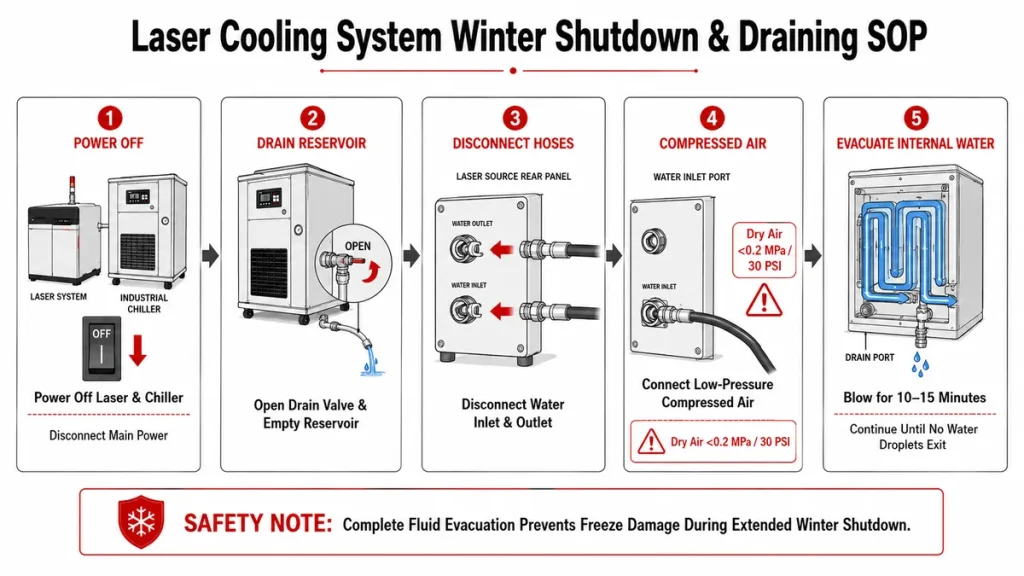
During winter holiday shutdowns (when heating systems are turned off), liquid coolants must be fully evacuated.
Compressed Air Evacuation Procedure:
To help you better understand the technical aspects of this equipment, we’ve compiled answers to some of the most frequently asked questions, covering operation, maintenance, troubleshooting, and performance optimization.
Q1: Can I keep antifreeze in my laser chiller all year round?
No. Glycol degrades over time, becoming acidic and lowering overall heat exchange capacity. Flush the system every spring with fresh pure water per our laser cooling water quality SOP.
Q2: What should I do if my factory loses heat overnight in winter?
Keep the chiller running 24/7 in winter mode. As long as the water pump circulates fluid continuously, water is much less likely to freeze in mild sub-zero conditions.
Q3: How do I know if condensation is forming inside my laser optical head?
Look for misting or tiny water droplets on the protective window glass or cabinet walls. If present, immediately turn off the chiller, increase optics temperature settings, and run a dehumidifier.
Q4: Why does adding glycol lower my chiller's cooling performance?
Glycol has a lower specific heat capacity and higher viscosity than pure water. Adding 20% glycol reduces thermal transfer efficiency by approximately 5–8%, requiring the compressor to work slightly longer.
Q5: Is Propylene Glycol safer than Ethylene Glycol for laser chillers?
Propylene Glycol is less toxic and environmentally safer, making it ideal for food/pharma packaging applications. However, Ethylene Glycol offers lower viscosity and better heat transfer efficiency at lower temperatures.
For more practical guidance on laser equipment maintenance, troubleshooting, performance optimization, and failure prevention, explore the related technical resources below. These articles provide additional engineering insights to help you improve machine reliability, efficiency, and long-term performance.




English

French

German

Hindi

Italian

Japanese

Korean

Portuguese

Russian

Spanish
Tell us about your manufacturing challenges.
Our engineers will design a laser solution tailored to your exact requirements.