What Is Laser Cutting? Process, Machine Types, Materials and Industrial Applications
-
August 3, 2026

-
27 min read

Laser cutting is one of the most widely used processes in modern manufacturing. It is used to produce sheet metal parts, tubes, structural profiles, automotive components, machinery parts, enclosures and many other products.
However, the term "laser cutting" can refer to several different technologies.
A flatbed fiber laser cutting machine, a tube laser cutter, a laser system and a five-axis laser cutting machine all use focused laser energy, but they are designed for different materials, workpiece geometries and production requirements.
Understanding these differences is important before selecting a cutting process or requesting a machine quotation.
This guide explains:
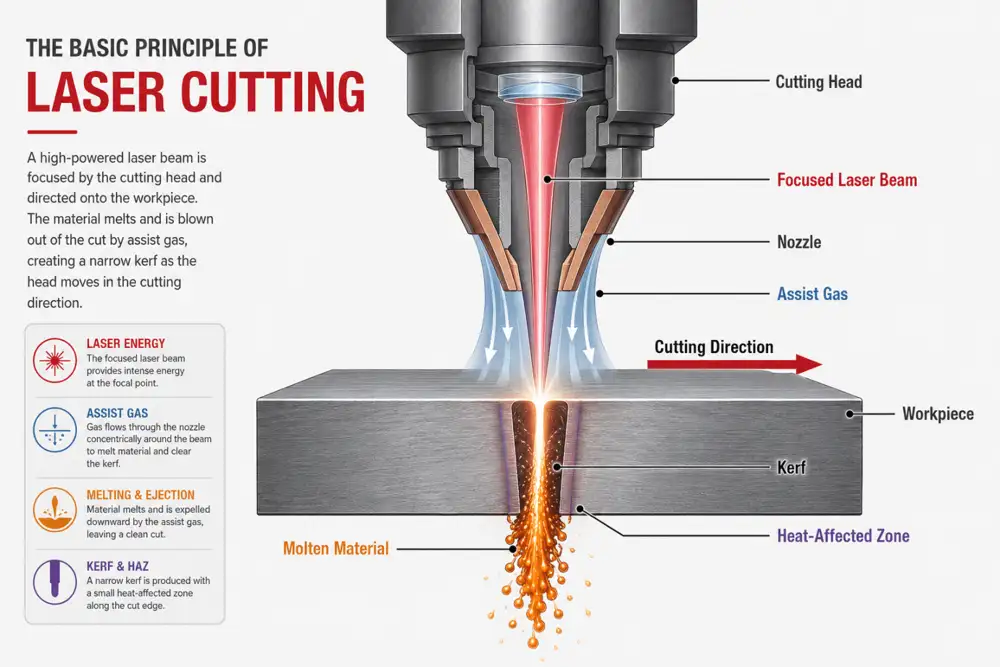
Laser cutting is a non-contact separation process that uses a concentrated beam of light to heat a selected area of material.
Depending on the material and process, the laser energy may:
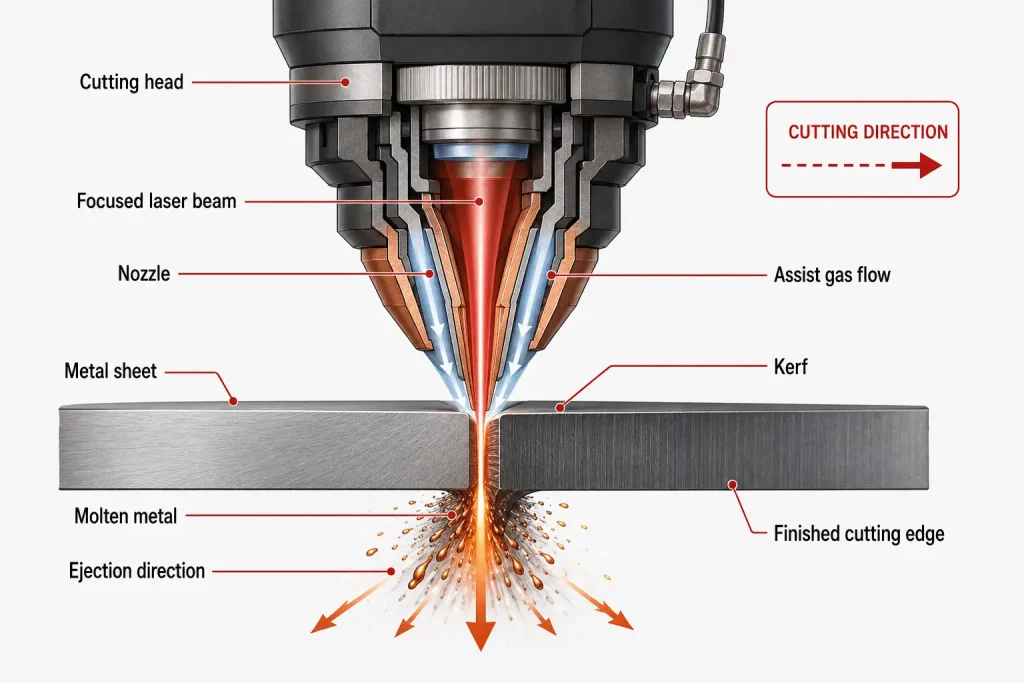
The focused beam follows a programmed cutting path. An assist gas is commonly directed through a nozzle to remove molten or vaporized material from the kerf.
The result is a separated part with a narrow cutting path and a geometry determined by the digital program.
Laser cutting is described as a non-contact process because the cutting tool does not mechanically press against the workpiece. However, it is still a thermal process, so heat input, material properties and cutting parameters can influence the final result. TRUMPF similarly defines laser cutting as a non-contact process in which a guided and focused beam heats the workpiece until the material melts or vaporizes.
The kerf is the width of material removed by the cutting process.
Kerf width is influenced by:
The CNC or CAM software may apply kerf compensation so that the finished part matches the required dimensions.
Normally, the laser beam does not physically contact the workpiece.
The cutting head remains above the surface while a height-control system maintains the required distance between the nozzle and the material.
This reduces mechanical cutting force and eliminates conventional cutting-tool wear, although the machine still contains consumable components such as:
Industrial laser cutting combines digital programming, laser generation, beam delivery, motion control and gas management.
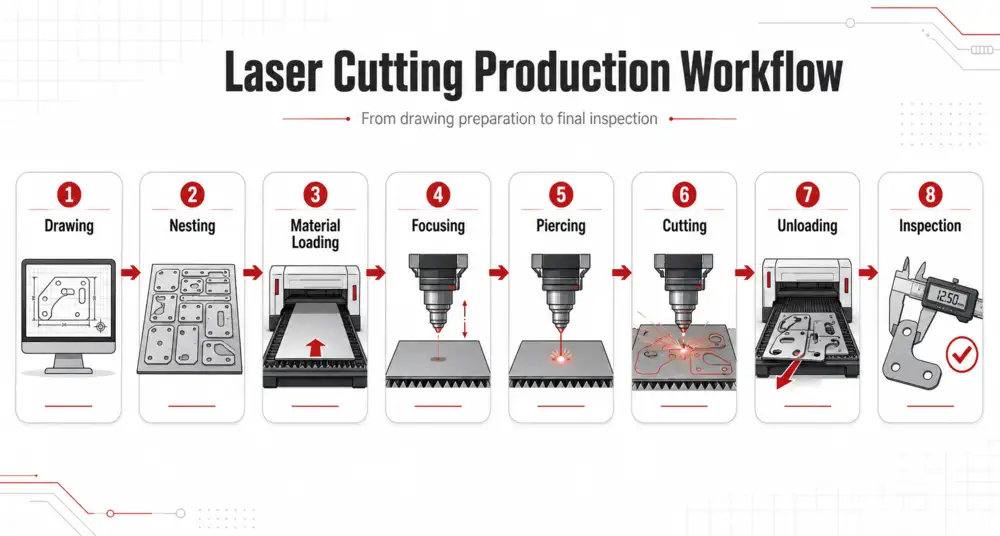
A typical production process follows these steps.
The part geometry is created or imported into CAD or CAM software.
Common file formats for two-dimensional cutting may include:
Three-dimensional cutting may require formats such as:
The exact supported formats depend on the control and programming software.
For sheet metal cutting, nesting software arranges parts on the sheet.
The objective may be to optimize:
For tubes or three-dimensional parts, the software also considers the workpiece coordinate system, clamping position and cutting-head orientation.
The material is placed on the cutting table or held in a fixture.
The workholding method depends on the machine:
| Machine | Typical Workholding |
|---|---|
| Flatbed laser | Slat cutting table |
| Tube laser | Rotating chucks and supports |
| Structural steel laser | Beam supports and positioning devices |
| Five-axis laser | Dedicated part fixture |
| Robotic laser | Fixture, positioner or workcell |
| CO₂ non-metal cutter | Honeycomb or knife-blade table |
Correct positioning is especially important for tubes, profiles and formed three-dimensional parts.
The laser source generates the beam.
Depending on the laser type, the beam may be delivered through:
The beam then enters the cutting head.
Lenses inside the cutting head focus the beam onto or near the workpiece surface.
Focusing the energy into a small area creates the power density required to melt, burn or vaporize the material.
The ideal focus position changes according to:
Before beginning a closed contour, the laser usually creates a starting hole.
Piercing may represent a significant portion of the cycle time when cutting:
Piercing parameters must therefore be evaluated separately from straight-line cutting speed.
The machine moves the cutting head, workpiece or both along the programmed path.
During this movement, the control system coordinates:
After cutting, the parts are unloaded and inspected.
Inspection may include:
The total production cycle includes more than laser-on time. Loading, positioning, piercing, table exchange, unloading and sorting can all influence real productivity.
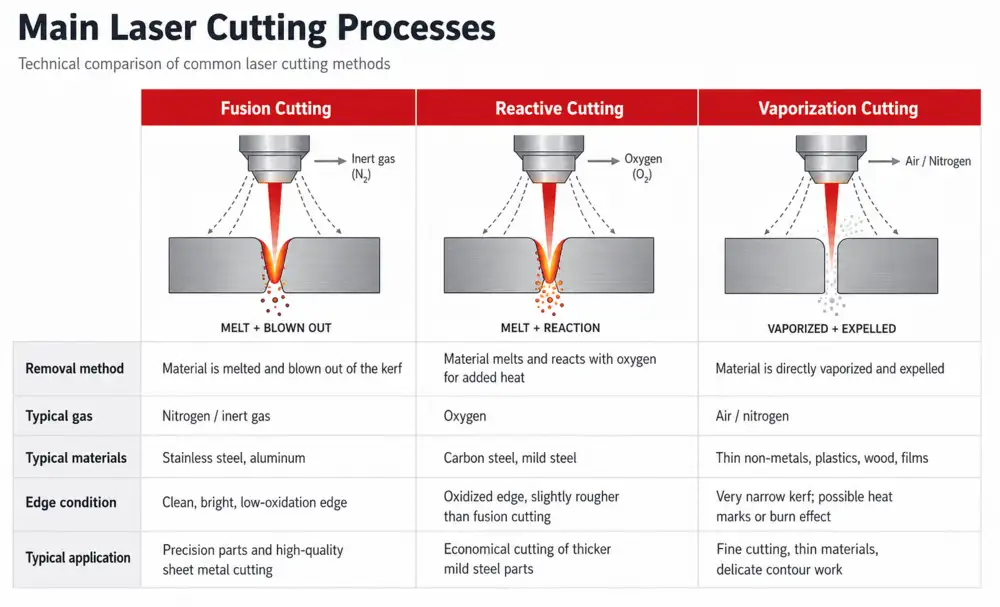
Laser cutting processes can be classified according to how material is removed.
The three primary methods are fusion cutting, reactive cutting and vaporization or sublimation cutting.
In fusion cutting, the laser melts the material.
A non-reactive or inert gas then blows the molten material out of the kerf.
Common gases include:
Because the gas does not intentionally create an oxidation reaction, fusion cutting can produce a low-oxidation or oxide-free edge under appropriate process conditions.
It is frequently used for:
TRUMPF describes fusion cutting as a process in which nitrogen or argon removes the molten material without chemically reacting with it.
Reactive cutting uses oxygen as the cutting gas.
The oxygen reacts with the heated metal, creating additional energy through oxidation. This reaction supports material removal.
Reactive cutting is commonly associated with carbon steel.
Potential benefits include:
The main trade-off is the oxidized cutting edge.
That oxide layer may need to be removed before:
TRUMPF identifies oxygen as the cutting gas used in flame cutting and explains that the metal melt burns and oxidizes in the kerf.
In vaporization or sublimation cutting, the laser removes material primarily through vaporization, with limited formation of a conventional molten zone.
This method may be used for:
The exact result depends heavily on laser wavelength, pulse duration, material absorption and thickness.
Sublimation cutting can provide high-quality edges in suitable applications, but it generally requires more energy to vaporize material than to melt it.
Laser ablation removes material from a surface, often in layers.
It is used in:
Ablation can be used to create through-cuts in thin or specialized materials, but it should not be confused with conventional continuous-wave sheet-metal cutting.
| Process | Main Removal Mechanism | Typical Application |
|---|---|---|
| Fusion cutting | Melting and gas ejection | Stainless steel, aluminum |
| Reactive cutting | Melting plus oxidation | Carbon steel |
| Vaporization cutting | Material vaporization | Thin and non-metal materials |
| Ablation | Controlled surface removal | Coatings, films, micro-features |
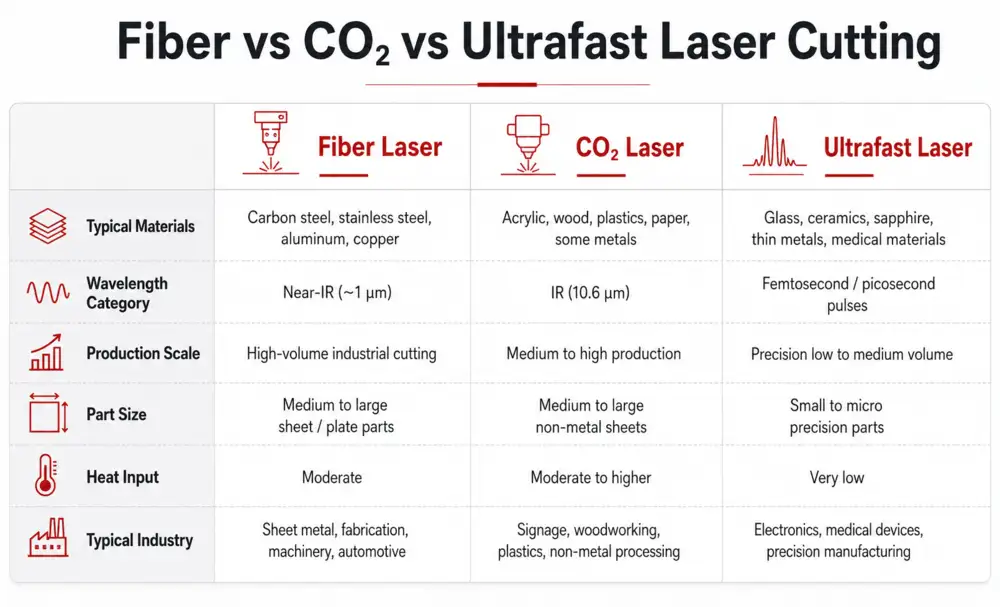
The type of laser source and the type of cutting machine are not the same thing.
For example:
A tube cutting machine may use a fiber laser source. A five-axis machine may also use a fiber or CO₂ source depending on the application.
Fiber lasers are widely used for industrial metal cutting.
The laser beam is generated and amplified in an optical-fiber-based system and delivered to the cutting head through fiber-optic components.
Typical applications include:
Fiber laser systems are commonly selected for metal production because they combine concentrated beam delivery, CNC integration and compatibility with modern automation.
However, final capability still depends on:
How to choose a fiber laser cutting machine
CO₂ lasers generate infrared light using a gas-based laser medium.
They remain useful for materials that absorb their wavelength effectively, including many:
CO₂ lasers can also cut metals when the machine and power level are designed for metal processing, although fiber lasers now dominate many general metal-cutting applications.
CO₂ technology should not be described as obsolete. It continues to serve applications where its wavelength and material interaction are advantageous. Access Laser, for example, continues to offer CO₂ systems for precision material processing, including glass and optical applications.
Specialized cutting systems may use:
These systems are typically selected for applications such as:
They should not be treated as direct substitutes for standard high-power sheet-metal cutting machines.
| Laser Type | Common Strength | Typical Application Area |
|---|---|---|
| Fiber laser | Industrial metal processing | Sheets, tubes, profiles, 3D metal parts |
| CO₂ laser | Strong compatibility with many non-metals | Acrylic, wood, textiles, paper |
| Ultrafast laser | Controlled micro-processing | Electronics, medical parts, glass, foils |
| Other solid-state lasers | Specialized processing | Application-dependent |
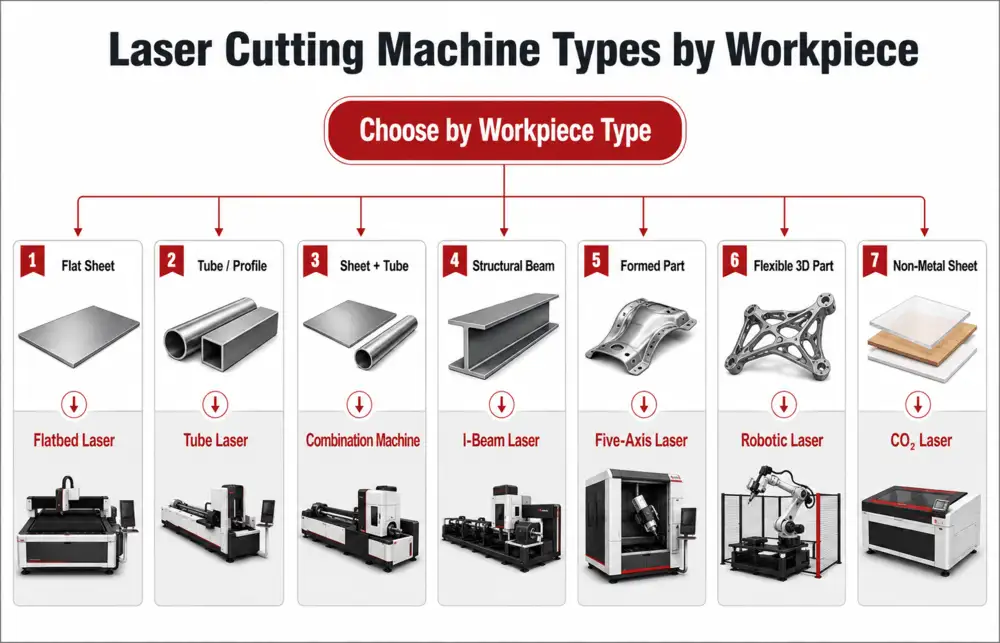
Laser cutting machines should also be classified by workpiece geometry and motion structure.
This classification is often more useful to equipment buyers than laser-source classification alone.
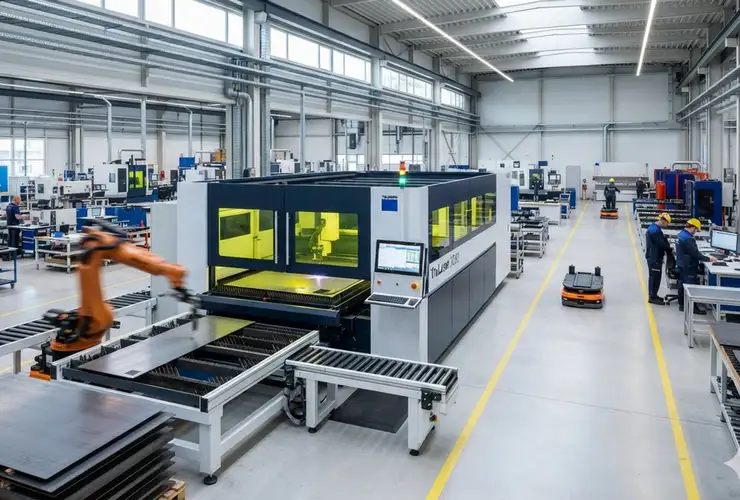
A flatbed laser cutting machine is designed mainly for two-dimensional sheet metal.
Typical workpieces include:
Important machine considerations include:
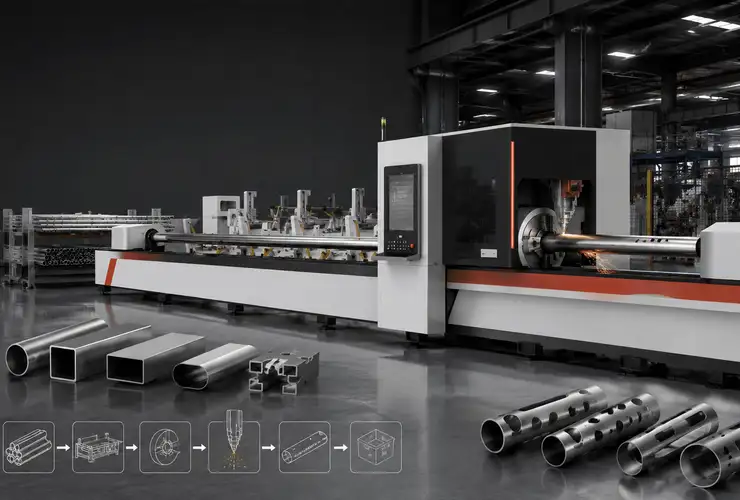
A tube laser cutting machine holds and rotates tubular material using chucks and support systems.
It may process:
Operations may include:
ZG Laser’s tube platform is currently presented for round, square, rectangular, oval and other profile shapes.
A tube-and-plate machine combines flat-sheet and tube-processing functions in one system.
It may be appropriate when:
However, a combination machine should still be evaluated against dedicated systems for:
Structural steel systems are designed for components such as:
Depending on the configuration, operations may include:
This type of system uses workholding, support and programming functions specifically designed for long, heavy structural components. ZG Laser currently separates this equipment from its standard sheet and tube platforms.
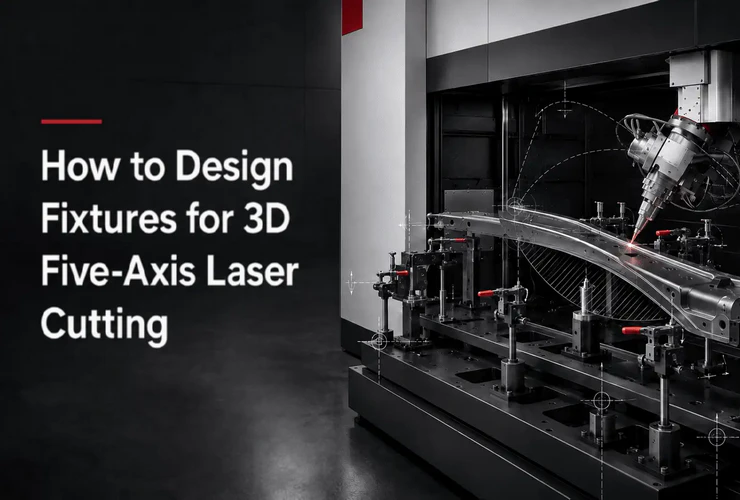
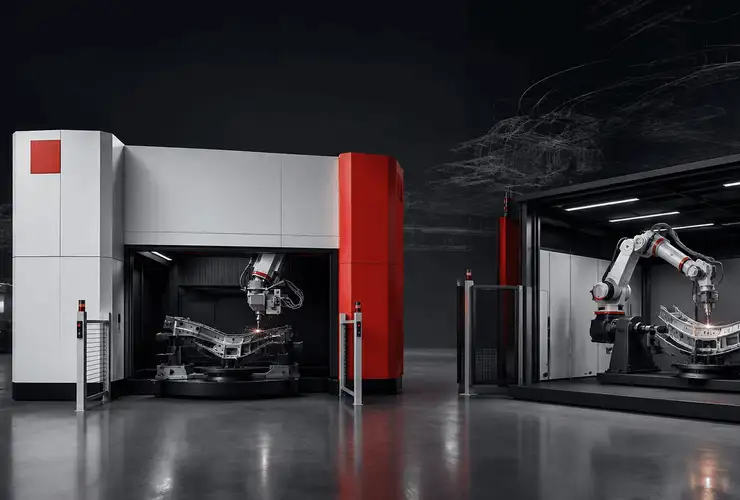
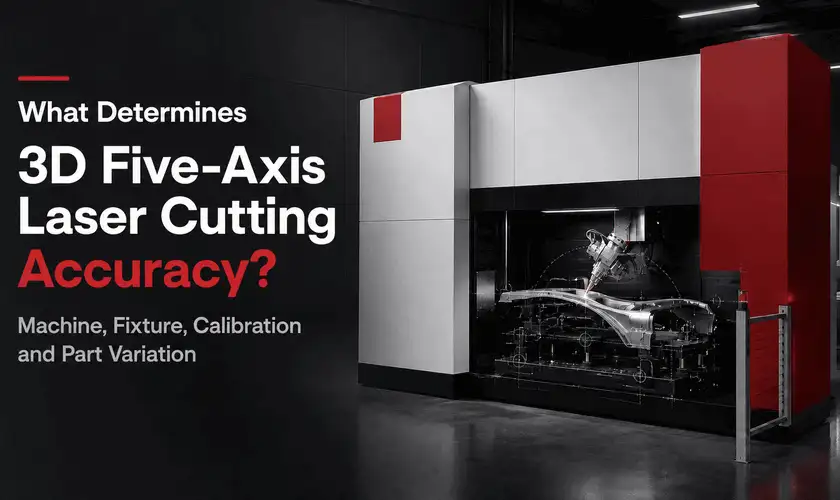
A five-axis laser cutting machine is used for formed, curved or three-dimensional components.
In addition to linear movement, the system controls the orientation of the cutting head through rotary axes.
Typical applications include:
Important factors include:
A robotic laser cutting system uses an industrial robot to move the cutting head or manipulate the workpiece.
It may be suitable for:
A robot offers flexibility, while a dedicated five-axis machine may provide a more controlled machine-tool structure for certain repeatable production applications.
The correct choice depends on:
ZG Laser describes its robotic platform as a multi-dimensional, multi-angle system for flexible 3D metal cutting.
| Workpiece Type | Typical Machine |
|---|---|
| Flat metal sheet | Flatbed fiber laser |
| Round or square tube | Tube laser |
| Sheets and tubes | Tube-and-plate system |
| I-beam or H-beam | Structural steel laser |
| Formed 3D component | Five-axis laser |
| Large or varied 3D part | Robotic laser |
| Acrylic, wood or textile | CO₂ laser system |
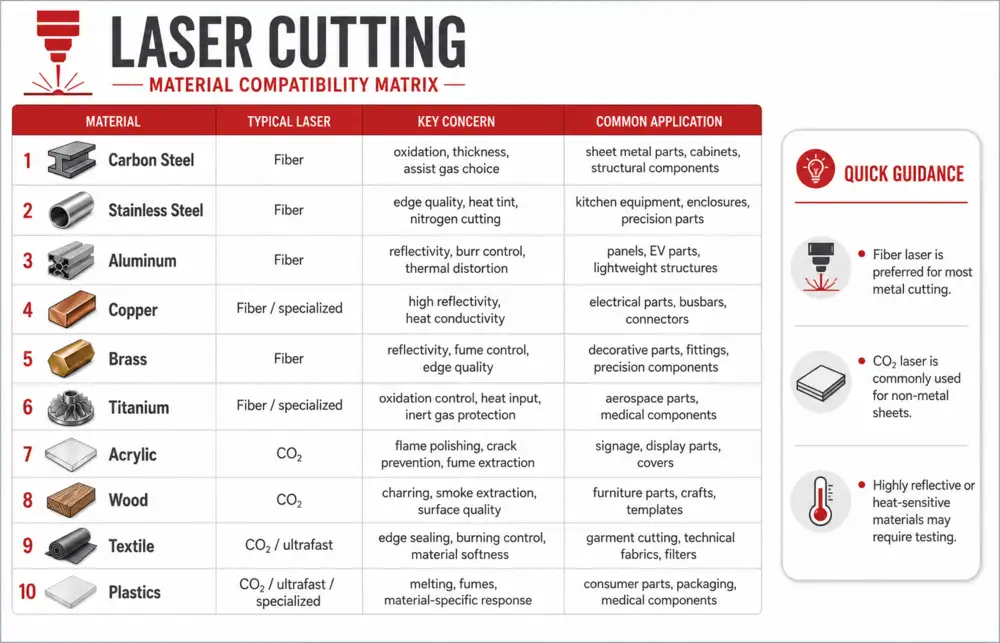
Many materials can be laser cut, but no single laser machine is suitable for every material.
Compatibility depends on:
Carbon steel is widely processed using industrial fiber laser systems.
Possible assist gases include:
The gas choice affects:
Stainless steel is commonly processed with nitrogen when a low-oxidation edge is required.
Compressed air may also be considered in suitable cost-sensitive applications, depending on thickness and quality requirements.
Aluminum can be cut with compatible fiber laser systems.
The process must account for:
Sample testing is important because different aluminum alloys may behave differently.
Copper and brass are reflective and thermally conductive materials.
Modern fiber systems may process them when equipped with suitable:
They should not be treated as identical to carbon steel during process selection.
Laser cutting can process galvanized and coated sheets, but the coating may influence:
The extraction system and process parameters must be suitable for the coating.
Titanium and selected high-value alloys require carefully controlled process conditions.
Considerations include:
Argon or other inert-gas arrangements may be required for selected applications.
CO₂ laser systems can produce polished-looking edges on suitable acrylic materials.
Results depend on:
Wood, plywood and selected engineered wood products can be laser cut with appropriate CO₂ systems.
Possible issues include:
CO₂ lasers are also used for:
The process can support complex contours without conventional dies, but fumes and fire risks must be controlled.
Some plastics can be laser cut, while others should not be processed.
Before cutting an unfamiliar plastic:
PVC and chlorinated plastics should not be laser cut because they can release hazardous and corrosive gases. MIT’s laser-cutter safety guidance specifically warns that PVC can produce hydrogen chloride gas, while OSHA requires suitable ventilation for hazardous fumes generated by laser cutting and related material interactions.
| Material | Common Laser Type | Key Consideration |
|---|---|---|
| Carbon steel | Fiber | Gas choice and oxidation |
| Stainless steel | Fiber | Clean edge and nitrogen cost |
| Aluminum | Fiber | Reflectivity and alloy |
| Copper and brass | Fiber | Back reflection and process stability |
| Titanium | Fiber or specialized | Inert atmosphere and metallurgy |
| Acrylic | CO₂ | Material type and edge finish |
| Wood | CO₂ | Smoke, charring and fire |
| Textile | CO₂ | Fume extraction and material composition |
| Paper and cardboard | CO₂ | Fire control |
| Plastics | CO₂ or specialized | Chemical safety and fumes |
Assist gas is directed through the cutting nozzle into the kerf.
Its functions may include:
The gas is not a minor accessory. It is a core process variable.
Oxygen is a reactive gas commonly used for carbon steel.
Its main characteristics include:
Nitrogen is an inert gas used when oxidation should be reduced.
It is commonly considered for:
Nitrogen often requires higher gas flow and pressure than oxygen processes, depending on the machine and application.
Bystronic notes that nitrogen is widely selected to prevent the oxidation that occurs when oxygen is used as an assist gas.
Compressed air contains nitrogen, oxygen and other atmospheric gases.
It may reduce purchased gas cost in suitable applications, but requires a properly specified system.
Evaluate:
An ordinary workshop compressor should not automatically be assumed suitable for laser cutting.
Argon may be used for selected reactive or high-value materials where an inert environment is required.
Its higher cost generally limits it to specialized applications.
| Assist Gas | Common Application | Main Trade-Off |
|---|---|---|
| Oxygen | Carbon steel | Oxidized edge |
| Nitrogen | Stainless and aluminum | Gas consumption and cost |
| Compressed air | Suitable cost-sensitive cutting | Edge quality and air-system requirements |
| Argon | Selected titanium and special alloys | Higher cost |
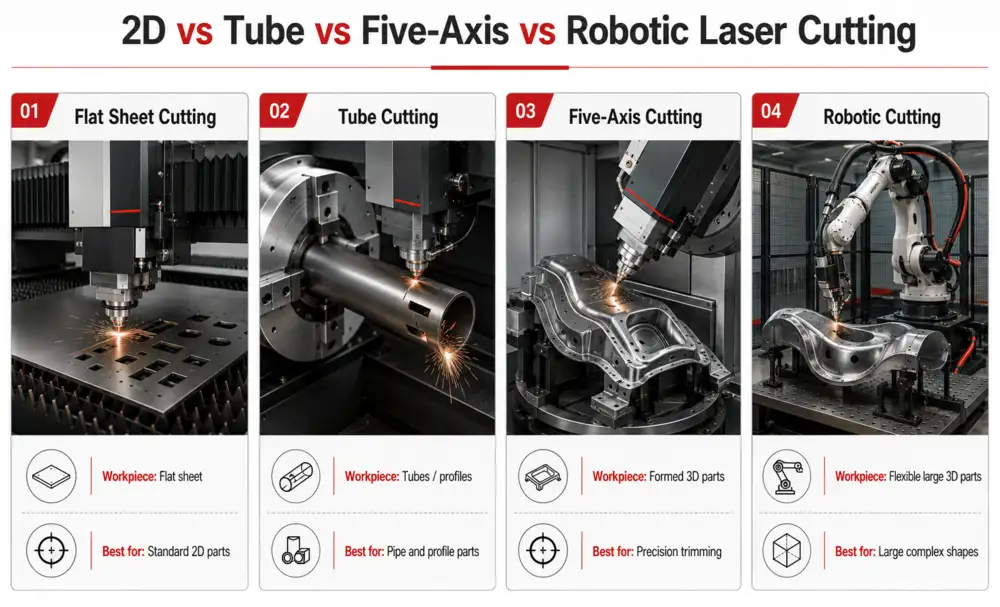
The difference is not only software. It affects the complete machine structure, motion system and workholding method.
Two-dimensional laser cutting processes contours primarily on a flat plane.
Typical machines include:
Typical workpieces include:
Tube cutting is not strictly the same as flat 2D cutting because the material rotates while the cutting head moves.
The machine coordinates:
The final cuts may appear around several faces of the profile.
Five-axis cutting is used when the cutting path lies on a curved or formed surface.
The system must control:
Typical parts include:
A robot provides a large flexible working envelope.
It may be selected where:
| Factor | 2D Flatbed | Tube Laser | Five-Axis Laser | Robot Laser |
|---|---|---|---|---|
| Workpiece | Flat sheet | Tube or profile | Formed 3D part | Varied 3D part |
| Workholding | Cutting table | Chucks | Dedicated fixture | Fixture or positioner |
| Programming | 2D nesting | Tube CAM | 3D offline programming | Robot programming |
| Motion | X/Y/Z | Linear plus rotation | Linear plus rotary axes | Multi-joint robot |
| Typical volume | Low to high | Low to high | Medium to mass production | Flexible production |
Laser cutting quality is not determined by laser power alone.
It results from the interaction between the machine, material, parameters, gas and programming.
The selected power must be appropriate for:
More power does not automatically improve every feature. Thin sheets and small contours may require careful power control.
If the speed is too high, possible results include:
If the speed is too low, possible results include:
Focus position affects the distribution of energy through the material thickness.
Incorrect focus may lead to:
The nozzle directs assist gas into the kerf.
A damaged, contaminated or misaligned nozzle can affect:
The distance between the nozzle and material should remain stable.
Material distortion, slag, incorrect calibration or height-sensor problems can disturb this distance.
Gas type, purity, pressure and flow affect:
Material factors include:
Two sheets sold under the same general material name may not produce identical cutting results.
Cutting quality may also be affected by:
| Defect | Possible Causes |
|---|---|
| Bottom dross | Speed, focus, gas flow or nozzle condition |
| Incomplete cut | Insufficient energy, excessive speed or gas problem |
| Burned corners | Excess heat during deceleration |
| Rough striations | Speed, focus, beam or gas mismatch |
| Oxidized edge | Oxygen exposure or gas selection |
| Taper | Focus, nozzle, beam alignment or thickness |
| Deformation | Heat input, material stress or poor support |
| Inconsistent dimensions | Calibration, material movement or fixture variation |
Troubleshooting should use recorded process data rather than changing several parameters at the same time.
The laser does not apply conventional cutting-tool force to the part.
This is useful for:
A new part can often be produced by changing the program rather than manufacturing a new hard tool.
This supports:
Laser cutting can produce:
The achievable feature size depends on material, thickness and machine capability.
A relatively narrow cutting path can improve:
A properly maintained and calibrated system can reproduce programmed geometries consistently.
Final repeatability still depends on:
Laser cutting can be integrated with:
Unlike punching, stamping or die cutting, many laser-cut components do not require dedicated physical cutting tools.
Fixtures may still be required for:
Laser cutting is versatile, but it is not the best process for every application.
An industrial system may require investment in:
Operating costs may include:
Laser cutting is a thermal process.
Possible effects include:
These effects can be minimized, but they should not be described as completely absent.
For some very thick materials, alternative processes may offer:
The comparison depends on material, required quality and production volume.
Copper, brass and aluminum may require:
Laser cutting may generate:
Suitable extraction and material review are essential. OSHA guidance identifies fumes and vapors from laser cutting as hazards that require adequate ventilation.
Combustible material, dust, hot slag and unattended operation can create fire risk.
The system may require:
Good results require knowledge of:
Buying a higher-power machine does not eliminate the need for process engineering.
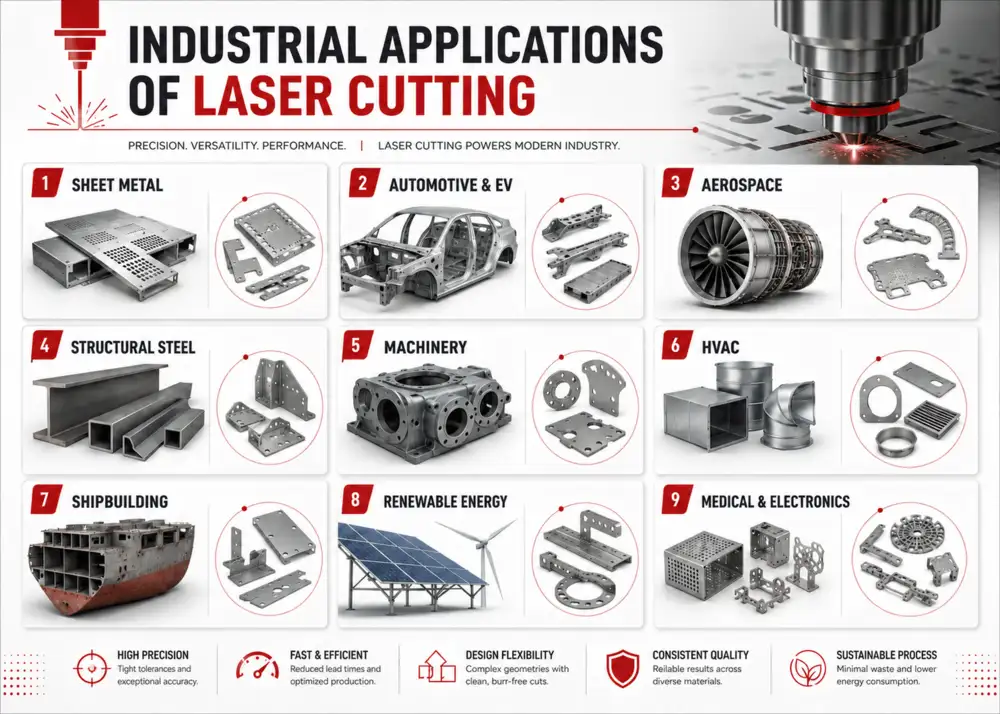
Laser cutting is widely used for:
It supports both one-off production and repeated batches.
Applications include:
Flatbed, tube and five-axis machines may all be used within the same automotive supply chain.
Laser cutting may be used for:
Aerospace applications may require strict control of:
Structural steel laser systems process:
Typical operations include cut-off, hole cutting, beveling and marking.
Tube lasers are used for products such as:
Applications include:
Typical parts include:
Laser cutting may be used for:
The correct process should be compared with plasma and oxy-fuel cutting for thicker materials.
Applications may include:
Specialized laser systems—not standard large-format sheet cutters—may be used for:
TRUMPF identifies fusion and sublimation cutting among the processes used for medical components such as metal stents and cannulas.
Laser cutting should be selected according to the production requirement, not because it is automatically superior in every situation.
Plasma cutting may be suitable for:
Laser cutting may offer advantages for:
Actual economics depend on thickness, power and edge-quality expectations.
Waterjet cutting uses a high-pressure water and abrasive stream.
Potential waterjet advantages include:
Potential laser advantages include:
Waterjet also involves abrasive consumption, water management and wet parts.
Punching may be efficient for:
Laser cutting may be more flexible when:
Combination punch-laser systems are also available for applications requiring both processes.
Sawing may be more economical for:
Laser cutting provides greater flexibility for:
Machining may provide:
Laser cutting is mainly a separation and contour-cutting process.
Many parts require both processes rather than one replacing the other.
Begin with the part, not the advertised machine power.
Is the part:
This determines the basic machine architecture.
List:
Record:
The most common workload should have the greatest influence on selection.
Specify:
Confirm:
Choose between:
Provide the supplier with:
Evaluate:
Compare more than purchase price.
Include:
How to evaluate an industrial laser cutting machine
| Requirement | Starting Direction |
|---|---|
| Flat metal sheets | Flatbed fiber laser |
| Tubes and profiles | Tube laser |
| Both sheets and tubes | Combination system |
| Long structural beams | Structural steel laser |
| Formed automotive parts | Five-axis laser |
| Varied large 3D parts | Robotic laser |
| Acrylic and wood | CO₂ laser |
| Micro-features | Specialized ultrafast laser |
Laser cutting is a digitally controlled, non-contact process that uses focused laser energy to separate materials.
However, “laser cutting” is not one single technology.
The correct process depends on:
Fiber laser systems are widely used for industrial metal cutting. CO₂ systems remain important for many non-metal materials and specialized processes. Flatbed, tube, structural-steel, five-axis and robotic systems each solve different manufacturing problems.
The best way to evaluate a project is to begin with the actual part.
Prepare the drawing, material, thickness, tolerance and production requirements, and then test the process under representative conditions.
ZG Laser provides cutting solutions for:
Send us:
Our application team will evaluate the project and recommend a suitable machine architecture and configuration.
Q1: What is laser cutting in simple terms?
Laser cutting uses a focused beam of light to melt, burn or vaporize material along a programmed path. Assist gas commonly removes the processed material from the cutting kerf.
Q2: Is laser cutting a contact process?
No. The cutting head normally remains above the material, so the beam does not apply mechanical cutting force to the workpiece.
Q3: What is the most common laser for metal cutting?
Fiber lasers are widely used for industrial metal cutting, including carbon steel, stainless steel, aluminum, copper and brass. The final capability depends on the complete machine configuration and process.
Q4: Can a laser cutter cut any material?
No. Material compatibility depends on wavelength, composition, thickness, fumes, fire risk and required quality. Some materials, particularly PVC and chlorinated plastics, should not be laser cut.
Q5: What is the difference between fiber and CO₂ laser cutting?
Fiber lasers are commonly used for industrial metals. CO₂ lasers remain widely used for acrylic, wood, textiles, paper and other non-metal materials. Machine configuration and power must still match the application.
Q6: What is the purpose of assist gas?
Assist gas removes molten material from the kerf and influences oxidation, edge appearance, cutting speed and process stability. Common gases include oxygen, nitrogen, compressed air and argon.
Q7: What is the difference between 2D and five-axis laser cutting?
A 2D machine processes primarily flat contours. A five-axis machine changes both the position and angle of the cutting head to process curved or formed three-dimensional parts.
Q8: Does laser cutting create a heat-affected zone?
Yes. Laser cutting is a thermal process. The size and effect of the heat-affected area depend on material, thickness, power, speed, focus and gas.
Q9: Is laser cutting better than plasma cutting?
Not in every application. Laser cutting is often preferred for detail, narrow kerf and fine contours, while plasma may be more economical for some thick conductive-metal applications.
Q10: What information is needed for a laser cutting machine quotation?
Provide the supplier with drawings, material, thickness, part dimensions, tolerance, production volume, cycle-time target, automation requirements and factory conditions.

English

French

German

Hindi

Italian

Japanese

Korean

Portuguese

Russian

Spanish
Tell us about your manufacturing challenges.
Our engineers will design a laser solution tailored to your exact requirements.