How to Choose a Fiber Laser Cutting Machine: Power, Table Size, Configuration and Cost
-
July 27, 2026

-
20 min read

Choosing a fiber laser cutting machine can be difficult because machines with similar table sizes and laser power may deliver very different results in real production.
A quotation may highlight laser power, maximum cutting thickness and machine speed. However, these specifications do not fully explain whether the system can process your typical materials efficiently, maintain stable cutting quality, fit your factory or support future production growth.
The right fiber laser cutting machine should be selected according to:
Modern fiber laser systems are also differentiated by beam control, motion performance, process software and automation—not only nominal laser power.
This guide explains how to evaluate these factors before requesting a quotation or placing an order.
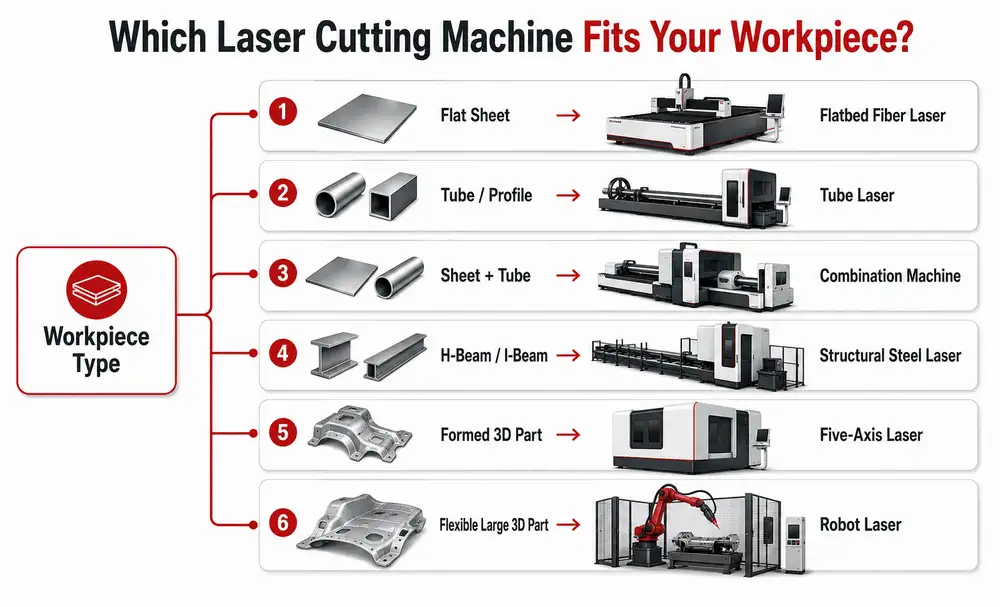
Before choosing power or table size, confirm that a flatbed fiber laser cutting machine is appropriate for the workpiece.
A standard flatbed fiber laser is mainly designed for two-dimensional sheet metal cutting.
Typical applications include:
However, not every metal part should be processed on a flatbed machine.
| Workpiece | More Suitable Machine |
|---|---|
| Flat metal sheets | Flatbed fiber laser cutting machine |
| Round, square or rectangular tubes | Tube laser cutting machine |
| Both sheets and tubes | Tube-and-plate laser cutting machine |
| H-beams and I-beams | Structural steel laser cutting machine |
| Formed or curved 3D parts | 3D five-axis laser cutting machine |
| Large, varied three-dimensional parts | Robotic laser cutting system |
A flatbed machine may technically cut a short tube after additional positioning, but it will not provide the productivity, clamping or programming functions of a professional tube cutting system.
Likewise, a standard three-axis flatbed cannot replace a five-axis machine for trimming hot-formed automotive parts or other complex three-dimensional components.
The machine should be selected around the parts that represent most of your production—not around the thickest sample you may occasionally receive.
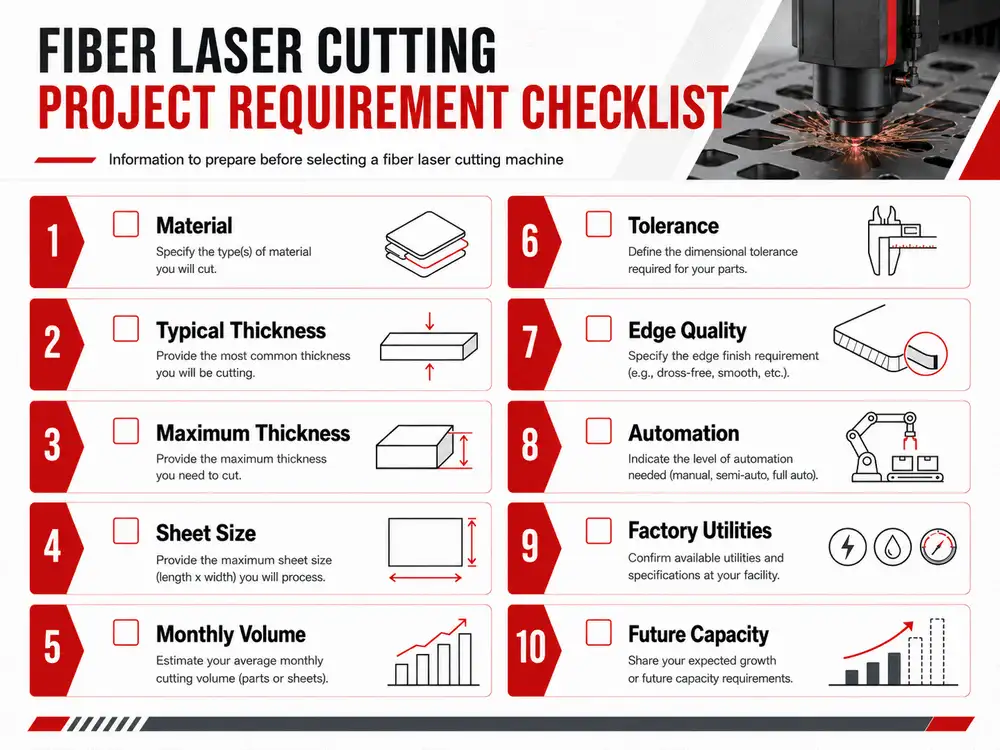
Before contacting a supplier, collect the following information.
List all materials that will be processed:
Different materials respond differently to laser energy and assist gas. The machine configuration and cutting process should therefore be evaluated against your real material mix.
Record three thickness values:
The most frequently processed thickness should have the greatest influence on machine selection.
For example, a factory that cuts thin stainless steel every day but occasionally processes a much thicker carbon steel plate should not select the complete system only around that rare maximum thickness.
Confirm:
Estimate:
A machine for low-volume, high-mix production may require different software and setup functions from a machine dedicated to continuous high-volume cutting.
Define:
Without this information, suppliers may recommend different configurations based on different assumptions, making quotations difficult to compare.
The machine working area should match standard raw material dimensions and actual production needs.
Common flatbed formats include:
The largest table is not automatically the best choice.
Confirm:
A 6000 × 2000 mm machine requires substantially more factory space than the cutting area alone suggests. The buyer must account for the machine enclosure, electrical cabinet, chiller, dust collector, gas system, loading area and service access.
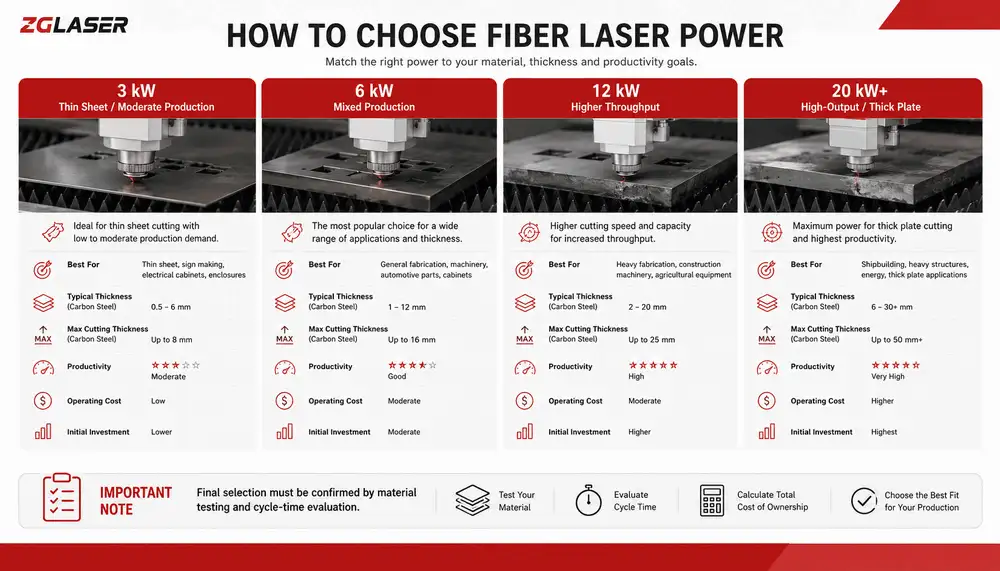
Laser power affects cutting speed, process capability and equipment cost, but it should not be selected in isolation.
The correct power level depends on:
A higher-power laser may cut certain materials faster, but the final productivity gain also depends on acceleration, piercing, part layout, table exchange, loading and unloading.
Manufacturers increasingly use beam-control technologies and optimized process modes to improve performance across different thicknesses, demonstrating that nominal power alone does not determine cutting speed or edge quality.
The following table is a starting point—not a universal cutting-capacity chart.
| Power Category | Typical Selection Logic |
|---|---|
| Around 3 kW | Thin-sheet production, moderate volumes and controlled investment |
| Around 6 kW | Mixed thin-to-medium sheet production and higher daily output |
| Around 12 kW | Higher throughput, broader thickness range and more demanding production |
| 20 kW and above | High-output production, thicker plate applications and operations where cycle-time reduction justifies the investment |
Actual cutting capability varies by material, source, cutting head, beam quality, gas, nozzle, focus position and acceptable edge standard.
A supplier may state that a machine can cut a certain maximum thickness, but that does not necessarily mean it can process that thickness efficiently in continuous production.
Ask:
Higher power may reduce cutting time, but it can also increase:
The correct comparison is not simply:
Price per kilowatt
A more useful comparison is:
Cost per acceptable finished part
This considers productivity, labor, gas, consumables, scrap and secondary processing.
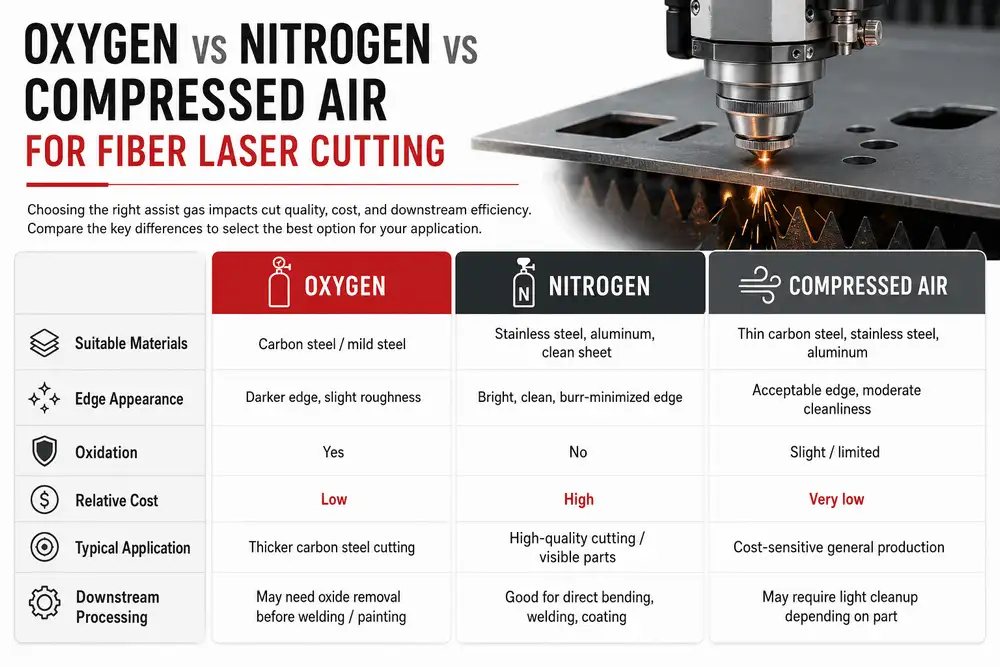
Assist gas affects cutting quality, speed, edge appearance and operating cost.
The three common choices are oxygen, nitrogen and compressed air.
| Assist Gas | Common Use | Main Consideration |
|---|---|---|
| Oxygen | Carbon steel cutting | Supports cutting reaction but creates an oxidized edge |
| Nitrogen | Stainless steel, aluminum and oxide-free cutting | Cleaner edge but may involve higher gas consumption and cost |
| Compressed air | Cost-sensitive production on suitable materials and thicknesses | Lower gas cost, but quality and capability must be tested |
Oxygen is commonly considered for carbon steel because the oxidation reaction supports the cutting process.
However, the finished edge contains an oxide layer. This may affect:
The buyer should determine whether oxide removal is required downstream.
Nitrogen is often selected when a cleaner, non-oxidized edge is required.
It may be preferred for:
Nitrogen consumption and supply method should be evaluated before purchase.
Possible supply options include:
Compressed air can reduce gas cost in suitable applications, but the actual result depends on:
Do not assume that an existing factory compressor can automatically support laser cutting. The supplier should confirm required pressure, flow and air quality.
Ask the supplier to provide estimated gas consumption for your typical:
Gas cost can significantly influence the total cost per part, especially in continuous nitrogen cutting.
Machine enclosure affects safety, smoke control, access and investment.
An open machine may provide:
However, the buyer must carefully evaluate:
A fully enclosed machine can provide:
Evaluate:
Do not assume that an enclosure alone makes the complete system compliant. The final installation, operating procedures, extraction and safety assessment must also be considered.
The table configuration affects loading time, productivity and machine footprint.
A single-table machine may be suitable for:
The laser must normally wait while the operator unloads parts and loads the next sheet.
An exchange-table system allows one table to be loaded or unloaded while the other is used for cutting.
Potential benefits include:
However, an exchange table does not automatically increase output if:
Evaluate total production flow rather than the table exchange time alone.
Machine quality should not be judged only by weight or visual appearance.
The structure must support:
Ask:
A heavier bed is not automatically superior. Structural design, manufacturing accuracy, thermal management and dynamic behavior must be evaluated together.
Evaluate:
A lightweight beam may support fast motion, while inadequate rigidity may affect dynamic performance. The correct balance depends on the complete machine design.
Possible components include:
Instead of focusing only on component brands, ask how the system is:
Positioning accuracy describes machine movement.
Final cutting accuracy is also influenced by:
Always confirm performance through actual cutting samples.
A fiber laser cutting machine is an integrated system.
The laser source, cutting head, motion control and process software must work together.
Confirm:
Do not select a source only by brand recognition. Service availability and integration with the complete system are equally important.
Evaluate:
Ask the supplier to demonstrate:
The control system should be appropriate for the operators and production workflow.
Evaluate:
Nesting software can influence:
Confirm whether the quotation includes:
Automation should be selected according to production volume, labor availability, part mix and factory layout.
Possible automation options include:
Automation can reduce manual handling and keep the cutting system operating for longer periods, but only when upstream material supply and downstream part handling are properly planned. Official industrial systems commonly pair fiber lasers with loading, unloading and storage equipment specifically to reduce idle time and support continuous production.
Even when full automation is not purchased initially, ask whether the machine includes:
Adding automation later may be difficult if the original machine and workshop layout were not designed for expansion.
A machine can only perform correctly when the factory is properly prepared.
Before placing an order, confirm:
Allow room for:
Confirm:
Request a factory preparation document before shipment—not after the machine arrives.
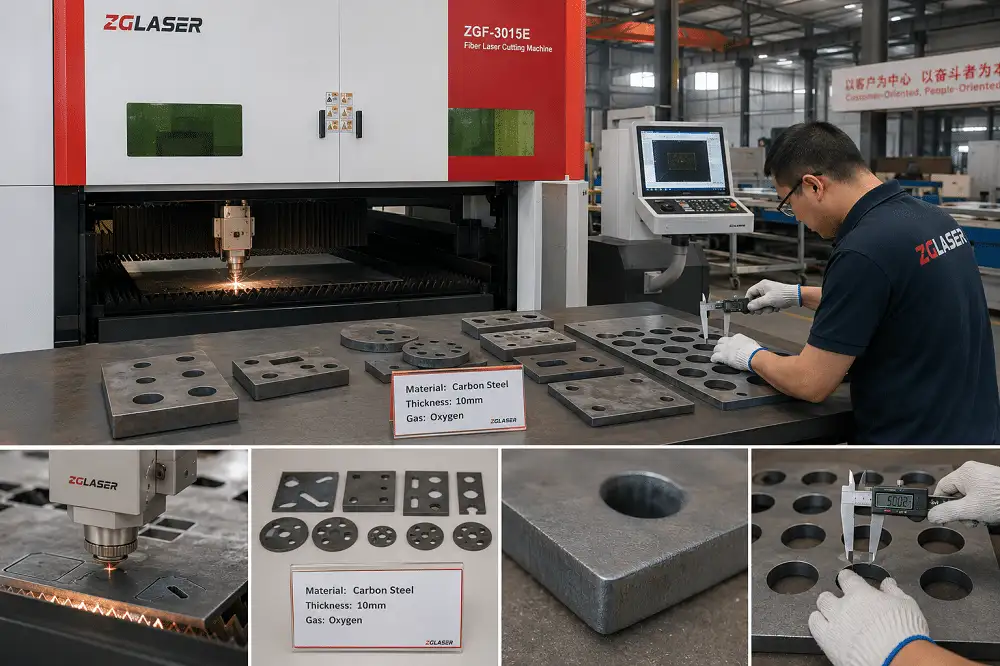
Sample testing is one of the most reliable ways to compare machines.
The test should use:
Ask the supplier to document:
Measure:
One successful sample does not prove production stability.
Where practical, ask the supplier to cut multiple identical parts and compare:
When evaluating several suppliers, use the same:
Otherwise, the results will not be directly comparable.
Send us your drawing, material, thickness and production requirements. The ZG Laser application team will evaluate the project and recommend a suitable configuration.
A low purchase price does not always mean a low production cost.
Evaluate:
A useful comparison is:
Cost per finished part = Total production cost ÷ Number of acceptable parts produced
This gives a more realistic picture than comparing only:
A fiber laser cutting machine requires technical support throughout its service life.
Before ordering, ask:
Ask for a written service scope.
General claims such as "24-hour support" are not enough unless the supplier explains:
Before shipment, conduct a factory acceptance test where practical.
The checklist should cover:
Agree on acceptance criteria before manufacturing or shipment.
The following matrix provides a preliminary selection direction.
| Production Profile | Suggested Starting Configuration |
|---|---|
| Small metal fabrication shop | Compact or economical flatbed, controlled power level, single or exchange table depending on volume |
| High-mix job shop | Flexible software, broad material database, exchange table and fast setup |
| High-volume thin sheet | Higher acceleration, fast piercing, exchange table and automatic loading |
| Mixed thin and medium sheet | Balanced laser power, autofocus head, reliable process database |
| Thick plate production | Higher power, heavy loading capacity, strong extraction and suitable gas supply |
| Stainless steel products | Nitrogen cutting capability, clean-edge focus and suitable gas infrastructure |
| Large-format sheet processing | Large table, high load capacity, automation and sufficient factory access |
| Multi-shift production | Enclosed system, exchange table, automation, remote monitoring and spare-parts planning |
This table should be used only as a starting point. Final configuration should be confirmed through drawings, material data and sample testing.
Before comparing quotations, ask each supplier the same questions:
A professional supplier should be able to explain the reasons behind the recommended configuration instead of offering only a model number and price.
Before placing an order, confirm:
The best fiber laser cutting machine is not necessarily the machine with the highest laser power or lowest purchase price.
It is the machine that can repeatedly process your typical materials at the required quality, output and operating cost while fitting your factory and future production plan.
ZG Laser provides fiber laser cutting systems for flat sheets, tubes, structural profiles and complex three-dimensional parts.
To receive a suitable machine recommendation, send us:
Our application team will review your requirements and recommend an appropriate machine type, power level, working area and system configuration.
The correct power depends on the material, typical thickness, required speed, edge quality, assist gas and daily production volume. Select power around the materials processed most frequently rather than only the maximum thickness.
No. Higher power may increase productivity in suitable applications, but it also increases investment and infrastructure requirements. Motion performance, cutting head, beam control, software, loading and gas supply also affect final output.
Choose a working area that matches standard purchased sheet dimensions and the largest frequently processed part. Also consider maximum table load, factory footprint, loading access and future automation.
A single table may be sufficient for low-volume production. An exchange table is generally more suitable when reducing loading and unloading delays is important. The value depends on the complete production cycle.
Compressed air can be suitable for certain materials, thicknesses and quality requirements, but the result must be tested. Compressor pressure, airflow, moisture and oil filtration must meet the cutting system requirements.
Yes. Sample testing with your actual material and drawings helps verify cutting quality, cycle time, dimensional accuracy and process stability.
Provide material, thickness, sheet size, drawings, required tolerance, production volume, target cycle time, automation requirements, factory utilities and destination information.
Maximum thickness may represent the machine's ability to separate the material under specific conditions. Production cutting thickness should provide acceptable speed, edge quality and repeatability for regular operation.
To further optimize your laser cutting operations and deepen your engineering knowledge, explore these related technical resources or fiber laser cutting machines:




English

French

German

Hindi

Italian

Japanese

Korean

Portuguese

Russian

Spanish
Tell us about your manufacturing challenges.
Our engineers will design a laser solution tailored to your exact requirements.