Five-Axis Laser Cutting vs Robotic Laser Cutting: Which System Fits Your 3D Parts?
-
August 26, 2026

-
21 min read

When a metal component cannot be processed on a conventional flatbed laser cutter, manufacturers often face two possible solutions:
Both can move the laser cutting head around complex three-dimensional parts.
Both can process curved surfaces, formed components, holes, contours and multi-angle features.
And both can be integrated into automated manufacturing cells.
However, they achieve this motion in fundamentally different ways.
A five-axis laser machine uses a machine-tool-style motion platform with coordinated linear and rotary axes. A robotic system typically uses a six-axis articulated industrial robot carrying the laser cutting head.
That difference influences:
There is therefore no universal answer to the question:
“Is a five-axis laser cutter better than a robot?”
The correct question is:
Which motion platform is better suited to the geometry, tolerance, volume and production strategy of my parts?
Dedicated five-axis systems are widely used for formed automotive components and other repeatable 3D cutting applications, while industrial robots provide a highly flexible multi-axis platform for laser cutting, welding and other processes. TRUMPF, KUKA and FANUC all currently offer or support 3D laser processing through these different machine architectures.
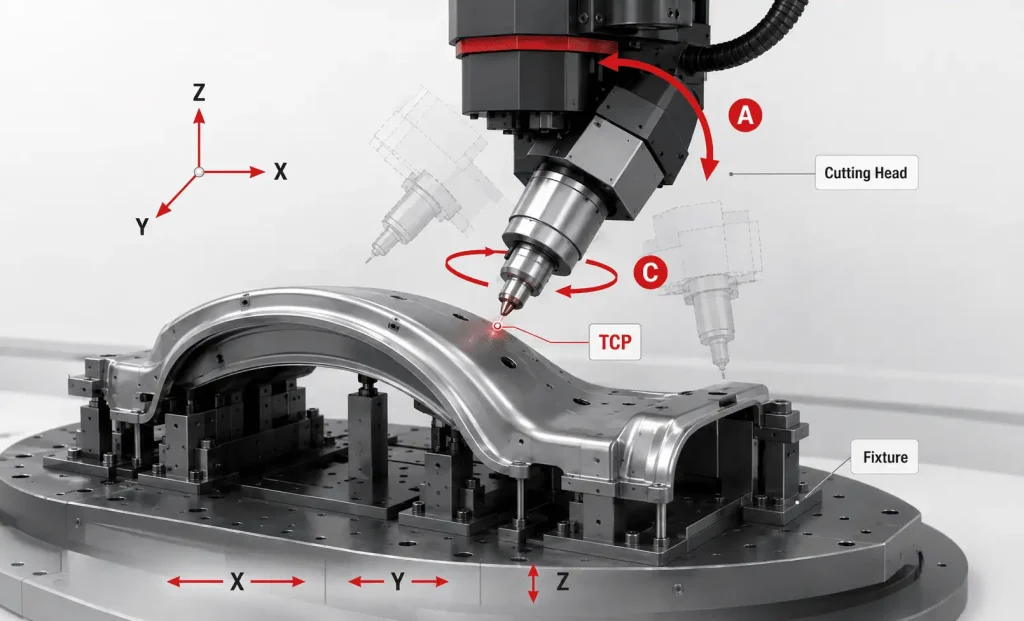
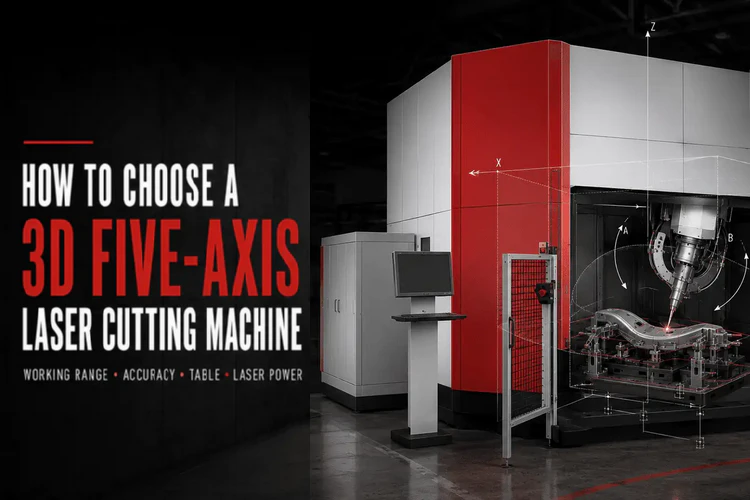
A dedicated five-axis laser cutting machine is designed specifically for processing three-dimensional workpieces.
Instead of moving only over a flat X-Y plane, it coordinates several motion axes so that the cutting head can approach the workpiece from different directions.
A typical configuration includes:
The exact axis naming and mechanical arrangement varies between manufacturers.
The purpose is the same:
control both the position and orientation of the laser cutting head relative to the 3D workpiece.
This allows the system to perform:
ZG Laser’s five-axis range is currently positioned for formed, curved and irregular metal parts and supports trimming, hole cutting, bevel cutting and multi-angle contour processing.
Typical parts include:
Dedicated hot-forming laser machines from established manufacturers such as TRUMPF are similarly designed around parts including B-pillars and crossmembers.
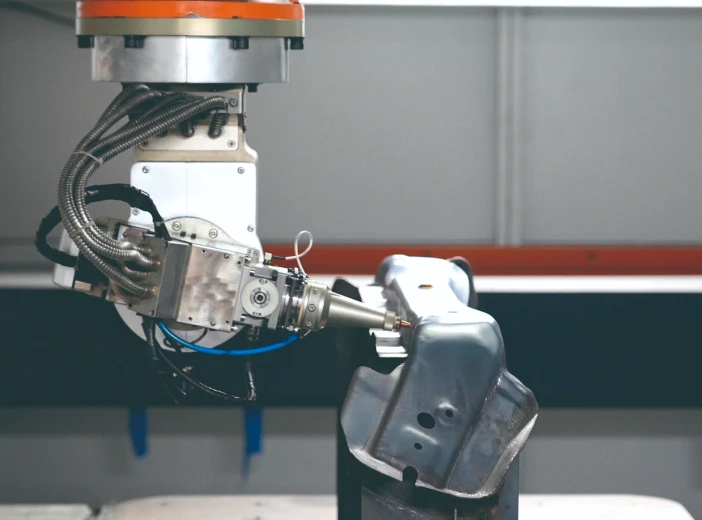
A robotic laser cutting system normally uses a multi-joint industrial robot to position the cutting head.
A typical industrial robot has six axes of motion.
Instead of moving along the linear guideways of a conventional machine tool, the robot combines several rotating joints:
The resulting motion allows the robot to reach around complex parts from many orientations.
ZG Laser currently describes its robotic cutting system as a six-axis platform for multi-dimensional and multi-angle 3D metal cutting, including curved parts, tubes and automotive components.
Industrial robot manufacturers also specifically support 3D laser cutting. KUKA positions robots for spatial 3D laser cutting, while FANUC offers six-axis robots designed for precision laser cutting and welding applications.
This makes robotic laser cutting highly configurable.
| Factor | Dedicated Five-Axis Machine | Robotic Laser Cutting |
|---|---|---|
| Motion structure | Machine-tool linear + rotary axes | Articulated multi-joint robot |
| Typical axes | 5 coordinated axes | Usually 6 robot axes |
| Working envelope | Defined machine workspace | Flexible robot reach |
| Large-part flexibility | Depends on machine travel | Strong advantage with robot reach or track |
| Path behavior | Machine-specific controlled kinematics | Depends strongly on robot posture and calibration |
| Repetitive production | Strong fit | Also possible with proper cell design |
| Part variety | Flexible with programs and fixtures | Highly flexible |
| Fixture | Normally dedicated fixture | Fixture or positioner |
| Programming | 3D CAM / machine CNC | Robot offline programming / simulation |
| Collision simulation | Important | Critical |
| Rotary table | Common option | Positioners can be integrated |
| Floor space | Defined enclosed machine footprint | Cell size varies significantly |
| Automation | Rotary tables, loaders, robots | Highly configurable |
| Typical strength | Controlled 3D production | Reach and flexibility |
| Typical applications | Hot-formed parts, formed components | Varied, large or complex 3D parts |
This table is a starting point rather than a universal performance ranking.
Robot design, five-axis machine architecture, software, calibration and application requirements can significantly change the result.
The most important difference between the two technologies is not the laser.
It is the machine motion.
A five-axis machine typically uses:
The motion system is designed around a specific working volume.
Once the workpiece is located in the machine coordinate system, the CNC coordinates all axes to keep the cutting tool at the programmed position and orientation.
An articulated robot uses a chain of rotary joints.
The final cutting-head position depends on the combined angular position of every joint in the chain.
This provides extremely flexible movement but introduces another important consideration:
robot posture.
The same cutting point may sometimes be reachable through several robot configurations.
Different postures can affect:
For this reason, robotic laser cutting requires careful path planning and simulation.
This is one of the most common—and most oversimplified—questions.
The traditional answer is often:
Five-axis machine = precise
Robot = flexible but inaccurate
That statement is no longer sufficient.
Modern industrial robots designed specifically for high-precision path applications have significantly improved.
For example, FANUC’s current M-800/60-20B is explicitly intended for applications including 3D laser cutting. FANUC publishes ±0.1 mm circular and linear path accuracy and ±0.015 mm repeatability for this specific high-precision robot configuration.
This does not mean every industrial robot achieves these figures.
It means robot selection and calibration matter.
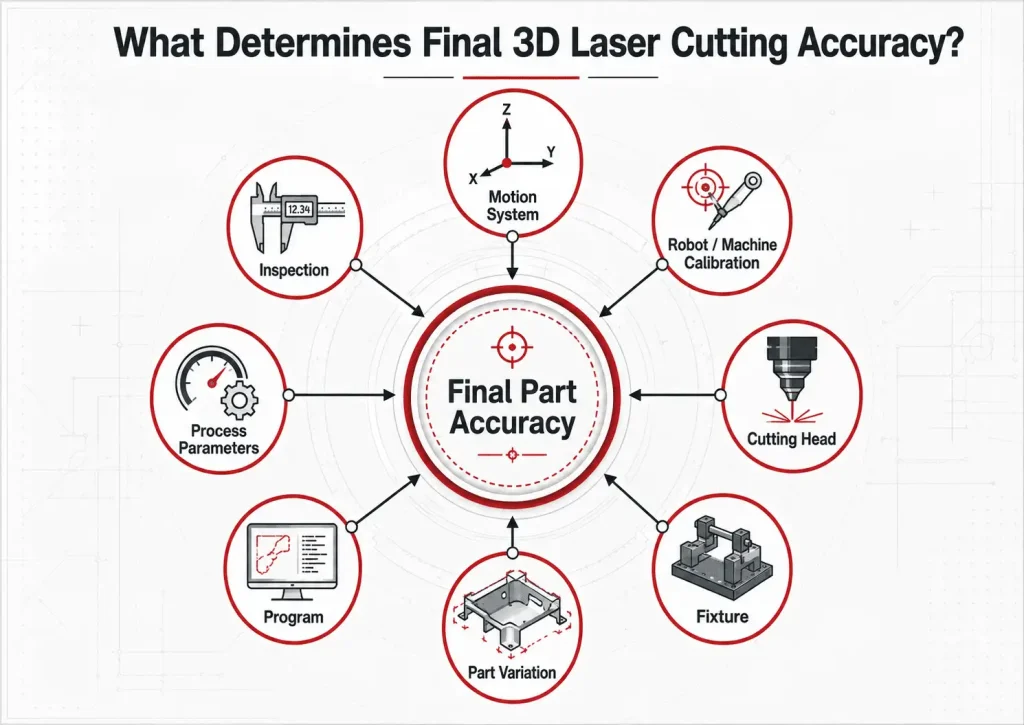
Final cutting accuracy also includes:
Therefore, do not compare:
machine specification vs robot specification
and assume that determines final part tolerance.
Compare:
actual finished parts produced under representative conditions.
Robots generally provide an attractive solution when a large and flexible reach is required.
An industrial robot can be installed:
The workpiece can also be mounted on a:
This can create a very large effective working envelope.
KUKA specifically emphasizes the flexibility of robotic cutting systems for different production requirements, while industrial robots can also be combined with external axes to extend the effective workspace.
A five-axis machine has a defined X/Y/Z travel and rotary-axis range.
This provides predictable working geometry but creates a clear maximum envelope.
The machine must be selected according to:
ZG Laser therefore offers several five-axis platforms with different working ranges and configurations rather than one universal machine size.
Robots deserve strong consideration when:
For repetitive trimming of press-hardened automotive components, a dedicated five-axis platform is a particularly established solution.
Typical applications include:
TRUMPF’s dedicated hot-forming machines are designed specifically for this production environment, including B-pillars and high-volume hot-formed crossmembers. Rotary tables are also used to reduce non-productive loading time.
ZG Laser’s S-Auto platform is similarly positioned specifically around automotive hot-formed structural parts and high-cycle production.
The production environment is predictable:
This allows the entire machine to be optimized around one type of production.
No.
Robots are widely used in automotive manufacturing and can perform 3D laser cutting.
KUKA documents automotive laser cutting of complex 3D geometries in production cells, while FANUC specifically targets new high-precision robots at automotive applications including large cast structures.
The choice depends on the component.
Laser trimming of hot-formed automotive parts
A robot can become particularly attractive as part size increases.
Consider components such as:
Building a dedicated five-axis machine around a very large working envelope may increase:
A robot may instead reach the part from several directions or move along an additional linear axis.
FANUC specifically identifies large automotive gigacastings as an example where high-precision robotic processing can provide an alternative or complement to traditional large CNC machine tools.
For large parts, evaluate:
A large reachable envelope is useful only if the process performs adequately across that envelope.
Both technologies are digitally programmable, so both are substantially more flexible than dedicated mechanical trimming tooling.
However, robotic cells provide particularly strong mechanical flexibility.
The robot can potentially:
KUKA’s laser application software, for example, integrates cutting and welding functionality directly with robot programming, highlighting the ability of a robot platform to support several laser processes.
A five-axis machine also offers strong product flexibility.
Changing production can involve:
TRUMPF highlights NC programming as a way to adapt hot-formed components to changed geometry without developing a new conventional trimming tool.
Think of it this way:
Five-axis flexibility:
Flexible production inside a defined machine workspace.
Robot flexibility:
Flexible production through a highly adaptable motion platform.
There is no universal winner.
Cycle time depends on:
Dedicated machines can be optimized for repetitive movement.
For series production, features such as:
can reduce non-cutting time.
TRUMPF’s current 3D laser cells use rotary-table and multi-station concepts specifically to allow loading and unloading while production continues.
Robot productivity depends heavily on:
A robot cell may be extremely fast when the path is optimized—but inefficient if the robot makes unnecessary orientation changes or approaches poor joint configurations.
Use:
Total Cycle Time = Loading + Clamping + Positioning + Cutting + Repositioning + Unloading
Do not compare only laser-on time.
Both systems require specialist programming for complex three-dimensional workpieces.
A typical workflow includes:
ZG Laser’s current five-axis system configuration includes offline programming and five-axis control for complex 3D geometries.
A robotic workflow may include:
Modern robot manufacturers offer dedicated offline simulation platforms for this work. FANUC, for example, supports offline programming and simulation through ROBOGUIDE, while KUKA provides application software specifically for robotic laser cutting and welding.
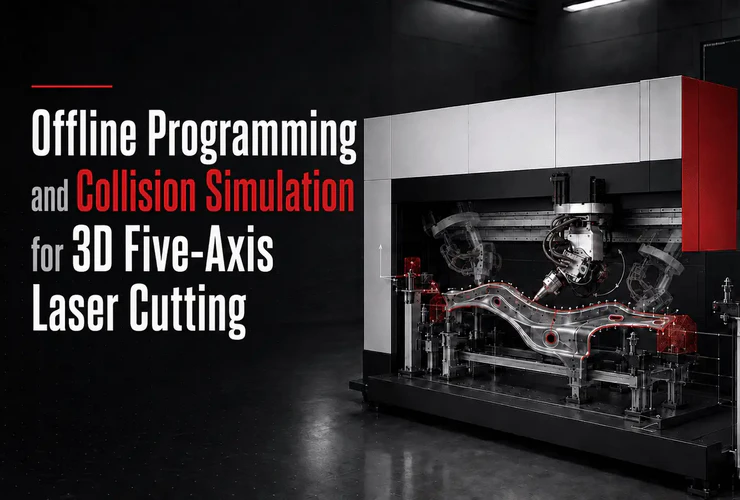
The programmer must consider:
How should the robot itself move?
not only:
Where should the laser cut?
Collision management is critical for both technologies.
Complex 3D parts may contain:
Possible collisions involve:
Additional risks may involve:
This makes a complete digital model particularly important for robotic processing.
The simulation model should include:
Do not simulate the laser path alone.
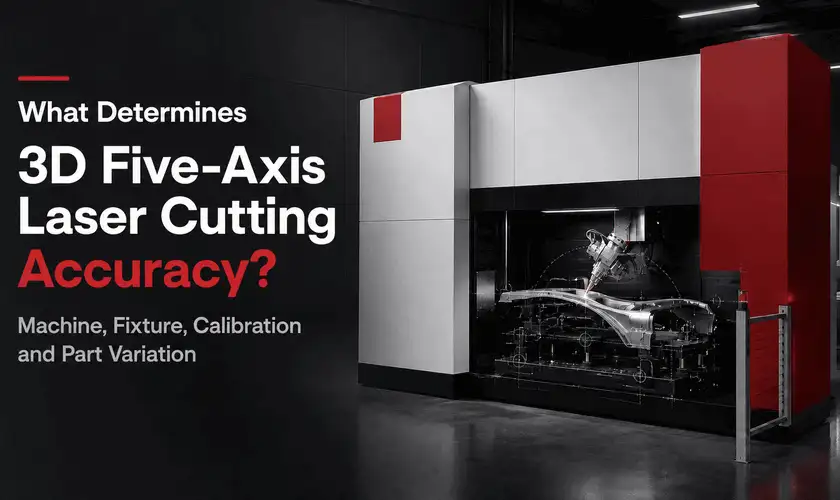
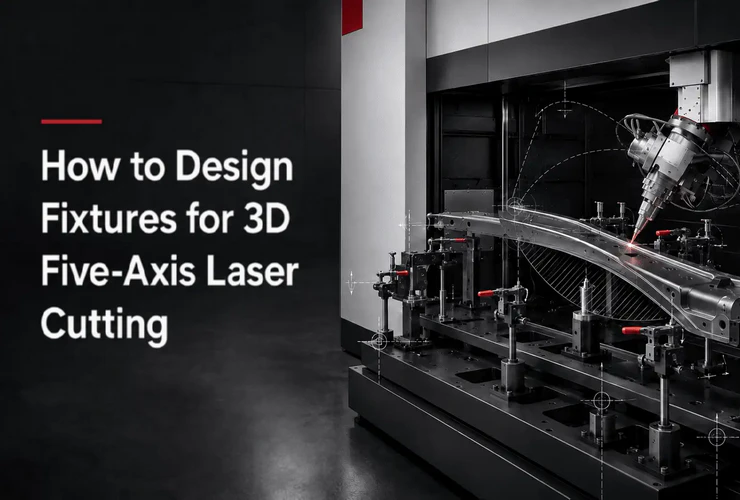
Both systems require accurate workholding.
The fixture determines:
Typically mounted on:
The fixture can be optimized around the defined machine envelope.
Can potentially be arranged:
This creates more layout options.
Flexibility in machine movement does not eliminate the need for accurate fixturing.
Even the most accurate motion platform cannot compensate for a part that moves or is located inconsistently.
This is particularly important for:
The real component may differ slightly from its nominal CAD model.
Possible causes include:
Both machine types may therefore benefit from:
The exact sensing capability depends on machine configuration and should be confirmed with the supplier.
Small-batch production changes the economics.
A dedicated automotive production cell designed around one component may be excessive if production involves:
Robots can be attractive because the same motion platform can accommodate several workstations and changing components.
However, compact dedicated five-axis machines are also increasingly targeted at small- and medium-volume 3D production.
TRUMPF positions its TruLaser Cell 5030 for small-to-medium lot sizes and frequent component changes, while ZG Laser currently positions its SF Series around prototypes and small-to-medium batches.
Therefore:
Small batch does not automatically mean robot.
Compare the actual part portfolio.
For repetitive mass production, the production cell becomes more important than the motion platform alone.
Evaluate:
Dedicated five-axis hot-forming systems are specifically available for serial automotive production. TRUMPF’s TruLaser Cell 8030, for example, is designed around high-productivity cutting of hot-formed components and large vehicle side structures.
A robotic solution can also be used for mass production when:
Neither should be selected from machine architecture alone.
A five-axis machine and a robot are not mutually exclusive.
This is an important point.
A production cell can contain:
In this configuration:
the five-axis machine performs precision processing
while
the robot performs material handling.
This can be an excellent solution for repetitive production because each system performs the task it is optimized for.
Likewise, a robotic laser cutting cell may use:
So the real comparison is often:
machine-cell architecture vs robot-cell architecture
—not simply machine vs robot arm.
Five-axis machines usually provide a defined integrated footprint.
The enclosure may contain:
This makes factory planning relatively straightforward.
Robot cells can vary significantly.
A robotic cell might contain:
A robot itself may look compact, while the final cell occupies substantial floor area.
Therefore always compare:
complete production-cell footprint
rather than the size of the robot or machine alone.
Both processes use high-power industrial lasers and require controlled safety systems.
Typical considerations include:
Robot cells also require control of:
The final safety design depends on applicable standards, laser class, machine configuration and destination market.
It is not accurate to state that one architecture is always cheaper.
The final cost depends heavily on how complex the robot cell becomes.
High-precision robots may sometimes provide a cost-effective alternative or complement to large CNC machine tools in suitable applications, but this should be validated on the specific project rather than treated as a universal cost rule.
How to evaluate the total cost of a laser cutting machine
Instead of comparing equipment price alone, calculate:
Cost per Finished Part = Total Production Cost ÷ Acceptable Parts Produced
Include:
A more expensive dedicated machine may be justified if it delivers:
A robot may provide better economics if:
The answer depends on your production mix.
Strong starting direction: Dedicated five-axis machine
Especially for:
Strong candidate: Robot
Especially where:
Evaluate both
Depending on:
Evaluate both carefully
Key factors:
Evaluate compact five-axis or robot
Production variety matters more than volume alone.
Robot may offer a strong flexibility advantage
Especially when a conventional five-axis machine workspace would become extremely large.
| Requirement | Strong Starting Direction |
|---|---|
| Repeated hot-formed automotive parts | Five-axis |
| High-cycle dedicated production | Five-axis |
| Defined medium-size 3D workpieces | Five-axis |
| Tight controlled machine workspace | Five-axis |
| Large irregular components | Robot |
| Very large reach required | Robot |
| Several workstations around one system | Robot |
| Frequent major part-size changes | Robot |
| Prototype / low-volume formed parts | Compare both |
| Hydroformed components | Compare both |
| Small-to-medium flexible production | Compare both |
| High precision | Test actual configuration |
| High product variety | Robot often deserves evaluation |
| Automated mass production | Evaluate complete cell |
Use the following process.
The supplier cannot reliably evaluate accessibility from overall dimensions alone.
Provide:
Specify:
Mark:
Identify critical dimensions separately from non-critical features.
Is the part:
Include:
This influences whether a dedicated production platform is required.
Simulate:
Test actual representative parts.
Compare:
machine + fixture + automation + labor + maintenance + cycle time
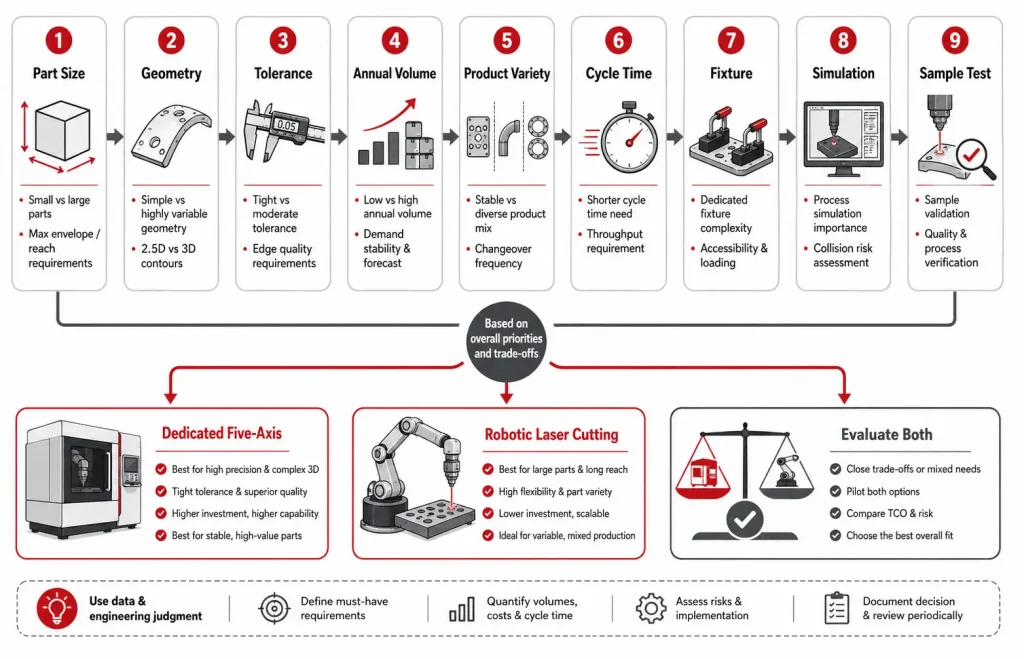
Do not compare demonstration videos.
Use your actual part.
Can the head reach:
Measure:
Inspect:
Record:
Cut multiple components.
One good sample proves feasibility.
Repeated samples provide much more useful information about production stability.
Before selecting a solution, ask:
ZG Laser currently offers both dedicated five-axis and robotic 3D laser cutting solutions.
The current five-axis portfolio includes several platforms for different production strategies:
ZG Laser’s five-axis systems support trimming, hole cutting, bevel cutting and multi-angle processing of formed and irregular components.
Explore ZG Laser 3D Five-Axis Machines
ZG Laser also provides a robotic fiber-laser platform using an industrial articulated robot for flexible multi-angle processing of curved metal parts, tubes and automotive components.
Explore Robotic Laser Cutting Systems
Five-axis laser cutting and robotic laser cutting are not competing versions of exactly the same machine.
They are two different motion architectures for solving three-dimensional processing problems.
A dedicated five-axis machine is a strong option when production requires:
A robotic system deserves serious consideration when production requires:
Modern high-precision robots also mean that the old assumption that robots are automatically unsuitable for accurate 3D laser cutting is increasingly outdated. FANUC, for example, now offers robot platforms specifically engineered for high-precision 3D laser processing.
The correct decision should therefore be based on:
The best way to make the decision is to provide the supplier with your actual 3D model and evaluate both architectures before finalizing the equipment.
Send ZG Laser:
Our application team can evaluate cutting-head accessibility, working range, fixture requirements and production strategy before recommending a machine architecture.
Send Your 3D Drawing for Evaluation
Explore 3D Five-Axis Laser Cutting Machines
Explore Robotic Laser Cutting Systems
Not automatically. Dedicated machine tools and articulated robots use different motion structures, and accuracy depends on machine design, robot model, calibration, fixture and application. Modern high-precision robots are specifically available for 3D laser cutting applications.
A dedicated five-axis machine provides a controlled machine-tool platform for repeatable multi-angle processing of formed 3D parts. It is particularly established for automotive hot-formed component trimming.
Robotic systems provide flexible multi-axis reach and can be configured around different fixtures, positioners and large workpieces. KUKA specifically highlights flexibility as a key advantage of robotic cutting systems.
Yes, when the robot, laser system, fixture and accuracy requirements are suitable. Robotic laser systems are used for complex 3D automotive-related cutting applications.
Dedicated five-axis machines are a well-established solution for B-pillar trimming and other hot-formed automotive components.
Robotic systems often deserve stronger consideration where a large or flexible working envelope is needed, particularly when robots can be combined with external axes or positioners.
Yes. Accurate workholding remains important for both five-axis and robotic cutting because part location directly influences the finished cutting result.
Yes. Compact and lower-investment 3D laser cells are available specifically for small-to-medium lot sizes, and ZG Laser’s current SF Series is also positioned around prototype and small-to-medium batch applications.
Not necessarily. The complete robot cell may require the robot, laser, cutting head, positioner, safety enclosure, software, integration and calibration. Compare complete production-cell investment and cost per finished part.
Yes. Actual sample testing is the best way to compare accessibility, cutting accuracy, cycle time, fixture design and repeated-part consistency.

English

French

German

Hindi

Italian

Japanese

Korean

Portuguese

Russian

Spanish
Tell us about your manufacturing challenges.
Our engineers will design a laser solution tailored to your exact requirements.