Laser Chiller Troubleshooting: Diagnosing & Fixing Common Alarms
-
August 7, 2026

-
4 min read

Industrial laser chillers are equipped with automated diagnostic interlocks designed to protect sensitive optical components. When a safety threshold is breached, the chiller triggers a visual/audible alarm and opens a relay circuit to shut off the laser beam.
Proper laser chiller troubleshooting requires a systematic approach to identify whether the fault originates from fluid restriction, thermal overload, or mechanical failure. This protocol forms a core pillar of our master laser cooling system maintenance guide.
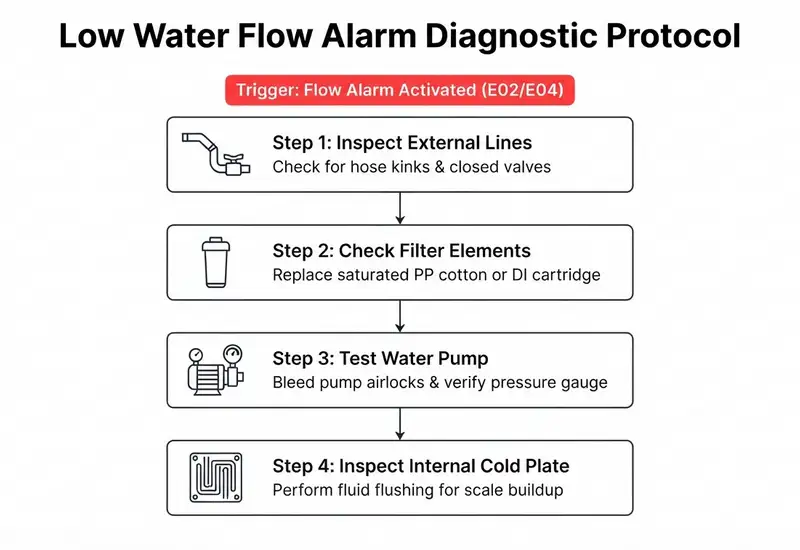
A water flow alarm (often displayed as E02 or E04) indicates that coolant circulation through the laser source has dropped below safe operational thresholds. Operating an industrial laser cutting machine without sufficient cooling flow will burn out laser diodes or melt fiber delivery cables within seconds.
Diagnostic & Corrective Steps:
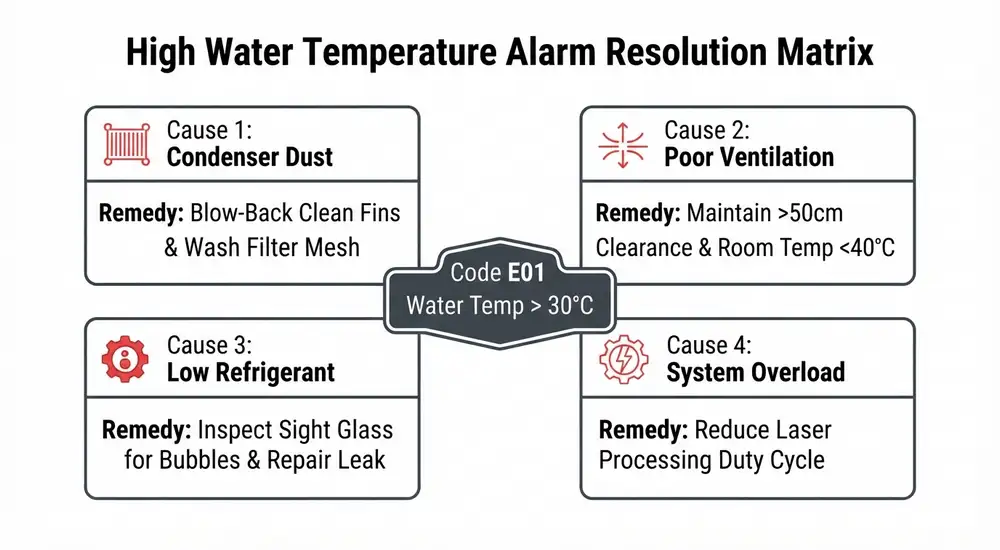
High temperature alarms occur when the coolant supply temperature exceeds the pre-programmed safety limit (typically 30 to 35). Uncontrolled temperature spikes on a high-duty-cycle laser welding machine lead to thermal expansion of internal optics and rapid beam drift.
Root Causes & Remedies:
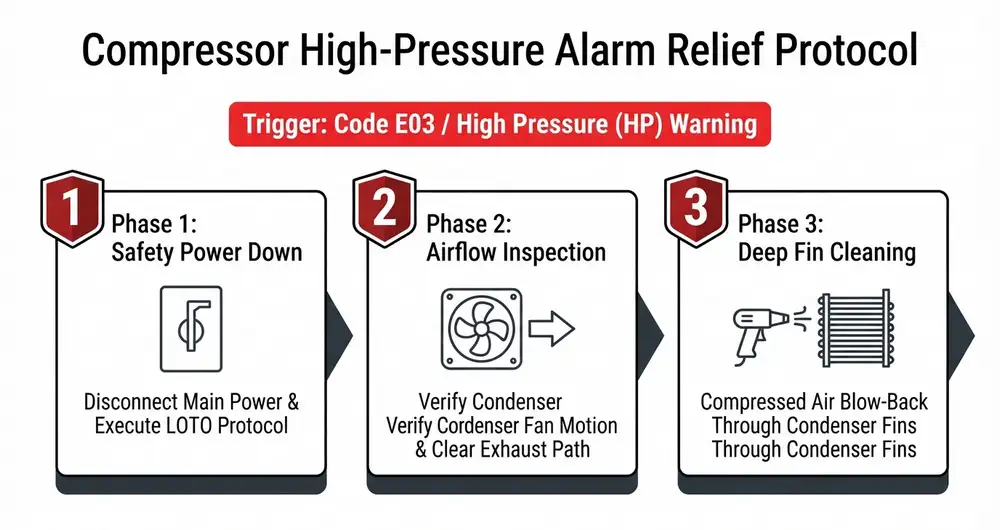
High-pressure alarms trigger when the compressor discharge pressure exceeds safe mechanical thresholds. This protection circuit prevents compressor motor burnout.
Corrective Protocol:
5. Universal Chiller Error Code Quick Reference
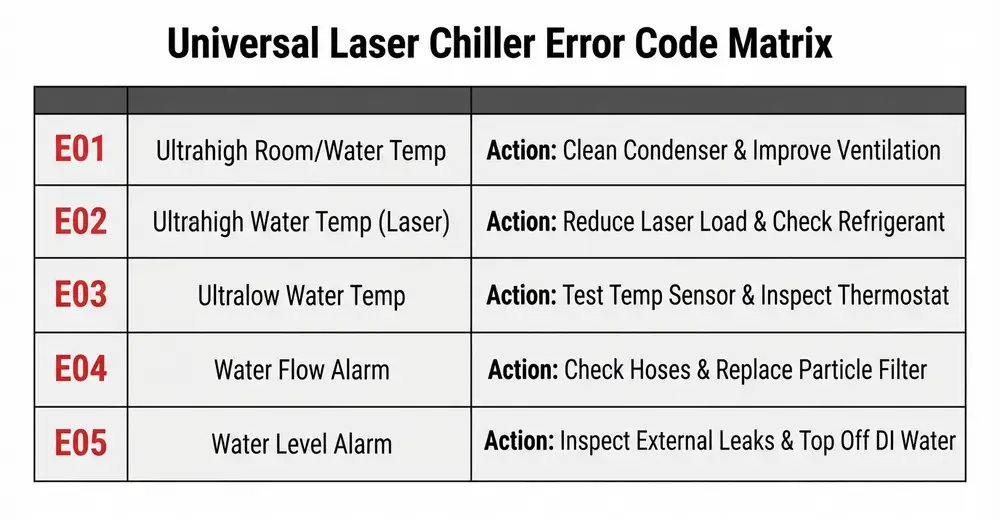
While code designations vary slightly between manufacturers, the table below provides standard diagnostic mappings:
| Error Code | Fault Description | Primary Cause | Immediate Remediation |
| E01 | Ultrahigh Room / Water Temp | Excessive ambient heat; clogged condenser | Improve room ventilation; clean condenser fins. |
| E02 | Ultrahigh Water Temp (Laser Loop) | Thermal overload; undersized chiller | Reduce laser output power; inspect refrigerant. |
| E03 | Ultralow Water Temp | Temp sensor fault; bypass valve stuck open | Inspect temperature sensor probe and thermostat settings. |
| E04 | Water Flow Alarm | Line blockage; pump failure; dirty filter | Check hoses for kinks; replace particle filter element. |
| E05 | Water Level Alarm | Fluid evaporation; external line leak | Inspect water lines for leaks; top off with DI water. |
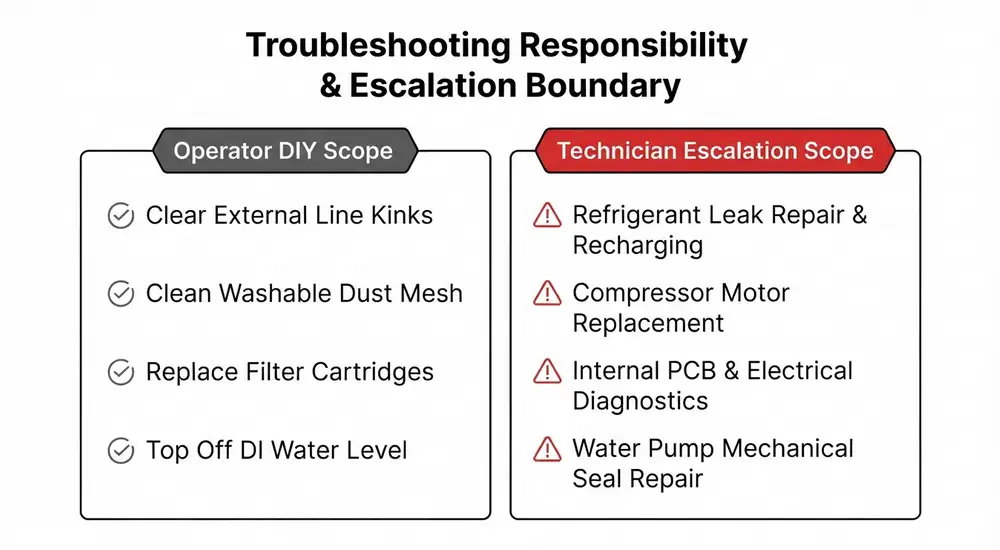
Operators can independently clear 80% of chiller alarms by cleaning filters, clearing hose kinks, and restoring water levels. However, internal refrigeration repair (compressor replacement, capillary tube unblocking, refrigerant recharging) or internal PCB electrical diagnostics require certified service engineers.
Q1: Why does my laser chiller alarm trigger immediately upon starting the machine?
Immediate flow alarms upon startup usually indicate an airlock inside the water pump or a closed line valve. Bleed the air valve on the pump head to restore prime.
Q2: Can I bypass the water flow alarm circuit temporarily to finish a job?
Never bypass a flow alarm. Operating a laser source without verified coolant flow can destroy optics or diode modules within seconds, leading to catastrophic failure.
Q3: What causes a chiller to display a low-temperature alarm in winter?
If the chiller is located in an unheated shop, low ambient overnight temperatures can drop the water temperature below 15. Install a chiller heater kit or keep ambient room temperatures controlled.
Q4: How do I know if my water pump is failing or just clogged?
Check the pressure gauge at the chiller discharge outlet. High pressure with low flow indicates a line restriction/clog. Low pressure with low flow indicates pump impeller wear or air cavitation.
Q4: Why does my chiller high-pressure alarm trip only during hot afternoons?This indicates marginal heat dissipation capacity. High ambient summer heat combined with dust-blanketed condenser coils pushes compressor head pressures beyond safe operating limits.


English

French

German

Hindi

Italian

Japanese

Korean

Portuguese

Russian

Spanish
Tell us about your manufacturing challenges.
Our engineers will design a laser solution tailored to your exact requirements.