Laser CDA Ventilation: Prevent Condensation in Laser Systems
-
September 4, 2026

-
13 min read

Industrial laser systems operate with sensitive optical, electronic, and cooling components that can be affected by moisture. In hot and humid environments, condensation can become a serious reliability risk when cooled laser components are exposed to humid air.
This is where laser CDA ventilation becomes an important part of a complete moisture-control strategy.
CDA, or Clean Dry Air, can help reduce internal humidity, displace moist air, and maintain a dry environment around sensitive laser components. However, CDA alone is not a complete solution. Effective laser condensation prevention also depends on dew point, ambient humidity, cooling temperature, correct startup procedures, and proper maintenance.
This guide explains how laser CDA ventilation works, why condensation occurs in industrial laser systems, what air-quality factors matter, and how CDA fits into a complete laser condensation prevention strategy.
laser condensation
Condensation occurs when moisture in the air changes from water vapor into liquid water after contacting a surface that is colder than the surrounding air's dew point.
For an industrial laser system, the basic risk can be simplified as:
Humid Air + Cold Surface Below Dew Point = Condensation Risk
This problem becomes more common when:
Unlike ordinary external surface condensation, internal moisture can be particularly concerning because industrial lasers contain sensitive components that may not be immediately visible during a routine inspection.
fiber laser condensation
When humid air enters a laser system and contacts sufficiently cold internal surfaces, water droplets may form. Depending on the laser design, condensation may affect:
Moisture can potentially contribute to contamination, corrosion, electrical problems, or abnormal equipment behavior.
For this reason, condensation should not simply be treated as a cosmetic issue.
Optical and electronic components generally require particular attention.
In a fiber laser cutting machine, for example, the laser source, optical transmission system, and cooling circuit may all depend on stable operating conditions.
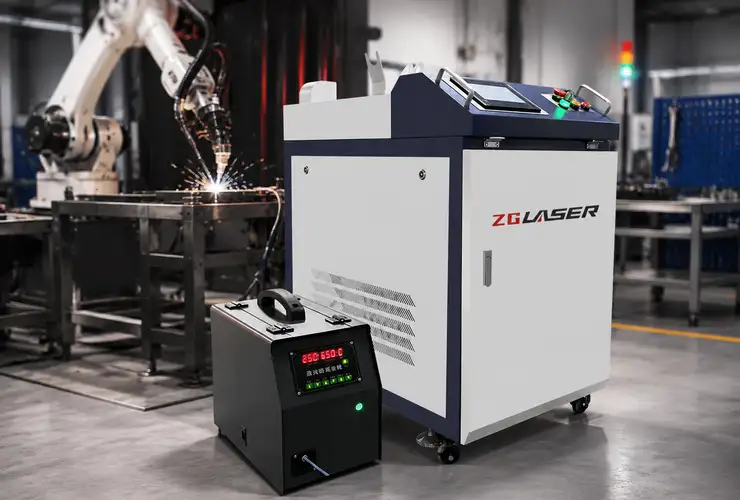
The same principle applies to equipment such as:
Although equipment configurations differ, moisture control becomes increasingly important when laser equipment operates in environments with high humidity and significant cooling loads.
If your laser has already generated a moisture or condensation-related alarm, refer to the Fiber Laser Condensation Alarm: Causes, Inspection and Recovery for a dedicated troubleshooting workflow.
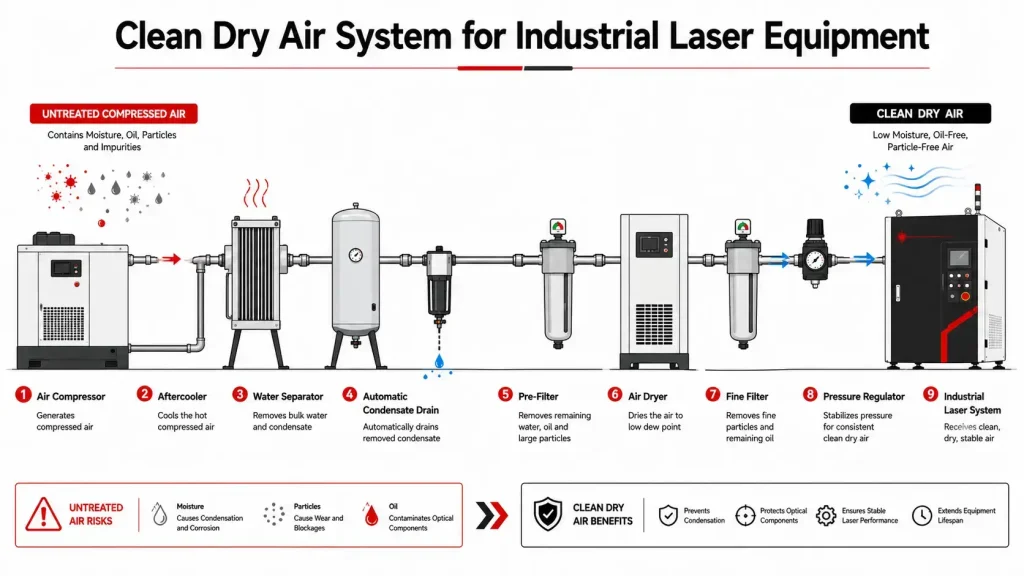
CDA stands for Clean Dry Air.
In industrial laser applications, CDA is used to supply air that has been properly treated to reduce moisture and contamination before it reaches sensitive equipment.
However, it is important to understand that:
Clean Dry Air is not automatically the same as untreated factory compressed air.
A compressed-air system may contain:
Therefore, connecting a standard compressed-air line directly to a laser CDA connection may not provide the required level of protection.
clean dry air for laser
The exact air specification depends on the laser manufacturer and equipment model. However, a CDA supply generally focuses on controlling four major factors:
A properly prepared CDA supply should provide air that is suitable for the equipment’s specified operating requirements.
Normal factory compressed air may be suitable for general pneumatic equipment while still being unsuitable for sensitive laser applications.
For example:
| Air Supply | Moisture Risk | Oil Risk | Particle Risk | Suitability for Sensitive Laser Equipment |
| Untreated factory air | High | Possible | High | Not recommended without treatment |
| Basic compressed air | Variable | Possible | Variable | Depends on treatment |
| Filtered air | Reduced | Variable | Reduced | May not be sufficient |
| Properly prepared CDA | Controlled | Controlled | Controlled | Follow equipment requirements |
The key point is that CDA should be evaluated based on actual air quality, not simply on the fact that compressed air is available.
For a detailed discussion of moisture, filtration, oil control, and air drying, see CDA Air Quality Requirements for Industrial Laser Systems.
laser CDA ventilation
CDA can support condensation prevention through several mechanisms.
The most important function of dry air is moisture control.
When sufficiently dry air enters an appropriate laser ventilation or purge system, it can help reduce the concentration of moisture inside the protected area.
Lower internal moisture means a lower internal condensation risk when surfaces become cold.
However, CDA performance depends on factors such as:
laser purge air
Before cooling begins, the internal atmosphere may contain humid ambient air.
CDA purging can help replace or dilute this moisture-containing air with drier air.
This creates a more favorable internal environment before cooled components reach temperatures where condensation could occur.
The general logic is:
Humid Internal Air
↓ CDA Purging
Reduced Internal Moisture
↓ Cooling
Lower Condensation Risk
Depending on the equipment design, a controlled CDA supply may also help maintain positive pressure inside protected areas.
This can reduce the tendency for humid external air to enter through small openings or connections.
Positive pressure should not be considered a substitute for proper sealing or correct equipment maintenance. Instead, it is one layer of a broader moisture-control strategy.
To understand the physical relationship between humidity and condensation, see Laser Dew Point and Condensation: A Guide to Humidity Control.
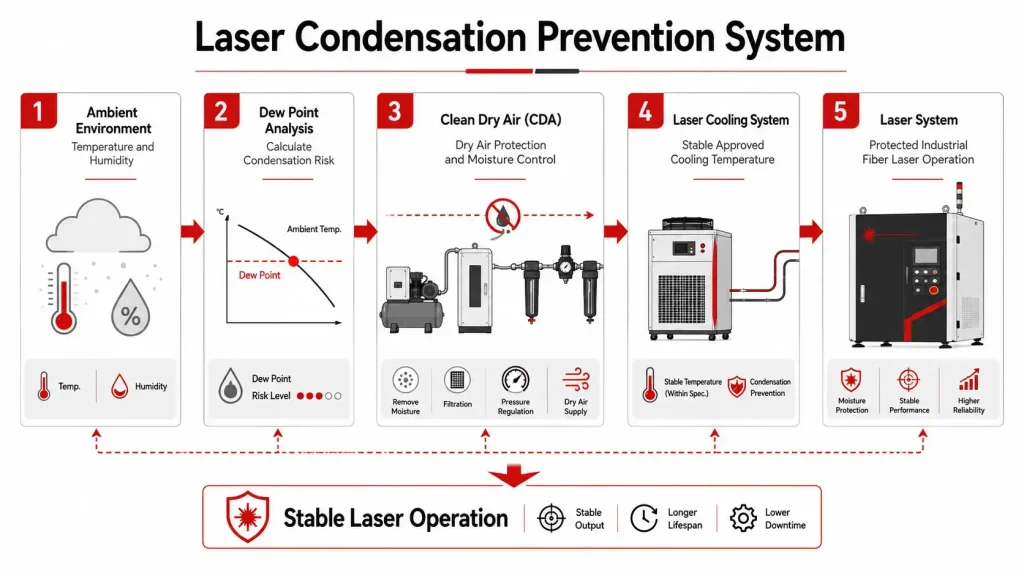
laser dew point
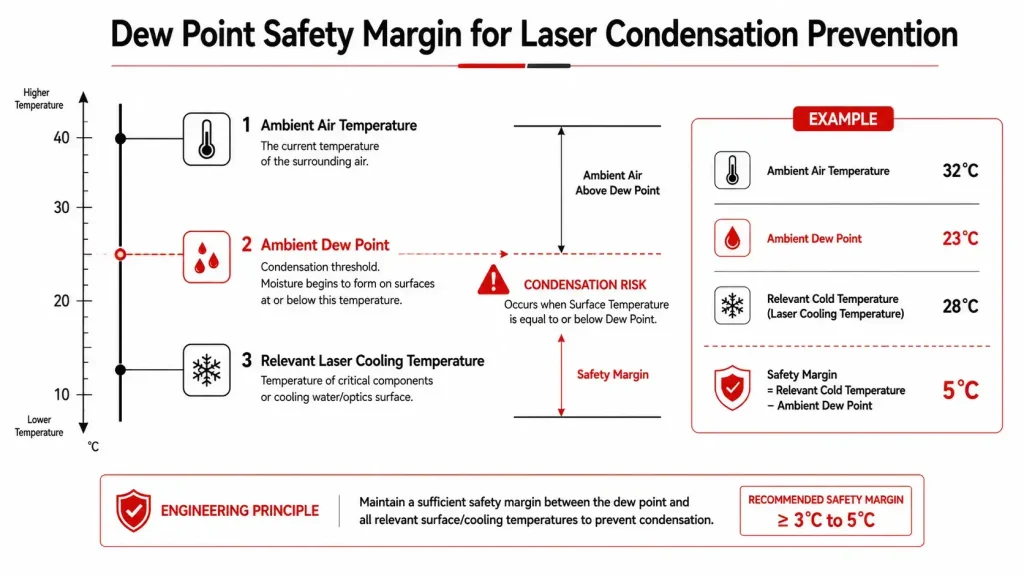
One of the most important concepts in condensation prevention is dew point.
Relative humidity alone does not tell you whether condensation will occur.
The critical comparison is:
Surface Temperature vs Dew Point
When a surface temperature falls below the dew point of the surrounding air, condensation can form.
A laser cooling system may lower the temperature of internal components or related surfaces.
If those surfaces become colder than the surrounding air’s dew point, moisture can condense.
For this reason, lowering cooling temperature without considering humidity may increase condensation risk.
Consider two workshops with the same air temperature.
Workshop A has relatively low humidity.
Workshop B has high humidity.
Although both workshops have the same temperature, their dew points may be very different.
The higher-humidity workshop may therefore create condensation at a higher surface temperature.
This is why:
Temperature settings should never be evaluated independently from humidity conditions.
For a detailed explanation of dew point calculation, humidity monitoring, and cooling-related condensation risk, read Laser Dew Point and Condensation: A Guide to Humidity Control.
CDA air quality
A CDA system cannot effectively support moisture protection if the supplied air itself contains excessive contamination.
The four main areas to consider are moisture, particles, oil, and pressure stability.
The air must be sufficiently dry for the laser application’s requirements.
Important considerations may include:
The required dryness level should follow the equipment manufacturer’s specifications.
Particles may come from:
Proper filtration helps reduce the risk of contamination entering sensitive equipment.
Oil contamination may come from the compressed-air generation system.
Depending on the equipment and air-treatment design, oil aerosols or vapors may require appropriate removal before the air reaches the laser.
CDA pressure must also remain within the equipment’s approved operating range.
Excessive pressure should not be used simply because more pressure appears to provide more protection.
Similarly, insufficient pressure may affect the intended ventilation or purge performance.
For detailed guidance, refer to CDA Air Quality Requirements for Industrial Laser Systems.
laser chiller condensation
CDA and cooling temperature should be treated as complementary systems.
CDA helps control the moisture content of the air.
Cooling temperature affects the temperature of surfaces exposed to that air.
Neither system should be considered independently.
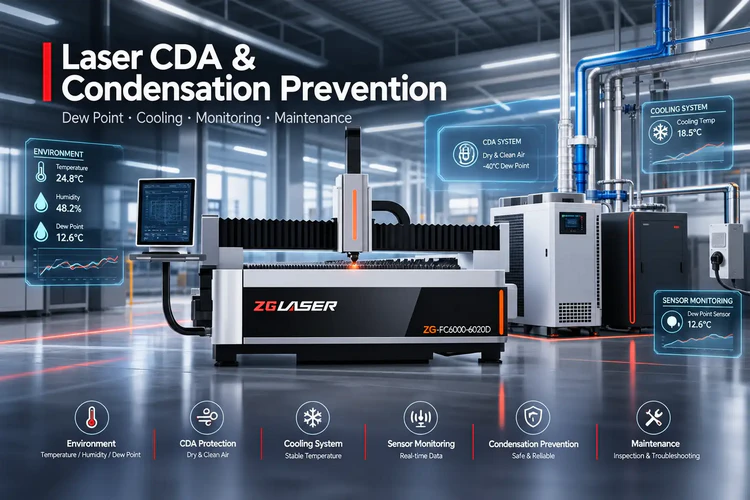
A simplified risk model is:
Ambient Humidity
↓
Dew Point
↓
Laser Component Surface Temperature
↓
Condensation Risk
CDA can help reduce internal moisture, while appropriate cooling control helps prevent surfaces from unnecessarily reaching condensation-risk conditions.
The goal is not simply:
Use colder water.
The goal is:
Maintain the cooling conditions required by the laser while managing the environmental conditions that influence condensation.
For more information, see Laser Chiller Temperature and Condensation Prevention Guide.
laser CDA startup
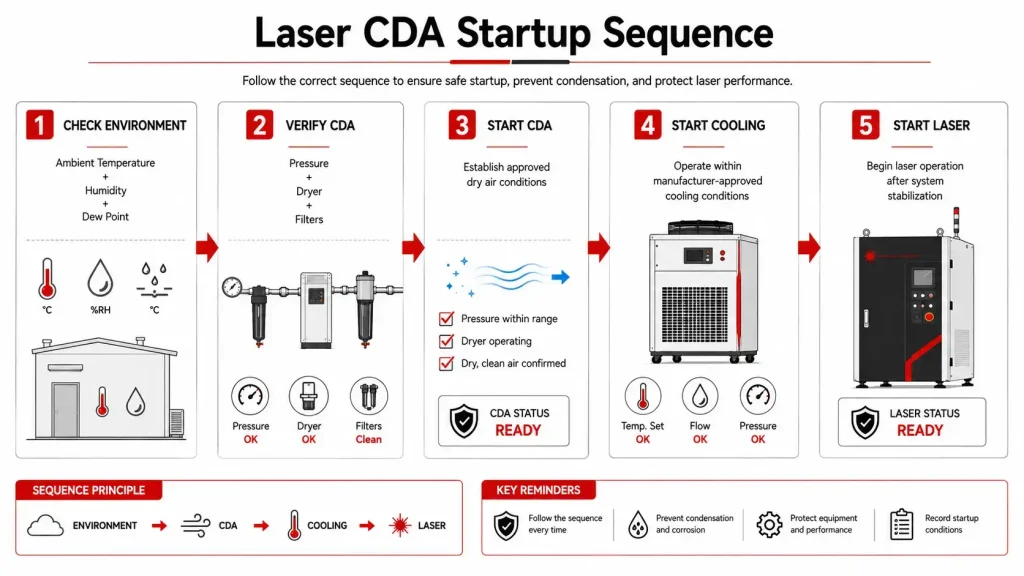
Startup sequence can significantly affect condensation risk.
A general moisture-control concept is:
Monitor:
High humidity should trigger additional attention to condensation risk.
Check:
Allow the laser system to receive CDA according to the equipment manufacturer’s approved operating procedure.
After the appropriate CDA preparation stage, start the cooling system according to the laser manufacturer’s instructions.
Before production:
Only begin normal operation when the system is operating under approved conditions.
The exact:
must not be treated as universal values.
They can vary between laser models and manufacturers.
For a dedicated operational procedure, see Laser CDA Startup Sequence: Prevent Condensation Before Cooling.
Even when CDA is connected, condensation problems can still occur.
Possible causes include:
Potential causes include:
Filters gradually accumulate contaminants.
Excessive restriction can affect:
Leaks may:
If cooling begins while humid internal air is still present, condensation risk may increase.
If you are investigating an active equipment problem, refer to Fiber Laser Condensation Alarm: Causes, Inspection and Recovery.
For long-term reliability, follow a structured Laser CDA System Preventive Maintenance Checklist.
laser humidity control
High humidity can create significant seasonal changes in laser operating conditions.
This is particularly relevant for facilities in:
In these environments, the workshop dew point may rise substantially.
A cooling temperature that causes no problems during a dry season may create condensation risk during humid weather.
A complete high-humidity strategy may include:
For seasonal guidance, see Summer Laser Maintenance: Preventing Condensation in High-Humidity Environments.
laser condensation prevention
The most reliable approach is not based on a single component.
Instead, condensation prevention should use multiple layers.
Layer 1: Monitor the Environment
Track:
Layer 2: Follow Correct Cooling Requirements
Always follow the laser manufacturer’s approved cooling specifications.
Layer 3: Use Properly Prepared CDA
Control:
Layer 4: Follow the Correct Startup Procedure
Prepare the internal environment before operating under conditions that could create condensation risk.
Layer 5: Maintain the CDA System
Regularly inspect:
Layer 6: Respond Correctly to Alarms
Do not ignore condensation or humidity-related warnings.
Investigate the environmental and equipment conditions before restarting the laser.
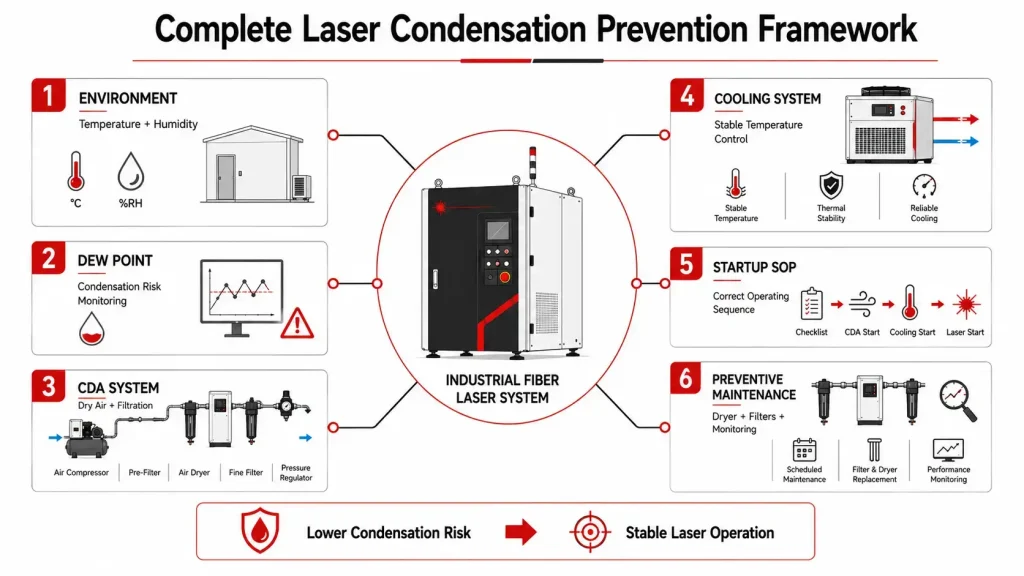
laser CDA ventilation is an important part of protecting industrial laser systems from moisture-related condensation risks.
However, CDA should not be viewed as an isolated solution.
A reliable condensation prevention strategy combines:
The central principle is simple:
Condensation is created by the relationship between moisture and temperature. Effective protection requires controlling both.
By understanding how CDA works together with dew point, cooling systems, environmental conditions, and maintenance procedures, laser operators can build a more reliable operating environment for sensitive industrial laser equipment.
CDA means Clean Dry Air. In laser applications, it refers to properly prepared air used to reduce moisture and contamination around sensitive components according to the equipment manufacturer’s requirements.
Not automatically. Factory compressed air may contain moisture, particles, or oil. The air should be treated and verified to meet the laser manufacturer’s requirements before use.
CDA can help reduce internal humidity, displace moist air, and maintain a drier environment around sensitive components. It should be used together with proper cooling and environmental control.
Many laser operating procedures use CDA preparation before cooling to reduce moisture-related risk. However, the correct sequence depends on the specific laser manufacturer’s approved instructions.
There is no universal CDA pressure for all industrial lasers. Always follow the approved pressure specification for the specific laser model.
Condensation can occur when a laser component or surface becomes colder than the dew point of the surrounding air.
Yes. Possible causes include wet CDA, insufficient air treatment, leaks, incorrect operating procedures, high ambient humidity, or unsuitable cooling conditions.
No. CDA is one part of a complete strategy that should also include humidity monitoring, dew point awareness, correct cooling conditions, approved startup procedures, and preventive maintenance.
Maintenance intervals depend on the air-treatment system, operating environment, contamination load, and component specifications. Filters, dryers, drains, leaks, pressure, and air quality should be inspected on a structured schedule.
Yes. High humidity can increase dew point and therefore increase condensation risk when cooled laser components operate at temperatures below environmental dew point. This can be relevant to applications including fiber laser cutting, laser welding, laser cleaning, and multi-axis laser processing.




English

French

German

Hindi

Italian

Japanese

Korean

Portuguese

Russian

Spanish
Tell us about your manufacturing challenges.
Our engineers will design a laser solution tailored to your exact requirements.