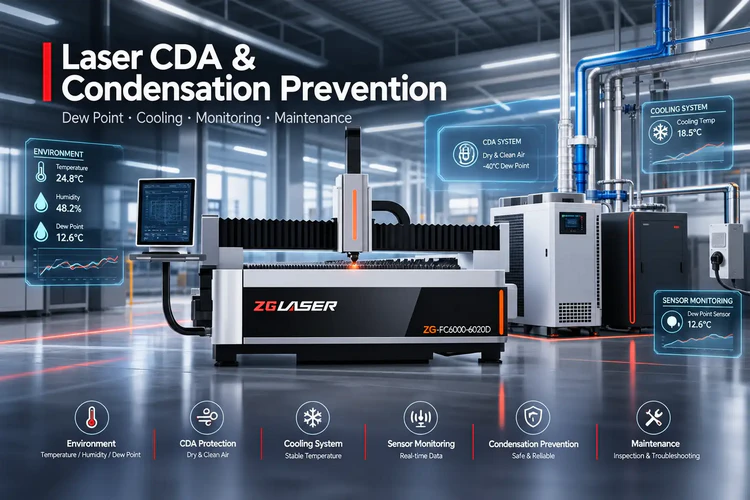
Laser Dew Point and Condensation A Guide to Humidity Control
-
September 11, 2026

-
21 min read

Introduction: Industrial laser systems are highly dependent on stable operating conditions. Temperature, cooling performance, water quality, and environmental cleanliness are all important, but humidity is often underestimated until a condensation problem occurs.
For laser equipment operating with a water chiller, condensation is not determined by cooling temperature alone. The actual risk depends on the relationship between temperature, humidity, dew point, and the temperature of cooled laser components.
Understanding laser dew point is therefore essential for preventing moisture-related problems in fiber laser systems and other industrial laser equipment.
A workshop may appear perfectly normal while the humidity level creates a high condensation risk. In many cases, operators focus on lowering the laser chiller temperature without checking whether the resulting component temperature is approaching or falling below the ambient dew point.
This guide explains what dew point is, how it causes condensation in industrial laser systems, how humidity affects laser cooling, and how to use dew point information as part of a complete condensation prevention strategy. For an overview of how Clean Dry Air fits into this broader protection strategy, see our Laser CDA Ventilation Guide: Preventing Condensation in Laser Systems.
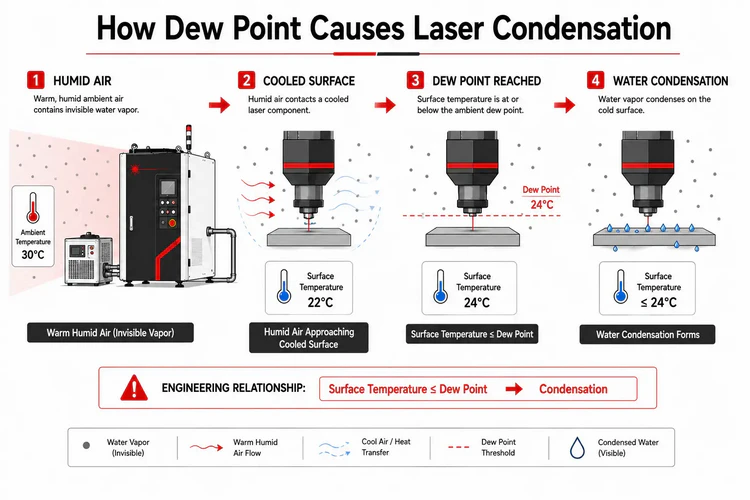
Dew point is the temperature at which the moisture in the air begins to condense into liquid water under a given pressure condition.
Air always contains a certain amount of water vapor. The amount of water vapor that air can hold depends largely on temperature.
Warm air can generally contain more water vapor than cooler air.
As air cools, its ability to hold water vapor decreases. When the air temperature reaches its dew point, excess moisture can begin to change from vapor into liquid water.
For laser condensation control, the most important concept is:
When a laser surface becomes colder than the dew point of the surrounding air, condensation can form.
This means that a laser system can experience condensation even when the workshop temperature itself does not seem particularly low.
The critical comparison is:
Laser Surface Temperature < Ambient Dew Point = Condensation Risk
This is the fundamental principle behind laser dew point control.
Relative humidity and dew point are closely related, but they are not the same measurement.
Relative humidity (RH) describes how much moisture is currently present in the air compared with the maximum amount of moisture the air could hold at that temperature.
For example:
However, relative humidity alone does not directly tell you the temperature at which condensation will occur.
Dew point provides a more direct condensation reference.
For example, two environments may have:
Their dew points can therefore be significantly different.
This is why laser operators should avoid using relative humidity as the only indicator of condensation risk.
Ambient temperature tells you how warm the workshop air currently is.
Dew point tells you the temperature at which moisture in that air can begin to condense.
The difference between these two values is often useful for understanding the environmental moisture margin.
For example:
In this environment, a surface would generally need to cool to approximately 15°C before condensation becomes likely.
However:
A much warmer surface could now experience condensation.
This is why high-humidity workshops create additional challenges for laser cooling systems.
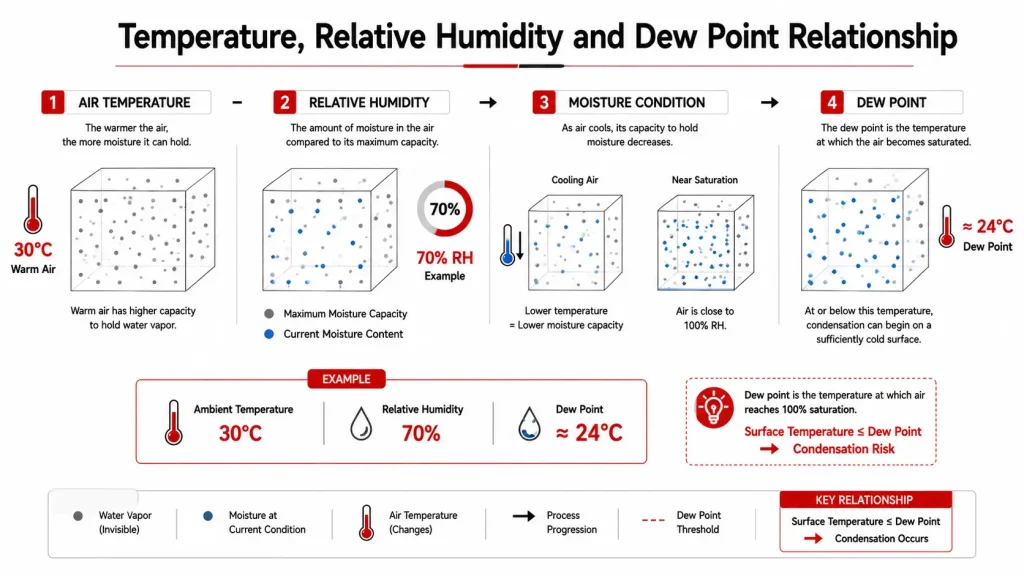
Laser dew point condensation occurs when humid air contacts a sufficiently cold surface.
In an industrial laser system, the process can be simplified as follows:
Ambient Air Contains Moisture
↓
Laser Cooling Lowers Component Temperature
↓
Surface Temperature Approaches Dew Point
↓
Surface Temperature Falls Below Dew Point
↓
Condensation Can Form
The actual location and severity of condensation depend on the equipment design and environmental conditions.
Potential risk areas may include surfaces associated with:
This is why moisture control should be considered before cooling-sensitive components reach condensation-risk temperatures.
H3: When Surface Temperature Falls Below Dew Point
The key question is not simply:
What is the laser chiller set temperature?
The more important question is:
What temperature do the relevant surfaces reach, and how does that compare with the ambient dew point?
Laser cooling water temperature and actual component surface temperature are not always identical.
Factors such as:
can affect the actual surface temperature.
However, the dew point principle remains the same.
If a surface is sufficiently cold relative to the moisture conditions in the surrounding air, condensation can occur.
Laser cooling systems are designed to remove heat and maintain stable operating temperatures.
However, cooling can also create a large temperature difference between laser components and the surrounding workshop air.
For example:
Warm, Humid Workshop Air
↓
Cold Laser Component
↓
Potential Condensation
This does not mean that laser cooling should simply be increased or decreased to solve every humidity problem.
Industrial laser systems have specific operating temperature requirements.
The correct approach is to:
For more information about cooling-related condensation control, see our Laser Chiller Temperature Guide for Condensation Prevention.
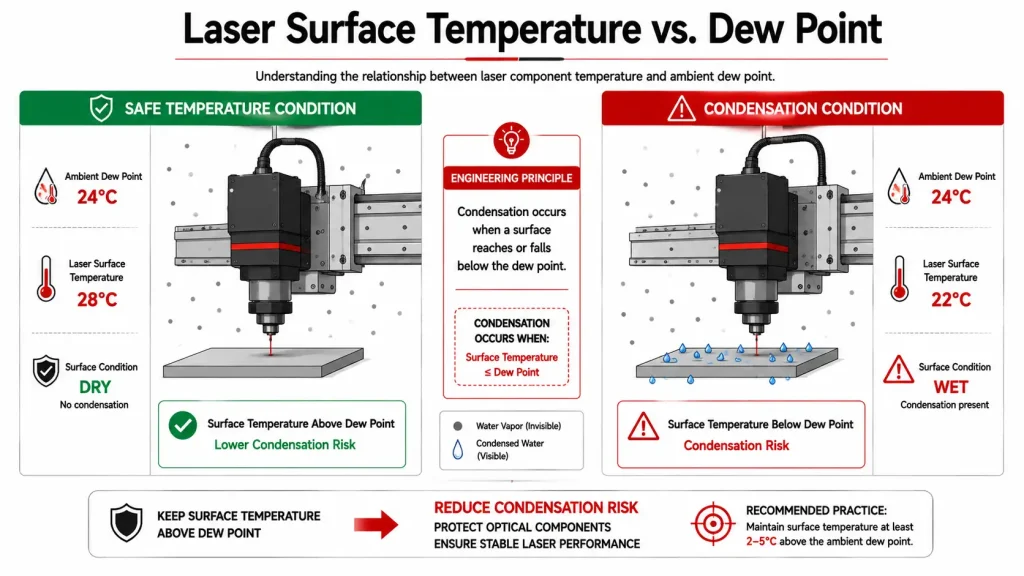
Understanding laser dew point does not require complex calculations during everyday equipment operation.
The two most common environmental inputs are:
These values can be measured using an environmental temperature and humidity meter.
The dew point can then be calculated using:
The purpose is not necessarily to perform manual calculations every day.
The goal is to understand whether the environmental moisture conditions are changing the condensation risk for the laser system.
Consider the following example:
This combination produces a much higher dew point than:
Although the ambient temperature remains unchanged, the condensation risk changes significantly because the amount of moisture in the air has changed.
This is one reason why laser equipment may operate normally during a dry period but develop condensation problems during:
A dew point calculator can help maintenance personnel quickly understand environmental risk.
The general workflow is:
Measure Temperature
↓
Measure Relative Humidity
↓
Calculate Dew Point
↓
Compare Dew Point With Cooling-Related Surface Temperatures
↓
Evaluate Condensation Risk
However, operators should not use a calculated dew point to override laser manufacturer requirements.
Dew point monitoring is a risk-management tool.
It does not replace approved equipment specifications.
Laser chiller dew point analysis is one of the most important parts of condensation prevention.
A laser chiller may be operating correctly according to its own temperature setpoint while the surrounding environmental conditions change.
For example:
During a dry season:
During a humid season:
The laser cooling system may have the same temperature setting in both cases, but the environmental condensation risk can be completely different.
This is why:
The same laser chiller setting may produce different condensation risks in different seasons.
A common mistake is to evaluate cooling temperature without considering humidity.
For example:
“The laser has always operated at this temperature.”
That may be true, but environmental conditions may have changed.
Possible changes include:
The correct engineering question is:
Has the environmental dew point changed?
If the answer is yes, the condensation risk may also have changed.
For a detailed discussion of this relationship, see Laser Chiller Temperature Guide for Condensation Prevention.
Knowing the ambient dew point is useful, but operators also need a practical method for deciding whether the current thermal conditions provide enough protection against condensation.
A simple dew point safety margin can be used as an operational reference.
The basic principle is:
Keep relevant laser surfaces above the ambient dew point by an appropriate safety margin, while always following the laser manufacturer's approved cooling specifications.
The safety margin is the temperature difference between the estimated or measured surface temperature and the ambient dew point.
Dew Point Safety Margin Formula
Safety Margin = Relevant Surface Temperature − Ambient Dew Point
For example:
Safety Margin = 25°C − 18°C = 7°C
A positive margin means that the surface is above the dew point.
However, a small positive margin should not automatically be considered sufficient because actual conditions can change due to:
Therefore, the objective is not simply to maintain a margin greater than zero.
The objective is to maintain a practical engineering buffer appropriate for the specific laser system and operating environment.
Step 1: Measure the Actual Environment
Measure or monitor:
The measurement should represent the air actually surrounding the laser equipment.
If humidity varies significantly across the workshop, do not rely on a sensor located far away from the laser installation.
Step 2: Identify the Relevant Cold Temperature
The relevant value should ideally be the temperature of the surface or component exposed to humid air.
Depending on the equipment design, this may be different from the laser chiller setpoint.
Potential temperature references may include:
If the actual surface temperature cannot be measured, do not assume that the chiller setpoint is always identical to every component's surface temperature.
Use the equipment manufacturer's guidance to determine the most appropriate reference.
Step 3: Calculate the Safety Margin
Use:
Safety Margin = Relevant Cold Temperature − Ambient Dew Point
Then interpret the result.
| Safety Margin | General Condensation Assessment |
| Below 0°C | Condensation conditions may already exist |
| Approximately 0°C | Very high condensation risk |
| Small positive margin | Conditions may be sensitive to measurement error or environmental changes |
| Larger positive margin | Greater resistance to normal environmental fluctuations |
These ranges are intended as a risk-assessment framework, not universal laser operating limits.
The required margin should be determined based on:
Suppose the workshop conditions are:
A relevant cooled surface is measured at:
The calculation is:
Safety Margin = 26°C − 24°C = 2°C
The surface is technically above the dew point.
However, a 2°C margin may be sensitive to:
The operator should therefore avoid interpreting:
“Above dew point”
as automatically meaning:
“No condensation risk.”
A small margin provides less tolerance for changing conditions than a larger margin.
Laser environments are not perfectly stable.
During operation, the following conditions may change:
For example, an environment may initially provide a positive safety margin.
Later, humidity increases.
The dew point rises.
The safety margin becomes smaller without any change to the laser chiller setting.
This is why continuous or periodic environmental monitoring can be valuable in high-humidity environments.
A practical operating philosophy is:Do not operate as close to the dew point as possible. Maintain an appropriate buffer whenever equipment specifications and process requirements allow.
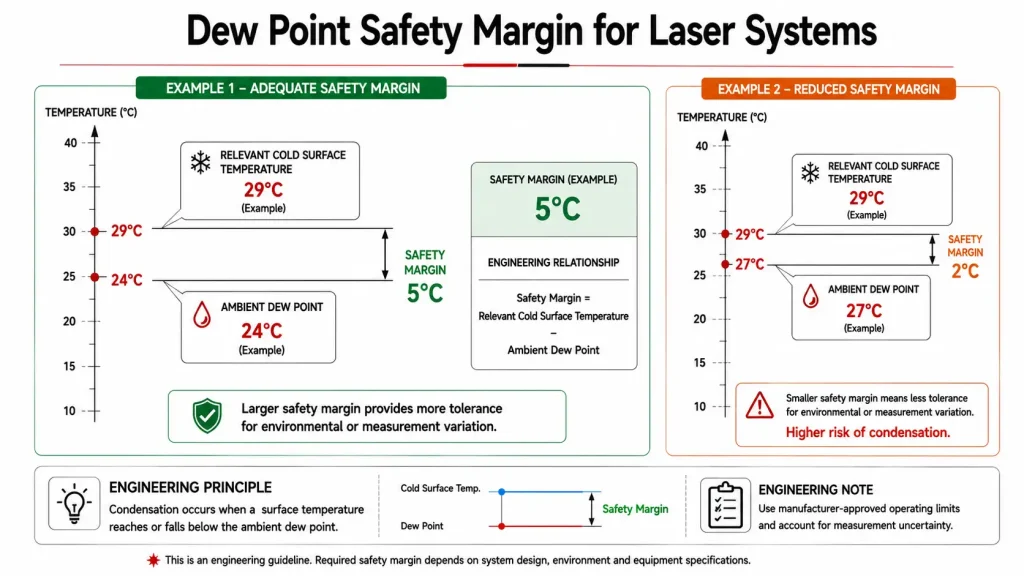
Maintenance teams can use the following workflow:
Measure Ambient Temperature and RH
↓
Determine Dew Point
↓
Identify Relevant Cold Surface Temperature
↓
Calculate Safety Margin
↓
Compare With the Site or Manufacturer-Approved Operating Margin
↓
Monitor for Environmental Changes
This approach provides a clearer engineering framework than looking only at:
A simple site-level monitoring strategy can use three conditions.
Green: Adequate Safety Margin
The relevant surface temperature remains comfortably above the ambient dew point according to the approved operating criteria.
Actions:
Yellow: Reduced Safety Margin
The safety margin has decreased and environmental changes could increase condensation risk.
Actions may include:
Red: Condensation Risk or Margin Limit Exceeded
The relevant surface temperature is approaching or falling below the dew point, or the manufacturer-defined safety criteria are no longer met.
Actions:
If a condensation-related warning has already occurred, refer to Fiber Laser Condensation Alarm: Causes and Troubleshooting.
One of the most important points in laser dew point management is that:
The laser chiller setpoint is not necessarily equal to the coldest surface exposed to ambient air.
The actual temperature of a laser component can be influenced by:
Therefore, where condensation risk is critical, the best approach is to use the temperature reference recommended by the laser manufacturer or directly monitor relevant accessible surfaces when appropriate.
For more information about cooling temperature management, see Laser Chiller Temperature Guide for Condensation Prevention.
The safety-margin method evaluates the relationship between:
Temperature
and
Environmental Moisture
CDA provides an additional layer of protection by helping control moisture inside designated laser areas.
A complete strategy can therefore be viewed as:
Control Ambient Humidity
↓
Monitor Dew Point
↓
Maintain an Appropriate Temperature Safety Margin
↓
Use Properly Prepared CDA
↓
Follow the Approved Startup Procedure
↓
Reduce Condensation Risk
CDA does not eliminate the need for a temperature safety margin, and a safe surface temperature does not eliminate the need for properly maintained CDA where the equipment requires it.
For the complete moisture-control framework, see Laser CDA Ventilation Guide: Preventing Condensation in Laser Systems.
The simplest practical method is:
Safety Margin = Relevant Cold Temperature − Ambient Dew Point
A larger positive margin generally provides greater tolerance against environmental fluctuations, while a small or negative margin indicates increasing condensation risk.
However, there is no universal temperature margin that applies to every laser system.
The correct operating limits must consider:
Use the safety-margin calculation as an engineering monitoring tool—not as a replacement for the equipment manufacturer's approved operating specifications.
High humidity laser operation requires additional attention because the environmental dew point can increase rapidly.
High-risk environments may include:
A fiber laser cutting machine operating continuously in a high-humidity environment may experience very different environmental conditions compared with the same machine operating in an air-conditioned facility.
Similarly, an industrial laser welding machine installed near humid manufacturing processes may require closer environmental monitoring.
Humidity conditions should therefore be considered part of the equipment operating environment.
Summer does not automatically mean condensation.
The real problem is often the combination of:
The risk increases when laser components are cooled significantly below the environmental dew point.
The basic pattern is:
Hot Weather
↓
Humid Air
↓
Higher Dew Point
↓
Laser Cooling
↓
Higher Condensation Risk
For seasonal recommendations, see Summer Laser Maintenance: Preventing Condensation in High-Humidity Environments.
CDA humidity control is an important complement to environmental dew point management.
It is important to distinguish between:
Ambient Dew Point Control
This focuses on the workshop environment.
Possible measures include:
Internal Moisture Control
This focuses on the environment inside or around sensitive laser components.
CDA can help:
This means CDA and environmental humidity control work at different levels.
A well-designed moisture-control strategy may use both.
For the complete framework, read Laser CDA Ventilation Guide: Preventing Condensation in Laser Systems.
CDA protects the areas where it is designed and connected to operate.
It does not automatically change the humidity throughout the entire workshop.
If the surrounding production environment remains extremely humid:
Therefore, CDA should be viewed as one layer of a broader moisture-control strategy.
CDA quality itself is also important.
Wet or contaminated compressed air cannot provide effective moisture protection.
For more information, see CDA Air Quality Requirements for Industrial Laser Systems.
Dew point monitoring can help operators identify changing environmental conditions before condensation becomes a visible problem.
A practical monitoring system may include:
Temperature Measurement
Monitor ambient air temperature near the laser equipment.
Avoid placing sensors directly next to:
unless those locations are specifically being evaluated.
Relative Humidity Measurement
Monitor workshop humidity.
Sudden increases may occur due to:
Dew Point Monitoring
Where condensation risk is critical, use a device or monitoring system capable of providing dew point information.
This can provide a more direct indication of moisture-related risk.
Sensor location should represent the actual environment affecting the laser.
Potential locations include:
Avoid assuming that one building-level humidity measurement represents every laser installation.
Large workshops may have significant environmental differences between areas.
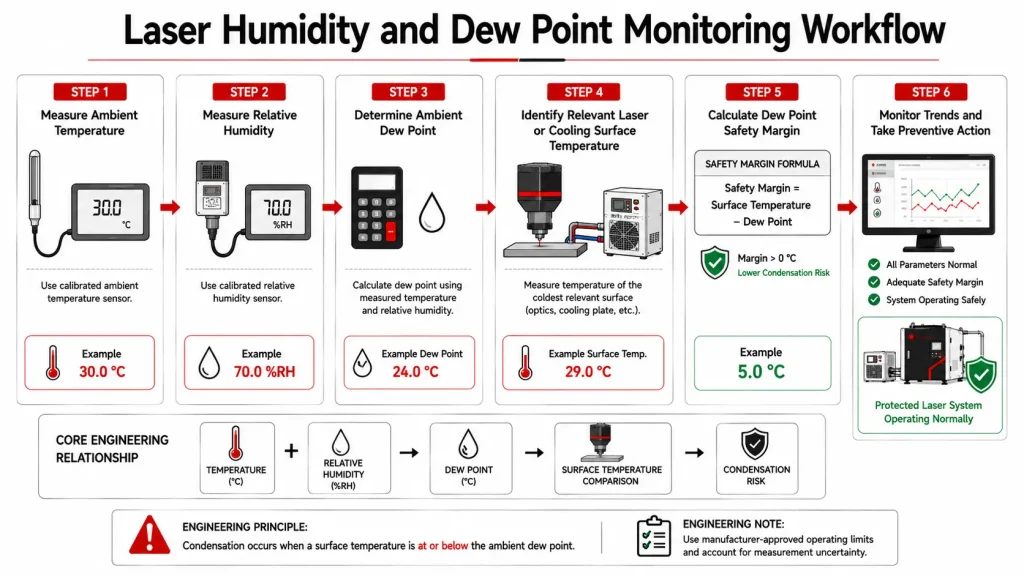
Before operating a laser under changing environmental conditions, consider the following checks.
1. Check Ambient Temperature
Record or monitor the workshop temperature.
2. Check Relative Humidity
Identify whether humidity is unusually high.
3. Check Dew Point
Use a dew point meter or calculate the value from temperature and relative humidity.
4. Review Cooling Conditions
Confirm that the laser cooling system is operating according to manufacturer requirements.
5. Inspect CDA Availability
Where CDA is required:
6. Confirm the Correct Startup Procedure
Follow the approved operating sequence.
For a dedicated operational workflow, see Laser CDA Startup Sequence: Prevent Condensation Before Cooling.
Mistake 1: Looking Only at Relative Humidity
High relative humidity is important, but it does not provide the complete condensation picture.
Dew point gives a more direct temperature reference for condensation.
Mistake 2: Using the Same Cooling Strategy All Year
Environmental conditions change.
A strategy that works during dry weather may require additional monitoring during humid periods.
Mistake 3: Ignoring Seasonal Changes
Summer and rainy seasons can significantly change moisture conditions.
Mistake 4: Treating CDA as the Only Solution
CDA is important, but environmental humidity and cooling conditions must also be considered.
Mistake 5: Ignoring Startup Conditions
Condensation risk may increase if humid air is present before cooled components reach their operating temperature.
Different laser applications may experience different environmental challenges.
Laser Cutting Applications
A high-power fiber laser cutting machine may operate continuously for long periods and generate significant thermal loads.
Environmental changes during long production shifts should be monitored, especially where workshop humidity fluctuates.
Laser Welding Applications
A handheld laser welding machine or automated laser welding system may be moved between different workshop areas.
Changes in the surrounding environment can affect the moisture conditions around the equipment.
Laser Cleaning Applications
A laser cleaning machine may operate in industrial environments with variable ventilation and environmental control.
If sensitive laser components are cooled, humidity conditions should remain part of the overall maintenance strategy.
These product applications should follow their individual equipment specifications, but the underlying dew point principle remains the same.
Understanding laser dew point is essential for effective condensation prevention.
Laser condensation is not caused by cooling temperature alone.
The actual risk depends on the relationship between:
The most important principle is:
When a cooled laser surface falls below the dew point of the surrounding air, condensation can form.
A complete prevention strategy should therefore include:
Dew point awareness allows maintenance teams to move from reacting to visible condensation toward proactively managing environmental risk.
For the complete moisture-protection framework, return to our Laser CDA Ventilation Guide: Preventing Condensation in Laser Systems.
Q1. What is the dew point in a laser system?
The dew point is the temperature at which moisture in the surrounding air can begin to condense. For laser systems, it is important because cooled components may develop condensation when their surface temperature falls below the ambient dew point.
Q2. Why is dew point important for laser cooling?
Laser cooling can reduce the temperature of components and surfaces. If those surfaces become colder than the dew point of the surrounding air, moisture can condense.
Q3. Is relative humidity enough to predict laser condensation?
No. Relative humidity is useful, but dew point provides a more direct reference for determining the temperature at which condensation can occur.
Q4. Can the same laser chiller temperature be safe in one season and risky in another?
Yes. Seasonal changes in humidity can change the environmental dew point. The same cooling conditions may therefore have different condensation risks at different times of the year.
Q5. How can I measure the dew point in a laser workshop?
You can use a dew point meter, an environmental monitoring system, or calculate dew point from measured temperature and relative humidity.
Q6. Does high humidity always cause laser condensation?
No. High humidity increases condensation risk, but condensation normally occurs when a surface becomes sufficiently cold relative to the dew point.
Q7. How does CDA help with laser dew point control?
CDA can help reduce moisture inside protected laser areas and displace humid air. It supports internal moisture control but does not replace workshop humidity management.
Q8. How do I calculate a dew point safety margin for a laser?
Use the following formula:
Safety Margin = Relevant Cold Surface Temperature − Ambient Dew Point
For example, if a relevant laser surface is 26°C and the ambient dew point is 24°C, the safety margin is 2°C.
A positive margin means the measured surface is above the dew point, but a very small margin may still be sensitive to humidity changes, sensor error, local cold spots, and operating fluctuations. The appropriate operating margin should therefore follow manufacturer requirements and site-specific engineering criteria.
Q9. Why does my laser experience condensation mainly during summer?
Summer may bring higher humidity and a higher dew point. If laser components remain cold while the environmental dew point rises, condensation risk can increase.
Q10. What should I check if my laser has a condensation alarm?
Check the ambient temperature and humidity, evaluate dew point conditions, inspect the laser cooling system, verify CDA operation if applicable, and follow the manufacturer's approved troubleshooting and recovery procedure.





English

French

German

Hindi

Italian

Japanese

Korean

Portuguese

Russian

Spanish
Tell us about your manufacturing challenges.
Our engineers will design a laser solution tailored to your exact requirements.